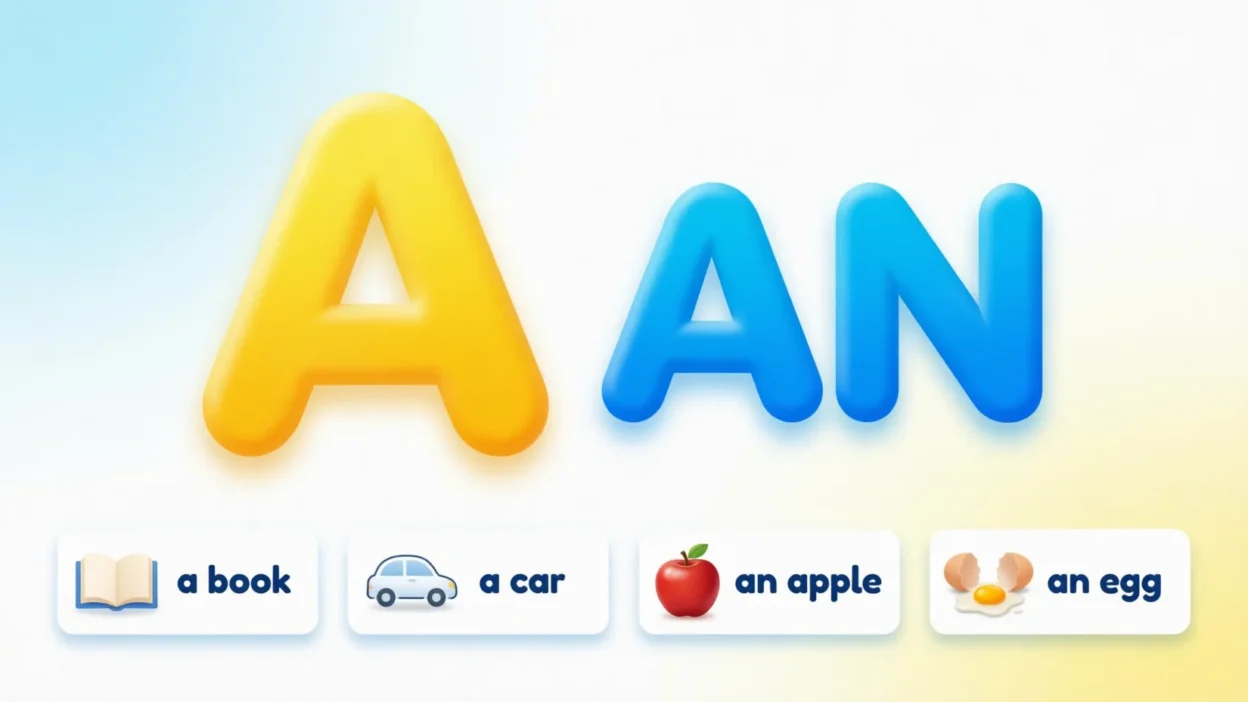
Have you ever wondered whether to use a or an before a word? These two small words are among the most common parts of English grammar, but choosing the correct one can sometimes be confusing. The good news is that the rule is simple once you understand how English sounds work. Learning when to use a or an will help you write more naturally and avoid common grammar mistakes.
The main difference between a and an depends on the first sound of the word that follows, not simply its first letter. Use a before a consonant sound, as in “a book” or “a university.” Use an before a vowel sound, as in “an apple” or “an hour.”
This rule applies to everyday conversations, school assignments, professional emails, and other forms of English writing. In this guide, you will learn the meanings, grammar rules, exceptions, and practical examples that make choosing a or an easy.
Quick Answer: A vs. An
Use a before a word that begins with a consonant sound, such as “a dog” or “a university.” Use an before a word that begins with a vowel sound, such as “an egg” or “an hour.” The important rule is to listen to the first sound, not just look at the first letter.
Why Do People Confuse A and An?
People often confuse a and an because both words are indefinite articles. They introduce a singular, countable noun without identifying a specific person, place, object, or idea.
The confusion usually comes from the difference between spelling and pronunciation. Some words begin with a vowel letter but a consonant sound, while others begin with a consonant letter but a vowel sound.
For example:
- A university: The word begins with the “yoo” sound, which is a consonant sound.
- An umbrella: The word begins with the vowel sound “uh.”
- A European country: European begins with the “yoo” sound.
- An honest person: The h in honest is silent, so the word begins with a vowel sound.
Understanding pronunciation is the key to choosing the correct article.
1. What Does A Mean?
A is an indefinite article used before a singular, countable noun that begins with a consonant sound. It introduces something that is not being identified as a particular person or thing.
Examples of A
- I saw a cat in the garden.
- She bought a new dress.
- He is a teacher.
- We visited a university.
- I need a pencil for my homework.
In these sentences, a introduces one person, animal, object, or institution without specifying exactly which one.
How to Use A in a Sentence
Use a when the next word begins with a consonant sound.
Common examples include:
- A book
- A table
- A car
- A student
- A house
- A useful idea
- A one-time opportunity
Notice that useful begins with a “yoo” sound, and one begins with a “w” sound. Both start with consonant sounds, so a is correct.
You can also use a before a singular noun that describes someone’s profession or identity.
Examples:
- My sister is a doctor.
- He is a talented musician.
- She wants to become a pilot.
2. What Does An Mean?
An is an indefinite article used before a singular, countable noun that begins with a vowel sound. Like a, it introduces something without identifying it as a specific item.
Examples of An
- I ate an apple.
- She has an umbrella.
- He is an engineer.
- We waited for an hour.
- They adopted an animal.
Each noun begins with a vowel sound, which makes an the correct article.
How to Use An in a Sentence
Use an before words that begin with vowel sounds, including words with silent initial consonants.
Common examples include:
- An apple
- An egg
- An orange
- An idea
- An umbrella
- An honest person
- An hour
- An MBA graduate
The words honest and hour begin with the letter h, but the h is silent. MBA begins with the letter M, pronounced “em,” which starts with a vowel sound.
Therefore, an is correct in all three cases.
A vs. An: Comparison Table
| Feature | A | An |
| Grammar role | Indefinite article | Indefinite article |
| Used before | A consonant sound | A vowel sound |
| Example | A banana | An orange |
| Before a profession | A doctor | An engineer |
| Before a silent h | Usually not used | An hour |
| Before a “yoo” sound | A university | Not an university |
| Before an initialism | A USB drive | An MRI scan |
The most important difference is the sound that begins the next word. Both articles serve the same grammatical purpose.
When Should You Use A or An?
Choosing the correct article becomes easier when you follow a few simple rules.
Use A Before a Consonant Sound
Choose a when the next word begins with a consonant sound.
Examples:
- A dog
- A school
- A computer
- A European city
- A useful tool
- A one-way street
Even if the word starts with a vowel letter, use a when the first sound is a consonant sound.
Use An Before a Vowel Sound
Choose an when the next word begins with a vowel sound.
Examples:
- An elephant
- An ice cream
- An old house
- An interesting story
- An hour
- An unusual experience
The first sound matters more than the written letter.
What About Words With Silent Letters?
Some English words contain silent letters at the beginning. When the first pronounced sound is a vowel, use an.
Examples:
- An honest answer
- An hour ago
- An heir to the property
The h in honest, hour, and heir is silent.
What About Abbreviations and Initialisms?
Choose the article based on how the abbreviation is pronounced.
Examples:
- A USB cable — USB begins with the “you” sound.
- An MRI scan — M is pronounced “em.”
- An FBI agent — F is pronounced “ef.”
- A NASA scientist — NASA is commonly pronounced as a word beginning with a consonant sound.
Always consider the spoken form rather than the written abbreviation.
15 Examples of A and An in Sentences
Here are practical examples to help you understand the difference.
- A: I bought a notebook for school.
- An: She ate an orange after lunch.
- A: My brother wants to be a doctor.
- An: My cousin is an architect.
- A: We saw a bird outside the window.
- An: He gave me an interesting book.
- A: She studies at a university.
- An: We waited for an hour.
- A: He found a useful website.
- An: She gave an honest answer.
- A: I need a USB cable.
- An: He is an MBA student.
- A: They live in a European country.
- An: I saw an eagle flying overhead.
- A: It was a one-day trip.
These examples show why pronunciation is more important than spelling when selecting the correct article.
Common Mistakes With A and An
Even experienced English speakers can make mistakes with indefinite articles. Here are some common errors and their corrections.
Mistake 1: Choosing An Before Every Vowel Letter
Incorrect: An university is nearby.
Correct: A university is nearby.
Why? University begins with the consonant-like “yoo” sound.
Mistake 2: Choosing A Before a Silent H
Incorrect: I waited for a hour.
Correct: I waited for an hour.
Why? The h is silent, so hour begins with a vowel sound.
Mistake 3: Ignoring the Pronunciation of Abbreviations
Incorrect: An USB cable.
Correct: A USB cable.
Why? USB is pronounced “you-ess-bee,” beginning with the consonant-like “y” sound.
Mistake 4: Using A or An Before an Uncountable Noun
Incorrect: I need an information.
Correct: I need some information.
Why? Information is generally uncountable in standard English. Use a suitable expression such as “some information” or “a piece of information.”
Mistake 5: Forgetting That A and An Refer to Singular Nouns
Incorrect: She bought a apples.
Correct: She bought some apples.
Why? A and an are used with singular countable nouns, not directly with plural nouns.
An Easy Memory Trick for A vs. An
Remember this simple rule:
A before a consonant sound; an before a vowel sound.
Try saying the word aloud and listening to its first sound.
- A banana — starts with a “b” sound.
- An apple — starts with an “a” sound.
- A university — starts with a “yoo” sound.
- An hour — starts with an “ow” sound.
Here is another helpful trick:
Listen, don’t just look!
The first letter can sometimes be misleading, so pronounce the word before choosing the article.
With regular practice, you will begin to recognize the correct article naturally.
A or An in American vs. British English
The basic rules for a and an are the same in American and British English. Both varieties use a before consonant sounds and an before vowel sounds.
However, pronunciation can vary between accents, which may occasionally affect the article used with a word.
For example, the word herb is often pronounced with a silent h in American English, making an herb common. In many British accents, the h is pronounced, making a herb the usual choice.
| Example | American English | British English |
| University | A university | A university |
| Hour | An hour | An hour |
| European | A European country | A European country |
| Herb | An herb (common) | A herb (common) |
| MRI | An MRI scan | An MRI scan |
The general principle remains the same: choose the article according to the sound you pronounce.
Similar Grammar Words You Should Know
A and an belong to a group of English words called articles and determiners. Understanding a few related terms can improve your grammar.
A, An, and The
- A: Introduces a singular countable noun beginning with a consonant sound.
- An: Introduces a singular countable noun beginning with a vowel sound.
- The: Refers to a particular person or thing that is identifiable from the context.
Examples:
- I saw a dog.
- I saw an elephant.
- The dog was sleeping.
Some and Any
Some and any are commonly used with plural countable nouns and uncountable nouns.
- I bought some apples.
- Do you have any water?
- We need some information.
This and That
This and that point to particular people or things.
- This book is interesting.
- That house is beautiful.
Unlike a and an, these words can identify a particular item.
Final Verdict: Which One Is Correct?
Both a and an are correct English articles, but the right choice depends on the first sound of the word that follows.
Use a before consonant sounds, as in “a book,” “a university,” and “a useful idea.” Use an before vowel sounds, as in “an apple,” “an hour,” and “an honest person.”
Do not rely only on the first letter. Consider pronunciation, especially with silent letters and abbreviations. Remember, too, that a and an are used with singular countable nouns.
Once you learn to listen for the first sound, choosing between a and an becomes much easier.
FAQs:
1. What is the main difference between a and an?
A is used before a consonant sound, while an is used before a vowel sound. For example, “a car” and “an apple” are correct because the first pronounced sounds are different.
2. Is it a university or an university?
The correct phrase is a university. University begins with the “yoo” sound, which functions as a consonant sound in English. The first letter is a vowel, but the pronunciation determines the article.
3. Is it a hour or an hour?
The correct phrase is an hour. The h in hour is silent, so the word begins with a vowel sound. This is why an is used.
4. Should I use a or an before abbreviations?
Use the article that matches the abbreviation’s pronunciation. For example, write “a USB drive” because U is pronounced “you,” but “an MRI scan” because M is pronounced “em.”
5. Can a and an be used with plural nouns?
No. A and an are used with singular countable nouns. For plural nouns, use words such as some or several. For example, say “some books,” not “a books.”
6. Is it an honest person or a honest person?
The correct phrase is an honest person. The h in honest is silent, so the word begins with a vowel sound.
7. Are the rules for a and an different in American and British English?
The basic rules are the same in both varieties. However, differences in pronunciation can affect the article used before certain words, such as herb. The correct choice depends on the pronunciation being used.
Remember This
- Use a before a consonant sound.
- Use an before a vowel sound.
- Focus on pronunciation, not just spelling.
- Use a and an with singular countable nouns.
- Consider silent letters and the pronunciation of abbreviations.
- The same basic rule applies to American and British English.
The easiest way to remember the rule is to say the word aloud and listen to its first sound.
Conclusion
Understanding the difference between a and an is an essential part of learning English grammar. Although both words introduce singular countable nouns, their use depends on pronunciation. Use a before consonant sounds and an before vowel sounds, even when the written letter might suggest otherwise. Examples such as “a university” and “an hour” demonstrate why listening to the first sound is so important.
The next time you write a sentence, take a moment to consider how the following word is pronounced. With regular practice and attention to common exceptions, you will choose the correct article more confidently. These small grammar improvements can make your writing clearer and your spoken English more natural.

John Morrison is a dedicated content writer at Synomity.com, focused on synonyms, vocabulary development, and word meanings. He creates clear, educational resources that help readers improve language skills and communicate with confidence.