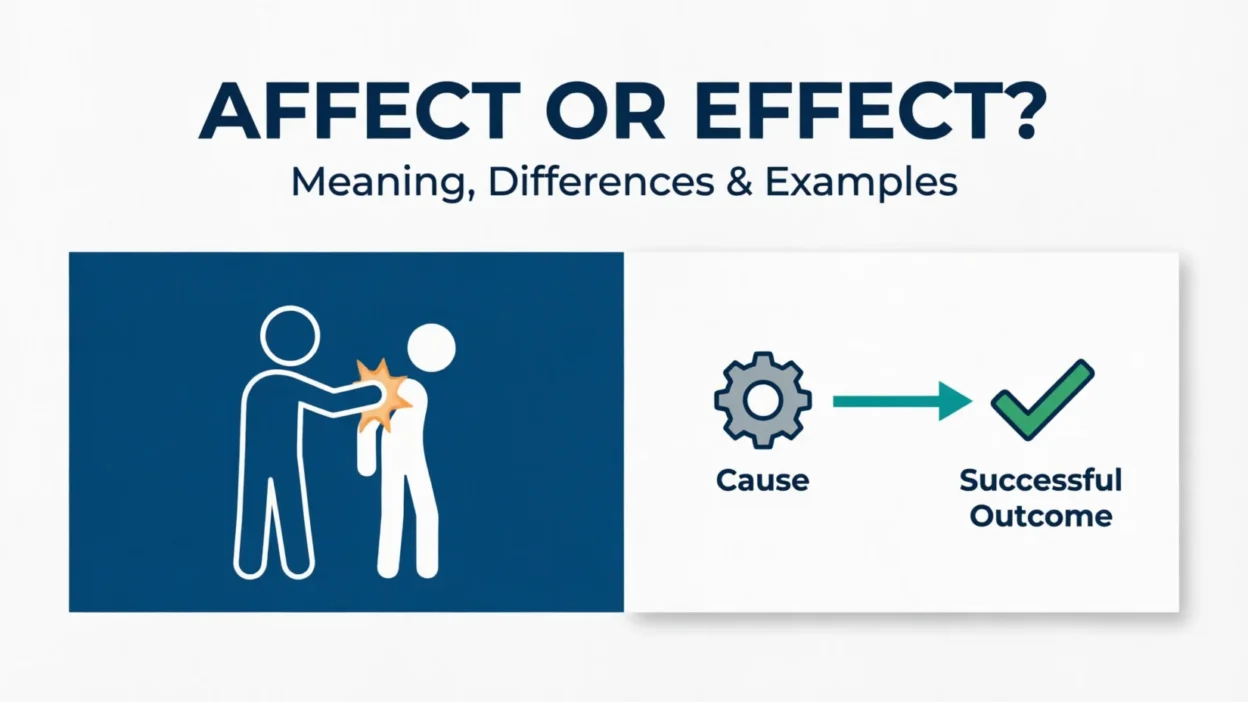
Have you ever wondered if to use affect or effect in a sentence? These two words sound similar and are often confused, even by fluent English speakers. However, they usually have different meanings and grammatical roles. Understanding the difference between affect and effect can help you write more clearly, avoid common grammar mistakes, and communicate your ideas with confidence.
The simplest rule is that affect is usually a verb meaning “to influence,” while effect is usually a noun meaning “a result.” For example, “Lack of sleep can affect your mood” means that insufficient sleep can influence how you feel. In contrast, “Lack of sleep can have an effect on your mood” refers to the result of insufficient sleep.
Although there are exceptions, this basic rule works in most everyday situations. In this guide, you will learn how to use both words correctly, explore practical examples, understand their grammatical differences, and discover an easy memory trick that will help you remember which word to choose.
Quick Answer: Affect vs. Effect
Affect is usually a verb meaning to influence or change something. Effect is usually a noun meaning a result or consequence. For example, “The weather affects our plans” uses affect as an action, while “The weather had an effect on our plans” uses effect to describe a result.
Why Do People Confuse Affect and Effect?
People often confuse these words because they sound almost identical in everyday speech. Both are commonly used when discussing changes, influences, and consequences.
Their meanings are also closely connected. When something affects a person or situation, it often produces an effect.
The main difference is their grammatical role:
- Affect: Usually describes an action or influence.
- Effect: Usually names the result of an action or influence.
Consider these examples:
- The new rule will affect students. (The rule will influence them.)
- The new rule will have an effect on students. (The rule will produce a result.)
Learning this distinction makes it easier to choose the correct word when writing emails, school assignments, reports, and everyday messages.
What Does Affect Mean?
Affect is most commonly used as a verb meaning to influence, change, or have an impact on someone or something.
When an event, decision, condition, or action affects something, it changes the way that thing feels, behaves, works, or develops.
Examples of Affect as a Verb
- Heavy rain can affect traffic.
- Stress may affect your sleep.
- Your decisions affect your future.
- The news affected everyone in the room.
- Rising prices are affecting many families.
In each example, affect describes an action that influences something else.
How to Use Affect in Different Tenses
Affect follows the usual patterns of a regular English verb.
| Tense | Example |
| Present | Noise affects my concentration. |
| Past | The storm affected several towns. |
| Future | The changes will affect everyone. |
| Present continuous | The heat is affecting our crops. |
| Present perfect | The decision has affected our plans. |
Remember that you normally use affect when explaining what influences or changes a person, object, situation, or outcome.
What Does Effect Mean?
Effect is most commonly used as a noun meaning a result, outcome, or consequence caused by an action or event.
It answers a question such as, “What happened as a result?”
Examples of Effect as a Noun
- The medicine had a positive effect.
- The storm caused serious effects in the area.
- Exercise has a beneficial effect on health.
- The new policy had little effect on sales.
- Bright colors can create a calming effect.
In these sentences, effect names the result or impact of something.
Common Expressions With Effect
You will often see effect in these phrases:
- Have an effect on: The weather has an effect on my mood.
- Take effect: The new rules will take effect tomorrow.
- Cause and effect: The lesson explains cause and effect.
- Side effect: The medication may cause a side effect.
- In effect: The agreement is now in effect.
These expressions are useful in everyday English, academic writing, and professional communication.
Affect vs. Effect: Comparison Table
| Feature | Affect | Effect |
| Usual part of speech | Verb | Noun |
| Main meaning | To influence or change | A result or consequence |
| Main question | What is influencing something? | What is the result? |
| Example | Sleep affects concentration. | Sleep has an effect on concentration. |
| Related form | Affected, affecting | Effects, effective |
| Common phrase | Affect someone’s mood | Have an effect on something |
The easiest way to remember the difference is that affect usually describes the action, while effect usually describes the result.
When Should You Use Affect or Effect?
Choosing the correct word becomes easier when you look at how it functions in a sentence.
Use Affect When You Mean Influence
Use affect when describing something that changes or influences a person, situation, or outcome.
Examples:
- Lack of exercise can affect your health.
- The teacher’s feedback affected my confidence.
- Economic changes may affect small businesses.
- Noise can affect your ability to study.
If you can replace the word with influence or change, affect is probably the correct choice.
Use Effect When You Mean Result
Use effect when talking about the outcome or consequence of an action or event.
Examples:
- The new schedule had a positive effect.
- The medicine’s effects lasted several hours.
- The campaign had little effect on public opinion.
- The changes took effect immediately.
If you can replace the word with result or consequence, effect is usually the right choice.
What About Affect and Effect as Nouns and Verbs?
Although the usual rule is helpful, both words have less common grammatical uses.
Affect as a noun: In psychology and psychiatry, affect refers to the observable expression of emotion. For example, “The clinician noted a flat affect.”
Effect as a verb: Effect can mean to bring about, accomplish, or cause something to happen. For example, “The organization hopes to effect meaningful change.”
These uses are less common than the everyday meanings, but they are important to recognize in formal and specialized writing.
12 Examples of Affect and Effect in Sentences
Here are practical examples that show how the two words work in different situations.
- Affect: Lack of sleep can affect your memory.
- Effect: Lack of sleep can have an effect on your memory.
- Affect: The rain affected our travel plans.
- Effect: The rain had a significant effect on our journey.
- Affect: The teacher’s advice affected my decision.
- Effect: Her advice had a lasting effect on me.
- Affect: Rising costs affect small businesses.
- Effect: Rising costs have a negative effect on small businesses.
- Affect: The new law will affect local residents.
- Effect: The new law will take effect next month.
- Affect: Loud music affects my concentration.
- Effect: Loud music has an unpleasant effect on my concentration.
Notice how the same topic can be expressed with either word by changing the sentence structure.
For example:
- The weather affects our mood.
- The weather has an effect on our mood.
Both sentences are correct, but affect is the verb in the first sentence, while effect is the noun in the second.
Common Mistakes With Affect and Effect
Even experienced writers sometimes mix up these words. Understanding common mistakes can help you avoid them.
Mistake 1: Using Effect Instead of Affect
Incorrect: The noise will effect my concentration.
Correct: The noise will affect my concentration.
Why? The sentence describes how noise influences concentration, so the verb affect is appropriate.
Mistake 2: Using Affect Instead of Effect
Incorrect: The new rule had a positive affect on attendance.
Correct: The new rule had a positive effect on attendance.
Why? The sentence describes a result, so the noun effect is correct.
Mistake 3: Confusing “Take Effect” With “Take Affect”
Incorrect: The new policy will take affect tomorrow.
Correct: The new policy will take effect tomorrow.
Why? The established expression take effect means to become active or begin operating.
Mistake 4: Forgetting the Difference in Longer Sentences
Incorrect: The changes affected a positive effect on the business.
Correct: The changes had a positive effect on the business.
You could also write, “The changes positively affected the business.”
Why? Use affect when describing the influence and effect when naming the result.
Mistake 5: Assuming the Rule Has No Exceptions
Although affect is usually a verb and effect is usually a noun, remember the specialized uses discussed earlier. Context and sentence structure matter.
What Is an Easy Memory Trick for Affect vs. Effect?
A popular memory trick is:
A = Action; E = End result.
- Affect usually describes an action or influence.
- Effect usually describes the end result.
Think of this example:
“The storm affected the town, and its effects included power outages and damaged roads.”
The storm influenced the town. The power outages and damaged roads were results of that influence.
You can also remember the phrase:
Affect acts; effect ends up as a result.
When you are unsure, try replacing affect with influence and effect with result. If the sentence still makes sense, you have probably chosen correctly.
Affect vs. Effect in American and British English
The distinction between affect and effect is essentially the same in American and British English. In both varieties, affect is generally the verb meaning to influence, and effect is generally the noun meaning a result.
Examples in American English:
- The weather affects our plans.
- The decision had a positive effect.
Examples in British English:
- The weather affects our plans.
- The decision had a positive effect.
The spelling of these two words does not change between the two varieties. Unlike pairs such as color and colour or organize and organise, affect and effect follow the same standard spelling in both.
Writers in the United States, the United Kingdom, Canada, Australia, and other English-speaking regions can use the same basic rule.
Similar Words Related to Affect and Effect
Understanding related words can make the difference even clearer.
| Word | Meaning | Example |
| Influence | To have an impact on something | Friends can influence your choices. |
| Impact | A strong effect or influence | The decision had a major impact. |
| Result | Something that happens because of an action | The result was unexpected. |
| Consequence | An outcome of an action or decision | Every choice has a consequence. |
| Affect | To influence or change | Stress can affect your sleep. |
| Effect | A result or outcome | Stress can have an effect on sleep. |
| Effective | Producing the intended result | This is an effective method. |
| Affected | Influenced or changed | The affected areas need help. |
One important distinction is that effective usually means successful in producing a desired result. For example, “The treatment was effective” means the treatment worked as intended.
Similarly, impact can function as either a noun or a verb in modern English, so it does not follow the same simple distinction as affect and effect.
Final Verdict: Affect or Effect?
The correct choice depends on what you want to say.
- Choose affect when you mean to influence, change, or have an impact on something.
- Choose effect when you mean a result, outcome, or consequence.
For example, “The delay affected our plans” describes an influence. “The delay had an effect on our plans” describes the result of that influence.
Keep in mind that affect can also be a specialized noun, and effect can be a verb meaning to bring something about. However, for everyday conversations, schoolwork, emails, and most professional writing, the basic action-versus-result rule will help you choose correctly.
FAQs:
1. Is it affect or effect on someone?
Both can be correct, depending on the sentence structure. Use affect as a verb, as in “The decision affected him.” Use effect as a noun after expressions such as “have an effect on,” as in “The decision had an effect on him.”
2. How do I remember affect vs. effect?
Remember A for Action and E for End result. Affect usually describes an action that influences something, while effect usually describes the result of that action.
3. Is affect always a verb?
No. Affect is usually a verb meaning to influence, but it can also be a noun in psychology and psychiatry. In those fields, it refers to the observable expression of emotion.
4. Is effect ever a verb?
Yes. As a verb, effect means to bring about, accomplish, or cause something to happen. For example, “The leaders want to effect positive change” means they want to bring about positive change.
5. Which is correct: “side affect” or “side effect”?
Side effect is correct. It refers to an additional, often unintended result of a medicine, treatment, or other action. For example, “Drowsiness is a possible side effect.”
6. Is it “take affect” or “take effect”?
Take effect is correct. It means to become active, start working, or begin producing a result. For example, “The new rules will take effect on Monday.”
7. Can affect and effect be used in the same sentence?
Yes. For example, “The weather can affect your mood, and its effect may be noticeable throughout the day.” Here, affect is a verb and effect is a noun.
Remember This
- Affect = influence or change.
- Effect = result or consequence.
- “The rain affected the game.”
- “The rain had an effect on the game.”
- “The new policy will take effect tomorrow.”
When in doubt, ask yourself whether the sentence describes an action or names a result. This simple question will help you use the two words correctly in most situations.
Conclusion
Affect and effect are easy to confuse because they sound similar and often appear in sentences about changes and consequences. However, their most common meanings are different. Affect is generally a verb that means to influence or change something, while effect is generally a noun that describes the result of an action or event.
The best way to remember the difference is to think of action and result. Something can affect your health, your plans, or your mood, and it can have an effect on those same things.
Practice using both words in everyday sentences, pay attention to their grammatical roles, and remember the less common exceptions when reading formal or specialized material. With a little practice, choosing between affect and effect will become much easier.