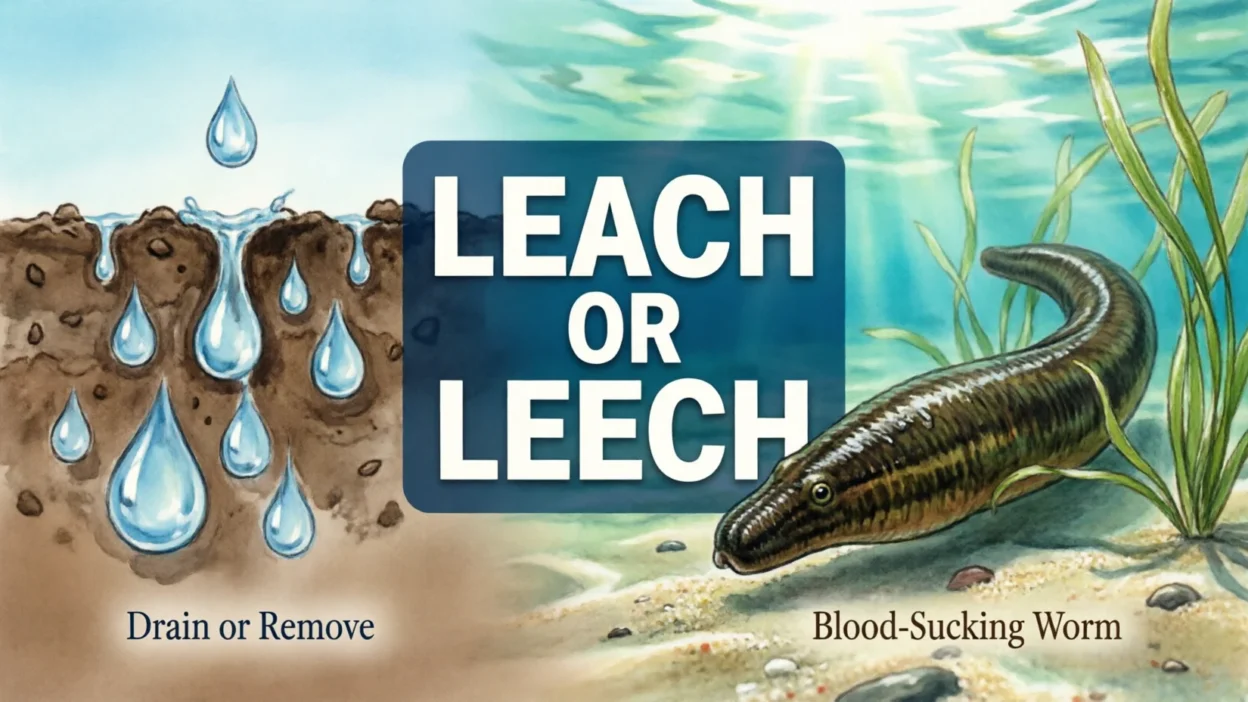
Have you ever wondered if to write leach or leech? These two words sound exactly alike, but they have different meanings and uses. Choosing the correct spelling depends on what you want to describe. Leach usually refers to the process of a liquid removing substances from a material, while leech can refer to a blood-sucking animal or a person who takes advantage of others.
Understanding the difference between these words can help you improve your spelling, write more clearly, and avoid common mistakes in school assignments, professional documents, and everyday conversations. Although both words are correct English words, they are not interchangeable in most situations.
In this guide, you will learn the definitions of leach and leech, see how they work in sentences, explore their grammatical forms, and discover simple tricks to remember which word to use. If you are a student, an English learner, or simply looking to improve your vocabulary, this comparison will make the distinction easy to understand.
Quick Answer: Leach vs. Leech
Leach means to remove or drain a substance from a material, usually through the action of a liquid. Leech refers to a worm-like animal that can suck blood or, informally, a person who takes advantage of someone else’s generosity. Both words are pronounced the same way, but their meanings and spellings are different.
Why Do People Confuse Leach and Leech?
People often confuse leach and leech because they are homophones. Homophones are words that sound alike but have different meanings and spellings.
Both words are pronounced like “leech,” with a long ee sound. When speaking, you cannot tell which word someone means just by hearing it. You need to understand the context.
For example:
- “Rainwater can leach minerals from the soil.” This describes a process.
- “A leech attached itself to his leg.” This describes an animal.
Their similar pronunciation makes spelling mistakes easy, especially for students and people learning English. Remembering their distinct meanings is the simplest way to choose correctly.
What Does Leach Mean?
Leach is primarily a verb that means to remove, dissolve, or drain a substance from a material by allowing a liquid to pass through it.
The word frequently appears in discussions about soil, water, chemistry, agriculture, mining, and environmental science.
Leach as a Verb
When a liquid passes through a substance and carries away dissolved materials, the process is called leaching.
Examples:
- Heavy rain can leach nutrients from the soil.
- Chemicals may leach from certain materials into water.
- Water can leach salt from the ground.
- The researchers studied how metals leach from the waste.
In these examples, leach describes the movement or removal of a substance by a liquid.
Leach as a Noun
The noun leach is much less common than the verb. In technical contexts, it can refer to a liquid extract produced by leaching. The related noun leachate is more commonly used for liquid that has passed through material and picked up dissolved or suspended substances.
Example: “The laboratory analyzed the leachate from the waste.”
What Does Leaching Mean?
Leaching is the process of extracting or carrying away substances through the action of a liquid.
For example, when rainwater moves through soil, it may carry dissolved minerals and nutrients into deeper layers. This is called leaching.
Leaching can happen naturally or be used intentionally in industrial processes.
What Does Leech Mean?
Leech is a noun that commonly refers to an aquatic or moisture-loving worm-like animal belonging to the subclass Hirudinea. Some leeches attach themselves to animals and feed on blood, although not all leeches are blood-feeding parasites.
The word can also be used informally to describe a person who takes advantage of another person’s money, kindness, or resources without giving much in return.
Leech as a Noun: The Animal
A leech is an invertebrate with a soft, segmented body. Many species have suckers that help them attach to surfaces or hosts.
Examples:
- A leech attached itself to the swimmer’s leg.
- The biologist studied leeches in the pond.
- Some leeches feed on the blood of other animals.
- The hiker checked his legs for leeches after crossing the stream.
Leech as an Informal Insult
In everyday English, leech can describe someone who continually depends on others or exploits their generosity.
Examples:
- He called his roommate a leech because he never paid his share of the bills.
- She felt that her former friend was leeching off her kindness.
This figurative use is informal and negative, so it should be used carefully.
Leech as a Verb
Leech can also be used as a verb, especially in the expression leech off or leech off of someone.
It means to take resources, money, or support from someone without making a fair contribution.
Example: “He continued to leech off his parents instead of finding a job.”
In this sense, leech is related in meaning to exploit or take advantage of, rather than to the scientific process described by leach.
Leach vs. Leech: Comparison Table
| Feature | Leach | Leech |
| Main meaning | To remove substances with a liquid | A worm-like animal or an exploiting person |
| Part of speech | Primarily a verb | Primarily a noun; also a verb |
| Typical context | Soil, water, chemicals, minerals | Wildlife, medicine, relationships |
| Example | Rain can leach nutrients from soil. | A leech attached to his foot. |
| Figurative meaning | Usually describes a removal process | Someone who takes advantage of others |
| Related form | Leaching, leached, leachate | Leeches, leeched, leeching |
| Pronunciation | /liːtʃ/ | /liːtʃ/ |
The main difference: Use leach when a liquid removes substances from something. Use leech when referring to the animal or a person who exploits others.
When Should You Use Leach or Leech?
The correct word depends on the situation. Look at the action or person being described before choosing your spelling.
Use Leach When Describing a Process
Choose leach when talking about liquids carrying substances out of a material.
Common contexts include:
- Soil losing nutrients because of rainfall.
- Chemicals moving out of plastic or other materials.
- Minerals being extracted from ores.
- Salts being washed out of contaminated ground.
- Scientific experiments involving liquid extraction.
Example: “The study examined whether chemicals could leach into drinking water.”
Use Leech When Describing an Animal
Choose leech when talking about the animal.
Common contexts include:
- Leeches in ponds, streams, and wet environments.
- Leeches attaching to animals or people.
- Scientists studying leech behavior.
- Medical discussions about the controlled use of certain leeches.
Example: “The researcher found a leech beneath a wet rock.”
Use Leech When Describing a Person
Choose leech when informally describing someone who takes advantage of another person’s generosity.
Example: “Everyone was tired of his cousin, who seemed to leech off the family.”
This usage can sound insulting, so a more neutral expression such as “takes advantage of others” may be preferable in formal writing.
12 Examples of Leach and Leech in Sentences
The following examples show how each word works in different situations.
Examples Using Leach
- Heavy rainfall can leach essential nutrients from farmland.
- Scientists tested whether the chemicals could leach into groundwater.
- The farmer added organic matter to help replace nutrients lost through leaching.
- Certain minerals leach out of rocks when exposed to water.
- Researchers examined how metals leached from the discarded batteries.
- The filter was designed to reduce harmful substances in the leachate.
Examples Using Leech
- A leech attached itself to the swimmer’s ankle.
- The children learned about leeches during their biology lesson.
- The hiker carefully removed a leech after walking through a wet forest.
- He jokingly called his friend a leech because he always borrowed money.
- She refused to let anyone leech off her hard work.
- The scientist observed a leech moving through shallow water.
These examples demonstrate that the surrounding words often reveal which spelling is appropriate.
Common Mistakes to Avoid
Even though leach and leech are both correct, using one in place of the other can change the meaning of a sentence.
Mistake 1: Using Leech for a Chemical Process
Incorrect: “Rainwater can leech nutrients from the soil.”
Correct: “Rainwater can leach nutrients from the soil.”
In scientific and environmental contexts, leach is the appropriate verb for this process.
Mistake 2: Using Leach for the Animal
Incorrect: “A leach attached itself to my leg.”
Correct: “A leech attached itself to my leg.”
The animal is spelled leech, with ee in the middle.
Mistake 3: Confusing Leaching With Leeching
Both forms exist, but they have different meanings.
- Leaching: A liquid removes substances from a material.
- Leeching: An animal-related action or the act of exploiting someone, depending on context.
For example, “The rain is leaching minerals from the soil” describes a physical process, while “He is leeching off his brother” describes taking advantage of another person.
Mistake 4: Assuming One Word Is Incorrect
Neither spelling is wrong. The difference lies in meaning and usage, not in whether the word is valid English.
What Is an Easy Memory Trick for Leach vs. Leech?
Use this simple memory trick to remember the difference:
Leach = Liquid removes something.
Both leach and liquid begin with the letter L. Think of water moving through soil and carrying away minerals.
Leech = Living creature.
Think of a leech as the worm-like animal that attaches itself to a host. The same spelling also applies to a person who takes advantage of someone else.
Here is an even shorter reminder:
- Leach: Think of water washing something away.
- Leech: Think of a creature or a person who takes from others.
If you remember these two associations, you can usually choose the correct word without hesitation.
Leach vs. Leech in American and British English
The distinction between leach and leech is essentially the same in American and British English. Both spellings are standard in both varieties, and their pronunciation is generally the same.
| Word | American English | British English |
| Leach | Standard spelling | Standard spelling |
| Leech | Standard spelling | Standard spelling |
There is no general American-versus-British spelling difference to learn for these words.
For example, an American scientist might write, “Chemicals can leach into groundwater,” while a British scientist would use the same spelling and meaning.
Likewise, both American and British speakers can refer to a blood-feeding animal as a leech or use the word figuratively for someone who exploits others.
The important distinction is meaning, not regional spelling.
Similar Words to Leach and Leech
Learning related vocabulary can make the difference easier to remember.
Words Related to Leach
- Leaching: The process of removing substances through a liquid.
- Leachate: Liquid that has passed through material and collected substances from it.
- Extract: To remove or obtain something from a source.
- Dissolve: To mix a substance into a liquid until it forms a solution.
- Drain: To allow liquid to flow away.
These words are useful in science, environmental studies, and everyday descriptions of liquids.
Words Related to Leech
- Parasite: An organism that lives on or in a host and benefits at the host’s expense.
- Bloodsucker: An informal term for an animal that feeds on blood, or a person who exploits others.
- Exploit: To take unfair advantage of someone or something.
- Freeloader: A person who benefits from others without paying or contributing fairly.
- Depend: To rely on someone or something for support.
These words are related but not exact substitutes in every context. For instance, not every leech is a blood-feeding parasite, and the figurative use of leech is more insulting than the neutral verb depend.
Final Verdict: Which Word Is Correct?
Both leach and leech are correct English words, but they have different meanings.
Use leach when a liquid carries substances out of soil, rock, waste, or another material. Use leech for the worm-like animal or, informally, a person who takes advantage of another person’s generosity.
Remember that the words sound alike, so context is the best guide to spelling. If the sentence describes water removing minerals or chemicals, choose leach. If it describes an animal or an exploitative person, choose leech.
FAQs:
1. Is it leach or leech?
Both are correct words. Leach usually means to remove substances from a material through a liquid, while leech refers to an animal or a person who takes advantage of others. The right choice depends on the meaning of your sentence.
2. What does leach mean in simple English?
To leach means to wash or draw a substance out of something using a liquid. For example, rainwater can leach nutrients from the soil as it moves through the ground.
3. What does leech mean when describing a person?
When describing a person, leech is an informal, negative term for someone who takes advantage of other people, often by relying on their money, resources, or generosity without giving much in return.
4. Are leach and leech pronounced the same?
Yes. Both words are generally pronounced /liːtʃ/, which sounds like “leech.” Because they are homophones, you must use context to determine which spelling is correct.
5. Is leech a verb or a noun?
Leech is most commonly a noun referring to an animal or an exploitative person. It can also be a verb, especially in the phrase “leech off someone,” meaning to take advantage of that person’s resources or support.
6. What is the difference between leaching and leeching?
Leaching usually describes a liquid carrying dissolved substances out of a material. Leeching can describe an action involving leeches or, informally, someone taking advantage of another person. Their meanings depend on the context.
7. Is leach or leech correct in American and British English?
Both words are standard in American and British English. Their spelling and basic meanings do not change between the two varieties, so the correct choice depends on what you want to say.
Remember This
- Leach = A liquid removes substances from a material.
- Leech = A worm-like animal or someone who takes advantage of others.
- Both words sound the same.
- Both spellings are correct, but they are not generally interchangeable.
- Use the meaning of your sentence to choose the right word.
Conclusion
The difference between leach and leech is easy to understand once you connect each word with its meaning. Leach describes the removal of substances through a liquid, such as rainwater carrying nutrients away from soil.
Leech refers to a worm-like animal and can also describe someone who takes advantage of other people. Although the two words sound identical, their spelling tells readers which meaning you intend.
To avoid confusion, remember the simple rule: liquid processes leach, while animals and exploitative people are called leeches. With a little practice and attention to context, you can use both words confidently in everyday writing, academic assignments, and professional communication.

Evelyn Mia is a passionate language writer and vocabulary enthusiast at Synomity.com, specializing in synonyms, word meanings, and language learning. She creates informative content that helps readers expand vocabulary and communicate more effectively.