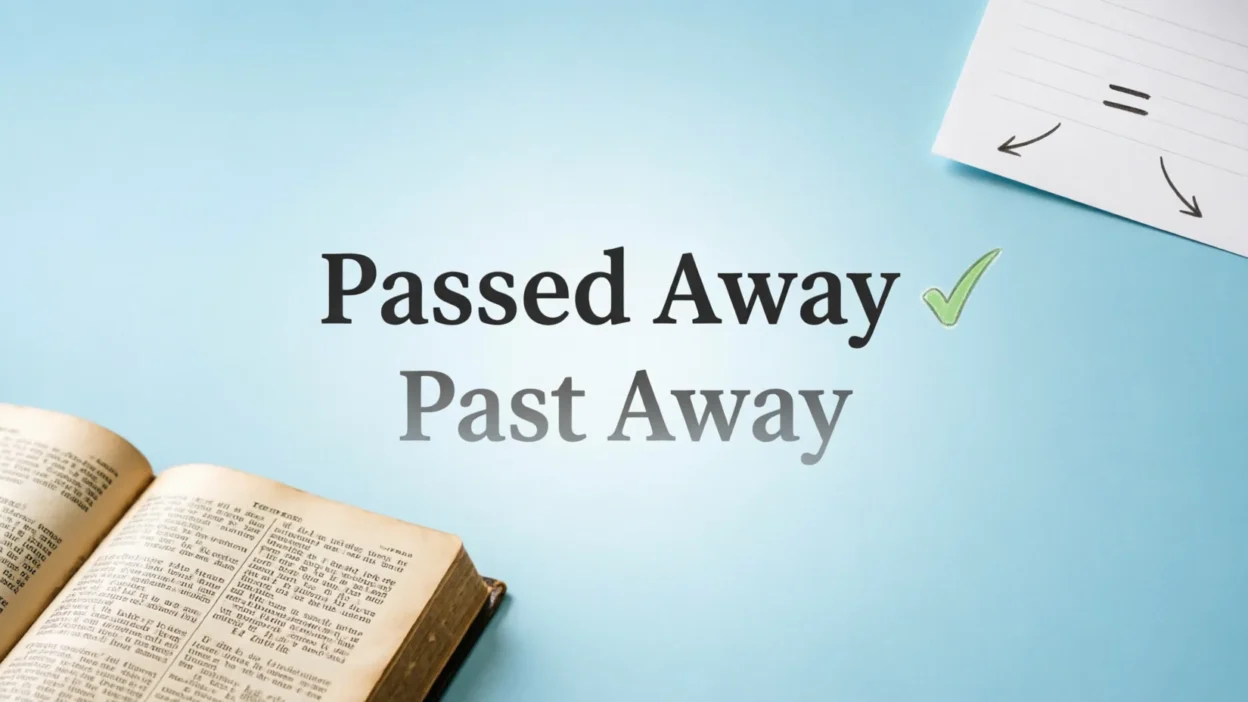
If you are wondering if “passed away” or “past away” is correct, the answer is “passed away.” The phrase passed away is a polite and respectful way to say that someone has died. Past away is incorrect when you mean death.
These two expressions are easy to confuse because passed and past sound similar in everyday speech. However, they have different meanings and grammatical roles. Passed is the past tense of the verb pass, while past can function as a noun, adjective, adverb, or preposition. Understanding this small difference can help you avoid a common spelling and usage mistake.
Quick Answer
Passed away is the correct expression when referring politely to someone’s death. Past away is incorrect in this context. For example: “Her grandfather passed away last year.” Here, passed away is a phrasal verb meaning died.
Why Do People Confuse “Passed Away” and “Past Away”?
People often confuse these phrases because passed and past have similar pronunciations.
However, they are different words:
- Passed → past tense and past participle of pass
- Past → refers to an earlier time or something that has gone beyond a point
- Passed away → a polite expression meaning died
- Past away → incorrect when referring to someone’s death
The correct phrase is therefore passed away.
What Does “Passed” Mean?
Passed is the past tense of pass. It can describe movement, completion, success, or the act of going beyond something.
Examples
- She passed the exam.
- The car passed us on the highway.
- He passed the ball to his teammate.
- Time passed quickly.
- My grandfather passed away peacefully.
In passed away, the word passed is part of the phrasal verb pass away.
What Does “Past” Mean?
Past generally relates to a time before now or to something that has already gone beyond a particular point.
Examples
- We talked about the past.
- The train went past the station.
- It is half past three.
- She walked past the house.
- Don’t worry about what happened in the past.
Past does not form the expression meaning “died.”
Passed Away vs. Past Away: Comparison Table
| Expression | Correct? | Meaning | Example |
| Passed away | ✅ Yes | Died | His uncle passed away last month. |
| Past away | ❌ No | Incorrect expression | ❌ His uncle past away last month. |
| Passed | ✅ Yes | Past tense of pass | She passed the test. |
| Past | ✅ Yes | Earlier time / beyond | We drove past the school. |
When Should You Use “Passed Away”?
Use passed away when you want to refer to someone’s death in a polite, gentle, or respectful way.
For example:
My neighbor passed away peacefully.
It is commonly used in conversations, sympathy messages, obituaries, announcements, and other situations where a softer expression is appropriate.
You can use different forms depending on the sentence:
- pass away — present/base form
- passed away — past tense
- has passed away — present perfect
- had passed away — past perfect
Examples
- Sadly, her father passed away last night.
- His grandmother has passed away.
- We learned that the actor had passed away earlier that morning.
- I am sorry to hear that your friend passed away.
10+ Examples of “Passed Away”
Here are practical examples showing how to use the correct expression naturally:
- Her grandfather passed away peacefully at home.
- My uncle passed away last year.
- We were saddened to hear that she had passed away.
- His father passed away after a long illness.
- The family announced that their beloved mother had passed away.
- I was sorry to learn that your friend passed away.
- Their teacher passed away several years ago.
- He passed away peacefully surrounded by his family.
- Many people attended the funeral after she passed away.
- I still remember my grandmother, who passed away when I was young.
- The news reported that the famous writer had passed away.
- We will always remember him after he passed away.
Common Mistakes With “Passed Away” and “Past Away”
The most common mistake is writing past away instead of passed away.
Incorrect
❌ My grandfather past away yesterday.
Correct
✅ My grandfather passed away yesterday.
Another mistake is assuming that past can replace passed because the words sound similar.
Remember that passed is related to the verb pass, while past generally refers to an earlier time or something beyond a particular point.
More examples
- ❌ She past away last year.
- ✅ She passed away last year.
- ❌ His father has past away.
- ✅ His father has passed away.
A Simple Memory Trick
Remember:
Passed away = passed from this life.
The word passed comes from the verb pass, as in “pass from one state to another.”
You can also remember:
Passed away = died
Past = earlier time
So, when you are talking about someone’s death, choose passed away.
American vs. British English
There is no American vs. British spelling difference between passed away and past away.
Both American and British English use passed away as the standard expression.
For example:
- American English: Her grandfather passed away.
- British English: Her grandfather passed away.
The phrase is understood across English-speaking varieties.
Similar Words and Expressions
Several expressions are related to passed away, although they may differ in tone and context.
Died
Died is direct and neutral.
His grandfather died in 2019.
Passed away
Passed away is generally more indirect and polite.
His grandfather passed away in 2019.
Deceased
Deceased is a formal adjective or noun.
The deceased person’s family released a statement.
Late
Late can be used before someone’s name to indicate that the person has died.
My late grandfather was a teacher.
Passed on
Passed on can sometimes be used as a euphemistic expression for death, but its meaning depends on context.
Her grandmother passed on peacefully.
Among these expressions, passed away is a very common respectful way to refer to someone’s death.
Final Verdict: Passed Away or Past Away?
Passed away is correct when you mean died.
Past away is not the standard English expression for death.
The easiest way to remember the difference is:
Passed away = died
Past = earlier time or beyond a point
So write:
✅ My grandfather passed away last year.
Not:
❌ My grandfather past away last year.
FAQs:
Is “passed away” correct English?
Yes. Passed away is correct English and is commonly used as a polite or respectful way to say that someone died.
Is “past away” ever correct?
Past away is not the standard phrase used to mean “died.” When referring to someone’s death, use passed away.
Why is it “passed away” and not “past away”?
Passed is the past form of the verb pass. The expression pass away means to die, so its past-tense form is passed away.
What is the difference between passed and past?
Passed is a form of the verb pass, while past generally refers to an earlier time or something beyond a particular point.
Can I say “has passed away”?
Yes. Has passed away is grammatically correct.
Her grandmother has passed away.
Is “passed away” more polite than “died”?
Passed away is generally considered a softer or more euphemistic expression than died. The appropriate choice depends on the context and tone.
What is the opposite of “passed away”?
There is no exact grammatical opposite. If you mean the opposite of death, expressions such as is alive or survived may be appropriate depending on the sentence.
Remember This
- ✅ Passed away = died
- ❌ Past away = incorrect for this meaning
- Passed = past form of pass
- Past = earlier time or beyond a point
- Passed away is commonly used as a respectful expression for death.
Conclusion
The correct expression is passed away, not past away. The phrase comes from the verb pass, and passed away is used as a polite way to say that someone died. Although passed and past sound similar, they have different meanings and grammatical functions.
Whenever you are talking about someone’s death, remember the simple rule: passed away = died. Use past when discussing an earlier time or something that is beyond a particular point. With this distinction in mind, you can confidently choose the correct expression in writing and conversation.

Lucas Smith is a skilled language writer at Synomity.com, passionate about synonyms, vocabulary enrichment, and word meanings. He develops engaging content that helps readers strengthen communication skills and expand their understanding of language.