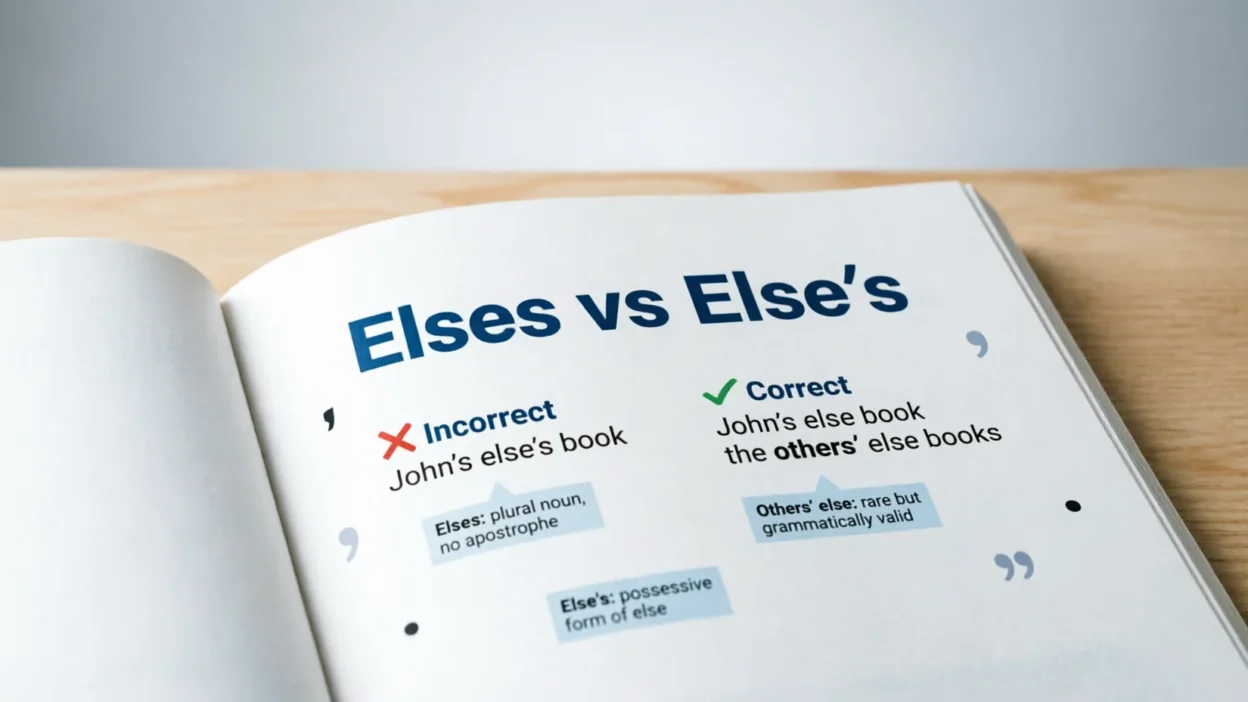
If you are wondering whether “else’s” or “elses” is correct, the answer is simple: “else’s” is the correct possessive form, while “elses” is generally incorrect. The apostrophe in else’s shows possession, meaning something belongs to, relates to, or is associated with someone or something else. For example, “I took someone else’s pen” is correct.
The word else is commonly used after words such as someone, somebody, anyone, anybody, everyone, and what. When you need to show possession, you add ’s to form else’s. This can sometimes look unusual because else usually follows another word.
Understanding this small spelling and grammar rule can help you avoid mistakes in writing, school assignments, emails, and everyday English. In this guide, you will learn the difference between else’s and elses, when to use each form, and how to recognize the correct construction.
Quick Answer
Else’s is the correct possessive form of else. It means that something belongs to or is associated with someone or something else. Elses is not normally used as a standard English word. For example, “This is someone else’s idea” is correct, while “someone elses idea” is incorrect.
Why Do People Confuse “Else’s” and “Elses”?
The confusion usually happens because else is often followed by another word, such as someone else or anything else. When possession is needed, writers may forget the apostrophe.
For example:
- someone else → someone else’s
- anyone else → anyone else’s
- everybody else → everybody else’s
- what else → what else’s
The apostrophe and s together indicate possession.
What Is the First Word: “Else”?
Else is an adverb that generally means “in addition,” “different,” or “other.”
It is commonly placed after words such as:
- someone else
- somebody else
- anyone else
- anything else
- everyone else
- everywhere else
- what else
- who else
Examples of “Else”
- Does anyone else know the answer?
- Would you like anything else?
- Who else is coming?
- Is there somewhere else we can go?
- What else do you need?
Notice that else does not normally take an apostrophe when it is simply modifying or completing the meaning of another word.
What Is the Second Word: “Else’s”?
Else’s is the possessive form used when something belongs to, comes from, or is associated with someone or something else.
For example:
- This is someone else’s phone.
- I accidentally took somebody else’s bag.
- That was someone else’s decision.
- We should respect everyone else’s opinions.
The apostrophe is important because it marks possession.
Else’s vs Elses: Comparison Table
| Form | Correct? | Meaning | Example |
|---|---|---|---|
| else | Yes | Other or additional | What else do you need? |
| else’s | Yes | Possessive form | It is someone else’s book. |
| elses | Generally no | Not a standard possessive form | ❌ Someone elses book |
| else’s | Yes | Same as else’s | Someone else’s car |
The key point is simple: use “else’s” when you need the possessive form.
When Should You Use “Else”?
Use else when you mean another, additional, or different.
Examples
- What else would you like?
- Is there anything else to discuss?
- Who else knows about this?
- Let’s try somewhere else.
- Do you need anything else?
- Everyone else has arrived.
- Somebody else called earlier.
- What else can we do?
- Did anyone else see him?
- I don’t know what else to say.
When Should You Use “Else’s”?
Use else’s when you want to show that something belongs to another person or thing.
Examples
- This is someone else’s notebook.
- I borrowed someone else’s pen.
- That is somebody else’s responsibility.
- We should respect everyone else’s choices.
- I accidentally wore someone else’s jacket.
- Is this anyone else’s seat?
- That was someone else’s idea.
- The decision was somebody else’s.
- I don’t want to use someone else’s computer.
- This problem is everyone else’s concern.
Common Mistakes With Else’s and Elses
Mistake 1: Leaving Out the Apostrophe
❌ This is someone elses phone.
✅ This is someone else’s phone.
The apostrophe is necessary because the phrase expresses possession.
Mistake 2: Using “Elses” as the Possessive
❌ I borrowed anyone elses book.
✅ I borrowed anyone else’s book.
Mistake 3: Confusing “Else” With “Else’s”
❌ Is this someone else bag?
✅ Is this someone else’s bag?
The first version does not correctly show possession.
Mistake 4: Adding an Apostrophe When You Do Not Need One
❌ What else’s do you want?
✅ What else do you want?
Use else’s only when the possessive meaning is actually intended.
A Simple Memory Trick
Remember this rule:
Else + ’s = possession.
If something belongs to another person, use else’s.
Think:
The apostrophe tells you that the book belongs to someone else.
Another useful test is to ask:
“Does something belong to someone?”
If the answer is yes, else’s is usually the form you need.
American vs British English
There is no major American-versus-British spelling difference between else’s and elses.
Both American and British English use else’s for the possessive form:
- American English: someone else’s car
- British English: someone else’s car
The incorrect form elses does not become correct simply because of regional English differences.
Similar Words and Expressions
Understanding related expressions can make the rule easier to remember.
Someone Else
Means another person.
Example: Someone else answered the question.
Someone Else’s
Shows possession by another person.
Example: This is someone else’s answer.
Anyone Else
Means any other person.
Example: Does anyone else want coffee?
Anyone Else’s
Shows possession by another person.
Example: Is this anyone else’s coat?
Everyone Else
Means all the other people in a group.
Example: Everyone else has finished.
Everyone Else’s
Shows possession by all the other people.
Example: I respect everyone else’s opinions.
Final Verdict: Else’s or Elses?
Else’s is the correct form when you need to express possession.
Elses is generally not correct in standard English as a possessive form.
Remember:
- else = other/additional
- else’s = belonging to someone or something else
- elses = generally incorrect
So write “someone else’s car,” not “someone elses car.”
FAQs:
Is “elses” a correct word?
Elses is generally not used as a standard English possessive form. If you want to show possession, use else’s, as in “someone else’s house.”
Is it “someone elses” or “someone else’s”?
The correct form is “someone else’s.” The apostrophe before the s shows possession.
What does “else’s” mean?
Else’s means belonging to or being associated with someone or something else. For example, “This is someone else’s phone” means the phone belongs to another person.
Is “someone else’s” grammatically correct?
Yes. Someone else’s is a standard possessive construction. For example: “I found someone else’s wallet.”
Is “anyone else’s” correct?
Yes. Anyone else’s is correct when you are asking about possession. For example: “Is this anyone else’s bag?”
Is “everyone else’s” correct?
Yes. Everyone else’s is correct when something belongs to or is associated with all the other people. For example: “We should consider everyone else’s opinion.”
Why does “else” have an apostrophe?
The apostrophe in else’s indicates possession. It works like other singular possessive forms, such as John’s, the teacher’s, and someone’s.
Remember This
Else means other or additional.
Else’s means belonging to someone or something else.
Elses is generally incorrect when you mean possession.
The easiest example to remember is:
Someone else’s book is on the table.
Conclusion
The difference between else’s and elses is mainly about the apostrophe. Else’s is the standard possessive form, while elses is generally not correct in standard English. Whenever you need to show that something belongs to another person or is associated with someone else, use the apostrophe: someone else’s, anyone else’s, or everyone else’s.
Once you recognize the possessive pattern, this spelling becomes easy to remember. Use else for the meaning “other” or “additional,” and use else’s when possession is involved. With these simple rules and examples, you can confidently avoid the common mistake of writing “someone elses” instead of “someone else’s.”

John Morrison is a dedicated content writer at Synomity.com, focused on synonyms, vocabulary development, and word meanings. He creates clear, educational resources that help readers improve language skills and communicate with confidence.