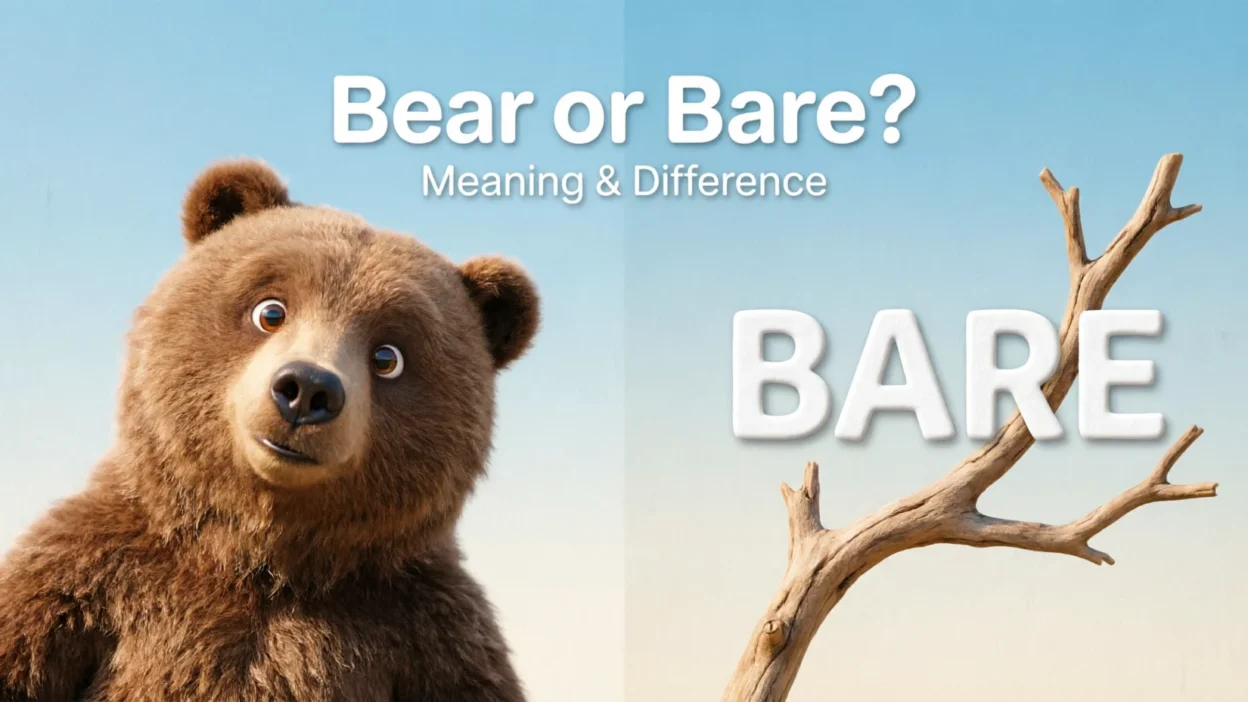
“Bear” and “bare” are two English words that sound exactly alike but have completely different meanings. Bear can be a noun meaning an animal or a verb meaning to carry, tolerate, or endure. Bare usually means uncovered, exposed, or lacking something. For example, “The bear is sleeping” and “His feet are bare” use the words correctly.
Because these words are pronounced the same, they are easy to confuse in writing. The key is to look at the meaning and the words around them. Bear is often connected with animals, carrying, enduring, or producing, while bare describes something uncovered or empty.
This guide explains the difference between bear and bare with simple definitions, examples, common mistakes, memory tricks, and useful comparisons so you can choose the correct word confidently.
Quick Answer
Bear and bare are homophones, meaning they sound alike but have different meanings. Bear can mean an animal, to carry, or to tolerate something. Bare means uncovered, exposed, or without something. Remember: a bear can carry or endure, while bare means uncovered.
Why Do People Confuse Bear and Bare?
People often confuse bear and bare because both words have the same pronunciation in standard English. Their spelling and meanings, however, are different.
- Bear → an animal, to carry, to tolerate, or to endure
- Bare → uncovered, exposed, or without something
For example:
- The bear climbed the tree.
- The child walked with bare feet.
- I cannot bear the noise.
- The room had bare walls.
The sentence’s meaning tells you which spelling you need.
What Does “Bear” Mean?
Bear has several meanings and can function as both a noun and a verb.
Bear as a Noun
As a noun, bear refers to a large, powerful mammal.
Examples:
- We saw a bear in the forest.
- The polar bear lives in Arctic regions.
- A bear was pictured on the sign.
Bear as a Verb
As a verb, bear can mean to carry, support, tolerate, or endure something.
Examples:
- I cannot bear the pain.
- She had to bear the responsibility.
- Can you bear the noise?
- He could hardly bear to watch.
“Bear” can also refer to producing or giving something, especially in formal or literary English.
- The tree bears fruit every year.
- She bore a child.
What Does “Bare” Mean?
Bare usually means uncovered, exposed, plain, or without the usual covering or contents.
It can be an adjective, verb, or, less commonly, a noun.
Bare as an Adjective
- He walked on the bare floor.
- She stood with bare feet.
- The walls were bare.
- The table was bare.
Bare as a Verb
As a verb, bare means to uncover or reveal.
- The wind bared the tree branches.
- The investigation bared the truth.
A related word is barely, which means “only just” or “almost not.”
- I barely caught the bus.
- There was barely enough food for everyone.
Bear vs Bare: Comparison Table
| Word | Meaning | Common Use | Example |
|---|---|---|---|
| Bear | A large animal | Noun | The bear is in the forest. |
| Bear | To tolerate or endure | Verb | I cannot bear the pain. |
| Bear | To carry or support | Verb | She must bear the responsibility. |
| Bare | Uncovered or exposed | Adjective | He had bare feet. |
| Bare | Without something | Adjective | The room had bare walls. |
| Bare | To uncover or reveal | Verb | The tree was bared by the wind. |
When Should You Use “Bear” or “Bare”?
Use bear when you are talking about:
- The animal
- Carrying something
- Supporting something
- Tolerating something
- Enduring something
- Producing something
Use bare when you mean:
- Uncovered
- Exposed
- Empty
- Plain
- Without a covering
- Revealing or uncovering something
A Simple Test
Ask yourself:
Does the sentence involve an animal, carrying, or enduring?
→ Use bear.
Does it describe something uncovered or exposed?
→ Use bare.
10+ Examples of Bear and Bare
Here are practical examples showing the difference:
- The bear disappeared into the forest.
- I cannot bear this cold weather.
- She had to bear the responsibility herself.
- The tree bears delicious fruit.
- He walked across the room with bare feet.
- The walls were completely bare.
- The children sat on the bare ground.
- The dog had a bare patch of skin.
- She could not bear to hear the bad news.
- The room contained only a bare table.
- The hikers were afraid of encountering a bear.
- The evidence bared the truth about the situation.
Common Mistakes with Bear and Bare
Mistake 1: “I can’t bare the pain.”
Incorrect:
Correct:
Here, bear means “tolerate” or “endure.”
Mistake 2: “He walked with bear feet.”
Incorrect:
Correct:
Here, bare means uncovered.
Mistake 3: “The room had bear walls.”
Incorrect:
Correct:
The walls are uncovered or plain, so bare is correct.
Mistake 4: “A bare was walking in the forest.”
Incorrect:
Correct:
The animal is a bear.
Memory Trick: How to Remember Bear vs Bare
Try this simple trick:
Bear = Beast or Endure
Think of a bear as the animal or remember the phrase “bear the pain.”
Bare = Barely Covered
Think of bare as something with no covering.
You can remember:
This quick association can help you choose the correct spelling when writing.
American vs British English
The meanings and spellings of bear and bare are generally the same in American and British English.
- American English: bear / bare
- British English: bear / bare
The main difference is not regional spelling but meaning and grammatical use. Both varieties use bear for the animal and for meanings such as “endure,” while bare describes something uncovered or exposed.
Similar Words to Bear and Bare
Understanding related words can make the distinction easier.
Words Related to Bear
- endure
- tolerate
- carry
- support
- withstand
- suffer
- animal
Examples:
Words Related to Bare
- uncovered
- exposed
- empty
- plain
- naked
- reveal
- uncover
Examples:
Final Verdict: Bear or Bare?
The correct word depends entirely on the meaning.
Use bear when referring to the animal or when you mean carry, tolerate, endure, support, or produce. Use bare when you mean uncovered, exposed, plain, or without a covering.
The easiest distinction is:
Although they sound identical, their meanings are very different. Once you connect each spelling with its main meanings, choosing between them becomes much easier.
FAQs:
Is it “bear with me” or “bare with me”?
The correct expression is “bear with me.” It means “please be patient with me” or “please tolerate this situation for a little while.”
Is it “bear feet” or “bare feet”?
The correct phrase is “bare feet.” It means feet without shoes or socks.
What is the difference between bear and bare?
Bear can refer to an animal or mean to carry, tolerate, or endure. Bare means uncovered, exposed, plain, or without something.
Is “I can’t bear it” correct?
Yes. “I can’t bear it” means “I cannot tolerate or endure it.”
What does “bare” mean in English?
Bare means uncovered, exposed, plain, or lacking something. For example, “bare feet” means feet without shoes or socks.
Are bear and bare homophones?
Yes. Bear and bare are homophones because they are pronounced alike but have different spellings and meanings.
Is “bear” always an animal?
No. Bear is also a verb. It can mean to tolerate, endure, carry, support, or produce something.
Remember This
Bear = animal, carry, tolerate, or endure.
Bare = uncovered, exposed, or plain.
Examples:
- The bear is dangerous.
- I cannot bear the pain.
- He has bare feet.
- The walls are bare.
If you remember “bear = endure” and “bare = uncovered,” you will avoid most common mistakes.
Conclusion
Bear and bare are easy to mix up because they sound the same, but their meanings are clearly different. Bear can describe an animal or express ideas such as carrying, tolerating, and enduring. Bare describes something uncovered, exposed, plain, or lacking a covering.
When choosing between them, focus on the meaning of the sentence rather than the sound. If you mean an animal or something you must tolerate, choose bear. If you mean something uncovered or exposed, choose bare. With a little practice, these two commonly confused words become simple to distinguish.