
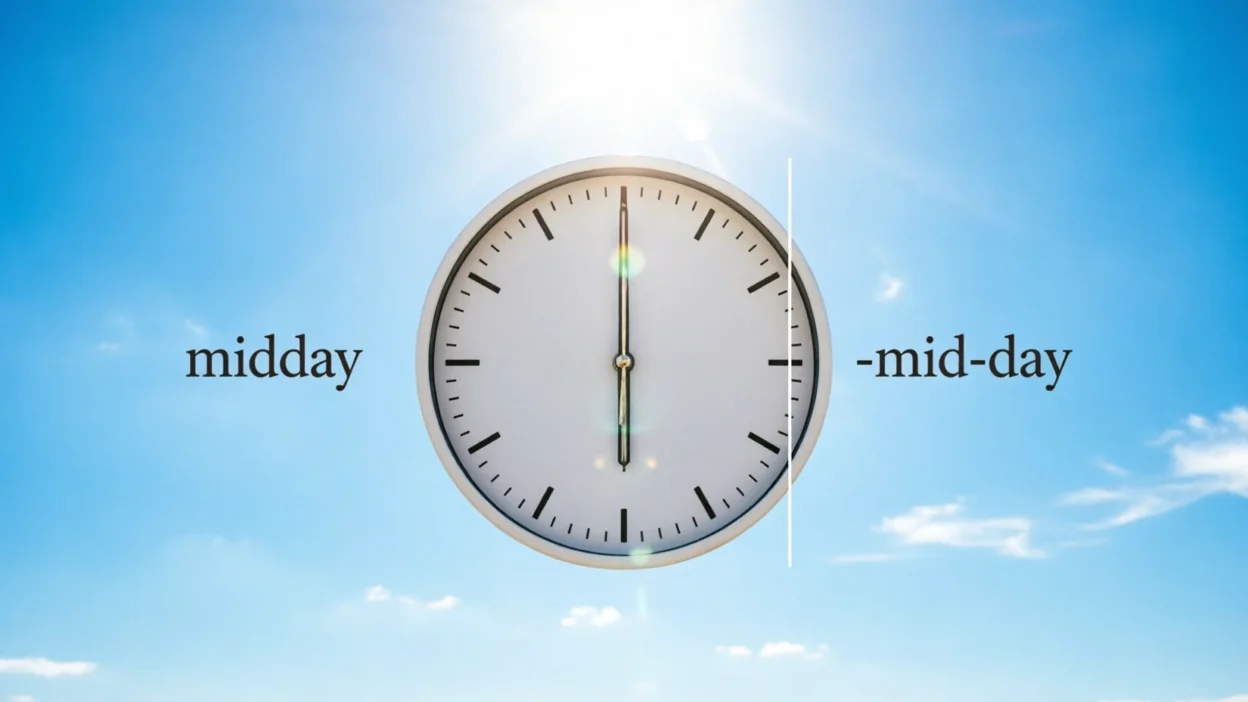
If you are wondering whether “midday” or “mid-day” is correct, the standard modern spelling is midday—written as one word. It means the middle of the day, usually around 12:00 noon. The hyphenated form mid-day is also understandable and has been used historically, but midday is the more common standard form in contemporary English.
This spelling question often causes confusion because many English compounds can be written as one word, two words, or with a hyphen depending on usage.
Words beginning with mid- can follow different patterns, so it is useful to learn the specific convention for midday rather than assuming every “mid-” word follows the same rule. In everyday writing, choose midday when referring to noon or the middle part of the day.
Quick Answer
Midday is the preferred modern spelling. It means the middle of the day, especially around noon. Mid-day is an older or less common hyphenated form and is generally unnecessary in ordinary modern writing. For most situations, write midday as one word.
Why Do People Confuse It?
People often confuse midday and mid-day because hyphens are commonly used in compound words to connect words that work together as a single expression.
The prefix mid- means “in the middle of” or “approximately halfway through.” When combined with day, the result is normally written as the single word midday.
Examples:
- We arrived at midday. ✓
- We arrived at mid-day. Understandable, but less standard.
- The midday sun was extremely bright. ✓
Modern dictionaries and general writing conventions favor midday.
What Does “Midday” Mean?
Midday is a noun meaning the middle of the day, particularly around 12 noon.
It can also function as a modifier before another noun.
As a noun
We usually eat lunch at midday.
Here, midday refers to a time of day.
As an adjective
The midday heat was intense.
Here, midday describes the heat occurring around the middle of the day.
What Does “Mid-Day” Mean?
Mid-day has the same basic meaning as midday: the middle of the day.
However, the hyphenated spelling is less common in contemporary general English. You may encounter it in older texts, particular publications, or stylistic contexts.
For ordinary modern writing, midday is usually the better choice.
Midday vs Mid-Day: Comparison Table
| Feature | Midday | Mid-Day |
| Spelling | One word | Hyphenated |
| Meaning | Middle of the day | Middle of the day |
| Modern usage | Common | Less common |
| Standard everyday writing | Preferred | Usually unnecessary |
| Part of speech | Noun/adjective | Noun/adjective |
| Example | We met at midday. | We met at mid-day. |
When Should You Use “Midday”?
Use midday when you mean the middle of the day or approximately noon.
Common examples
- The meeting starts at midday.
- We reached the town by midday.
- The midday sun was hot.
- She usually takes a break around midday.
- The restaurant becomes busy at midday.
“Midday” is natural in both formal and everyday English.
When Should You Use “Mid-Day”?
In most modern writing, you normally do not need the hyphen.
The form mid-day can still be encountered, especially in older writing or where a particular style guide or publication uses it. However, if you are simply asking which spelling to choose, midday is the safer standard choice.
10+ Examples of “Midday” in Sentences
- We arrived at the hotel around midday.
- The temperature was highest at midday.
- She usually eats lunch at midday.
- The midday sun made the road difficult to see.
- By midday, the work was nearly finished.
- The shop closes briefly at midday.
- They planned to leave before midday.
- The park is usually crowded around midday.
- He received the message at midday.
- The birds became less active during the midday heat.
- We should reach the village by midday.
- The midday meal was served in the garden.
Common Mistakes With Midday
Mistake 1: Always adding a hyphen
Some writers assume mid-day must be hyphenated because mid- acts like a prefix.
Incorrect for standard modern usage:
We will arrive at mid-day.
Preferred:
We will arrive at midday.
Mistake 2: Confusing “midday” with “midnight”
These words refer to opposite points of the day.
- Midday = around 12 noon
- Midnight = around 12 at night
Example:
The event begins at midday and ends at midnight.
Mistake 3: Using “midday” when you mean afternoon
Midday generally refers to around noon, not the entire afternoon.
For example:
I will call you at midday.
means roughly around noon, while:
I will call you in the afternoon.
refers to a broader period after noon.
Memory Trick: “Mid” + “Day” Becomes One Word
A simple way to remember the spelling is:
mid + day = midday
Think of midday as a single name for the middle of the day.
Just remember:
Noon → midday → one word
So, when you need the ordinary modern spelling, choose midday.
American vs British English
Midday is standard and widely understood in both American English and British English.
There is no major difference in meaning between the two varieties for this word. The spelling midday is the practical choice for general English writing regardless of whether you are writing for an American or British audience.
For example:
- American English: We arrived at midday.
- British English: We arrived at midday.
The meaning remains the same.
Similar Words
Several words and phrases are related to midday:
- Noon — 12:00 in the daytime
- Midnight — 12:00 at night
- Morning — the earlier part of the day
- Afternoon — the period after noon
- Evening — the later part of the day
- Midmorning — approximately the middle of the morning
- Midafternoon — approximately the middle of the afternoon
Midday vs Noon
Midday and noon are closely related, but they are not always exact synonyms in every context. Noon specifically refers to 12:00 p.m., while midday can refer more generally to the middle portion of the day around noon.
Final Verdict: Midday or Mid-Day?
Midday is the preferred spelling in modern standard English.
Use midday as one word when you mean the middle of the day or approximately noon. Mid-day has the same basic meaning but is less common and generally unnecessary in ordinary contemporary writing.
Best choice: ✅ midday
Less common: mid-day
If you are writing an essay, email, article, school assignment, or everyday message, midday is the spelling to choose.
FAQs:
Is “midday” one word or two?
Midday is one word. It is the standard modern spelling for the middle of the day.
Is “mid-day” grammatically correct?
Mid-day is understandable and has been used as a hyphenated form, but midday is generally preferred in modern standard English.
Does midday mean 12 PM?
Midday generally means around noon, and noon is conventionally 12:00 p.m. In everyday usage, however, “midday” can refer somewhat more broadly to the middle part of the day.
Is midday the same as noon?
They are closely related. Noon specifically refers to 12:00 p.m., while midday commonly refers to the middle of the day, particularly around noon.
Should I write “midday sun” or “mid-day sun”?
Write “midday sun” in normal modern English. The compound modifier is commonly written as one word.
Is midday used in American English?
Yes. Midday is commonly used in American English and British English.
What is the opposite of midday?
There is no exact grammatical opposite, but midnight refers to the middle of the night and is commonly contrasted with midday.
Can “midday” be used as an adjective?
Yes. For example, “midday heat” and “midday meal” use midday as a modifier describing something associated with the middle of the day.
Remember This
Midday = preferred modern spelling.
- ✅ midday
- ⚠️ mid-day — less common
- ❌ Avoid unnecessary hyphenation in ordinary modern writing.
- Midday means the middle of the day, especially around noon.
- Noon specifically refers to 12:00 p.m.
Conclusion
When choosing between midday and mid-day, use midday in most modern English writing. It is the standard one-word form for the middle of the day and works naturally as both a noun and a modifier.
Although mid-day may appear in some older or stylistically specific texts, the hyphen is generally unnecessary in everyday English. Remembering mid + day = midday makes this spelling easy to use correctly in school, work, and everyday communication.

Evelyn Mia is a passionate language writer and vocabulary enthusiast at Synomity.com, specializing in synonyms, word meanings, and language learning. She creates informative content that helps readers expand vocabulary and communicate more effectively.