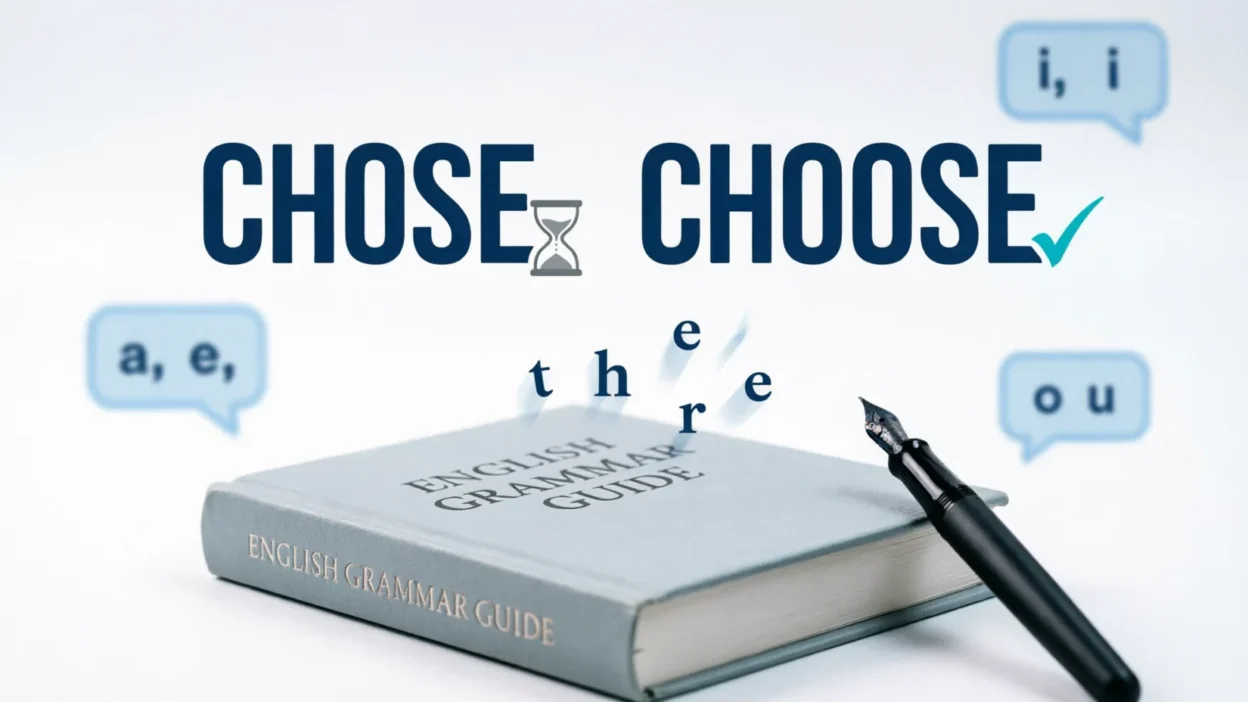
Many English learners confuse chose and choose because they look and sound similar, but they are used at different times. Choose is the present-tense form, while chose is the simple past form. For example, “I choose tea every morning” describes a present or regular choice, while “I chose tea yesterday” describes a choice made in the past.
Understanding the difference between chose vs. choose is important because using the wrong form can make a sentence grammatically incorrect. The key is to look at when the action happens. If you are talking about a choice you make now, regularly, or in the future, use choose. If the choice already happened, use chose. Once you understand this simple tense difference, these two commonly confused words become much easier to use correctly.
Quick Answer
Choose is the present-tense verb meaning to select or decide between options. Chose is its simple past form. Use “choose” for current, regular, or future choices and “chose” for a completed choice in the past. The past participle is chosen, as in “I have chosen.”
Why Do People Confuse Chose and Choose?
People often confuse these words because they come from the same verb and have very similar spellings.
The main difference is tense:
- Choose → present tense
- Chose → simple past tense
- Chosen → past participle
Compare these sentences:
- I choose healthy food every day.
- I chose the salad yesterday.
- I have chosen the salad already.
The time of the action tells you which form to use.
First Word: Choose
Choose is the present-tense form of the verb. It means to select something from two or more possibilities.
Examples of “Choose”
- I choose tea over coffee.
- Please choose one answer.
- We need to choose a restaurant.
- She usually chooses the blue dress.
Notice that choose can also be used for future decisions:
I will choose a book tomorrow.
After modal verbs such as will, can, should, must, and may, use choose, not “chose.”
Second Word: Chose
Chose is the simple past tense of “choose.” Use it when someone made a decision or selection in the past.
Examples of “Chose”
- I chose the red shirt yesterday.
- She chose the smaller room.
- They chose a different route.
- We chose pizza for dinner last night.
A useful clue is a past-time expression such as yesterday, last week, last year, earlier, or a few minutes ago.
Chose vs. Choose: Comparison Table
| Word | Grammar | Meaning | Example |
| Choose | Present tense | Select or decide now/usually | I choose tea. |
| Chose | Simple past | Selected or decided in the past | I chose tea yesterday. |
| Chosen | Past participle | Used with helping verbs | I have chosen tea. |
The most important pattern to remember is:
choose → chose → chosen
When Should You Use Each?
Use “Choose” for Present Choices
Use choose when the decision is happening now or is a regular habit.
I usually choose fruit for breakfast.
Use “Choose” for Future Choices
Use choose when talking about a decision that will happen later.
I will choose my course tomorrow.
Use “Chose” for Completed Past Choices
Use chose when the selection happened in the past.
She chose a new laptop last week.
Use “Chosen” with Perfect Tenses
Use chosen after forms of have or has.
I have chosen my favorite option.
Do not say:
I have chose my favorite option. ❌
Say:
I have chosen my favorite option. ✅
10+ Examples of Choose and Chose
- I choose water instead of soda.
- She chooses her clothes carefully.
- We choose a different route every summer.
- Please choose one of these options.
- I will choose a gift later.
- He chose the blue car yesterday.
- They chose a quiet place for dinner.
- She chose the most affordable option.
- We chose to stay at home last night.
- I chose this book because it looked interesting.
- He usually chooses chocolate ice cream.
- I have chosen a new career path.
Common Mistakes
Mistake 1: Using “Chose” for the Present
Incorrect:
I chose what I want now. ❌
Better:
I choose what I want now. ✅
Mistake 2: Using “Choose” for a Completed Past Action
Incorrect:
Yesterday, I choose the red dress. ❌
Correct:
Yesterday, I chose the red dress. ✅
Mistake 3: Using “Chose” After “Have”
Incorrect:
I have chose a new phone. ❌
Correct:
I have chosen a new phone. ✅
Remember that chosen is the past participle.
Mistake 4: Confusing “Chose” with “Choose”
The pronunciation can also help:
- choose sounds like “chooz”
- chose sounds like “chohz”
The spelling difference is small, but the grammar difference is important.
Memory Trick: Choose → Chose → Chosen
A simple way to remember the forms is:
Today: I choose.
Yesterday: I chose.
Already: I have chosen.
You can also remember:
Choose = now
Chose = before
Chosen = used with have/has/had
For example:
- Today, I choose pizza.
- Yesterday, I chose pizza.
- I have chosen pizza.
American vs. British English
There is no major difference between American and British English in the basic use of choose and chose.
Both varieties use:
- choose for the present
- chose for the simple past
- chosen as the past participle
For example, both American and British speakers can say:
I chose this option yesterday.
The difference is therefore not about American versus British spelling. It is primarily about verb tense and grammatical form.
Similar Words
Several words are related to choose and can sometimes cause confusion.
Select
Select means to choose something, often from a list or group.
Please select your preferred option.
Decide
Decide focuses more on making a decision than physically selecting something.
I need to decide what to study.
Pick
Pick is a common, informal alternative to “choose.”
Pick your favorite color.
Prefer
Prefer means to like or favor one option more than another.
I prefer tea to coffee.
These words can be related, but they are not always interchangeable.
Final Verdict: Chose or Choose?
The correct word depends on when the choice happened.
- Use choose for the present or future.
- Use chose for a completed action in the past.
- Use chosen as the past participle after forms of have.
The easiest pattern is:
Choose → present
Chose → past
Chosen → past participle
If you see a past-time expression such as yesterday or last week, chose is usually the correct form. If you are describing a current, habitual, or future choice, use choose.
FAQs:
Is “chose” the past tense of “choose”?
Yes. Chose is the simple past tense of choose.
I choose a book today.
I chose a book yesterday.
Is it “choose” or “chose” for present tense?
Use choose for the present tense.
I choose this option.
For third-person singular subjects, use chooses:
She chooses this option.
What is the past participle of “choose”?
The past participle is chosen.
I have chosen the blue one.
The three main forms are choose – chose – chosen.
Is “I chose” grammatically correct?
Yes. I chose is grammatically correct when talking about a completed decision in the past.
I chose the red one yesterday.
Can I use “chose” after “will”?
No. After will, use the base form choose.
Correct:
I will choose tomorrow. ✅
Incorrect:
I will chose tomorrow. ❌
What is the difference between “choose” and “chosen”?
Choose is the base/present form, while chosen is the past participle.
I choose carefully.
I have chosen carefully.
What is the easiest way to remember choose and chose?
Think of the timeline:
Now → choose
Past → chose
Have/has/had → chosen
This pattern will help you use all three forms correctly.
Remember This
Choose = present
Chose = past
Chosen = past participle
A quick example:
I choose a meal every day.
Yesterday, I chose pasta.
I have chosen my meal.
If the action already happened, think chose. If it is happening now or describes a regular/future choice, think choose.
Conclusion
The difference between chose and choose is simple once you focus on verb tense. Choose is used for present, habitual, and future choices, while chose describes a completed choice in the past. The third form, chosen, is used as a past participle with helping verbs such as have, has, and had.
When you are unsure, look for clues about time. Words such as today, usually, or tomorrow often point to choose, while yesterday, last night, or last year point to chose. Remember the complete pattern—choose, chose, chosen—and you will be able to use these forms confidently in everyday English.

Evelyn Mia is a passionate language writer and vocabulary enthusiast at Synomity.com, specializing in synonyms, word meanings, and language learning. She creates informative content that helps readers expand vocabulary and communicate more effectively.