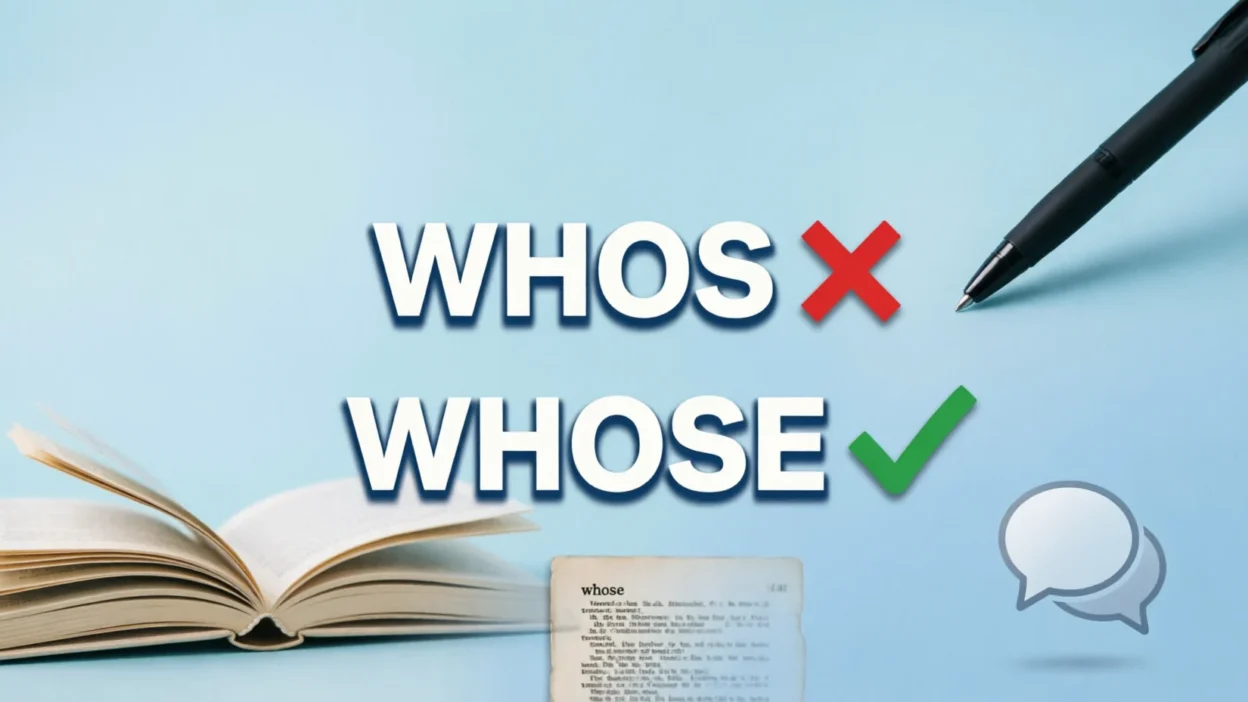
Who’s and whose sound exactly the same, but they have different meanings and grammatical roles. Who’s is a contraction of who is or who has, while whose shows possession or asks who something belongs to. For example, “Who’s coming to dinner?” means “Who is coming to dinner?” but “Whose phone is this?” asks who owns the phone.
These two words are easy to confuse because they are pronounced alike. The apostrophe in who’s can also make it look like a possessive form, which is misleading. In fact, whose is the possessive form of who, while who’s is simply a shortened form of two words. Learning this small difference will help you avoid a common grammar and spelling mistake in questions, conversations, emails, and everyday writing.
Quick Answer
Who’s means “who is” or “who has.” Whose means “belonging to whom” or asks about ownership. Use who’s when you can replace it with “who is” or “who has.” Use whose when you are asking or describing who owns something.
Why Do People Confuse Who’s and Whose?
People often confuse who’s and whose because they have the same pronunciation.
The apostrophe can also cause confusion. In many English words, an apostrophe indicates possession, such as Sarah’s book. However, who’s does not show possession.
Instead, the apostrophe in who’s tells us that letters have been removed:
- who’s = who is
- who’s = who has
- whose = possessive form of who
A simple substitution test can usually tell you which word is correct.
First Word: Who’s
Who’s is a contraction of who is or who has.
Who’s = Who Is
Examples:
- Who’s at the door? → Who is at the door?
- Who’s your teacher? → Who is your teacher?
- Who’s coming with us? → Who is coming with us?
- Who’s responsible for this? → Who is responsible for this?
Who’s = Who Has
Examples:
- Who’s finished the assignment? → Who has finished the assignment?
- Who’s seen my keys? → Who has seen my keys?
- Who’s taken my notebook? → Who has taken my notebook?
If replacing who’s with who is or who has makes sense, who’s is probably the right choice.
Second Word: Whose
Whose is used to show possession. It asks or tells us who something belongs to.
Examples:
- Whose bag is this?
- Whose car is parked outside?
- Whose idea was it?
- I know whose jacket this is.
Unlike who’s, whose does not contain an apostrophe.
It can be used before a noun:
Whose book is on the table?
It can also appear without a noun when the meaning is already clear:
Whose is this?
Here, whose means “belonging to whom.”
Who’s vs Whose: Comparison Table
| Word | Meaning | Grammar | Example |
| Who’s | Who is | Contraction | Who’s your friend? |
| Who’s | Who has | Contraction | Who’s finished the work? |
| Whose | Belonging to whom | Possessive | Whose phone is this? |
| Whose | Of whom | Possessive | Whose decision was it? |
When Should You Use Each?
Use “Who’s” When You Mean “Who Is”
Who’s your new neighbor?
You can expand it:
Who is your new neighbor?
So who’s is correct.
Use “Who’s” When You Mean “Who Has”
Who’s already eaten?
This means:
Who has already eaten?
Again, who’s is correct.
Use “Whose” for Ownership
Whose laptop is this?
The question is asking who owns the laptop, so whose is correct.
Use “Whose” Before a Noun
Whose shoes are these?
Here, whose describes the noun shoes.
Who’s or Whose: 10+ Examples
- Who’s coming to the party?
= Who is coming to the party? - Whose phone is ringing?
= Who owns the phone? - Who’s your best friend?
= Who is your best friend? - Whose jacket did you borrow?
= Who owns the jacket? - Who’s been using my computer?
= Who has been using my computer? - Whose keys are on the desk?
= Who owns the keys? - Who’s responsible for this project?
= Who is responsible for this project? - Whose idea was this?
= Who had this idea? - Who’s already finished the test?
= Who has already finished the test? - Whose bicycle is outside?
= Who owns the bicycle? - Who’s going to help us?
= Who is going to help us? - I wonder whose book this is.
= I wonder who owns this book.
Common Mistakes With Who’s and Whose
Mistake 1: Using “Who’s” for Possession
❌ Who’s bag is this?
✅ Whose bag is this?
The sentence asks about ownership, so whose is needed.
Mistake 2: Using “Whose” Instead of “Who’s”
❌ Whose coming with us?
✅ Who’s coming with us?
Here, who’s means who is.
Mistake 3: Assuming the Apostrophe Shows Possession
It is tempting to think:
who’s = something belonging to someone
But that is incorrect.
The apostrophe in who’s represents missing letters in who is or who has.
Memory Trick for Who’s vs Whose
Use this simple test:
Can you replace the word with “who is” or “who has”?
- If yes → use who’s
- If no, and the sentence involves ownership → use whose
For example:
Who’s at the door?
→ Who is at the door? ✅
Whose coat is this?
→ Who is coat is this? ❌
Therefore, whose is correct.
Another quick memory trick is:
Who’s = who is / who has
Whose = ownership
American vs British English
There is essentially no difference between American and British English when it comes to the basic distinction between who’s and whose.
Both varieties use:
- who’s for who is or who has
- whose for possession
For example:
American English:
Who’s coming?
British English:
Who’s coming?
Likewise:
American English:
Whose bag is this?
British English:
Whose bag is this?
The spelling and grammatical distinction remain the same.
Similar Words
Several English words follow patterns that can cause similar confusion.
Who and Whom
- Who generally refers to the person performing an action.
- Whom traditionally refers to the person receiving an action or following a preposition.
Example:
Who called you?
Whom did you call?
Your and You’re
This is another common contraction-versus-possession distinction:
- You’re = you are
- Your = belonging to you
Example:
You’re very kind.
Where is your phone?
Its and It’s
Similarly:
- It’s = it is or it has
- Its = belonging to it
Example:
It’s raining.
The dog wagged its tail.
These examples show why contractions and possessive forms should be learned by meaning rather than simply by looking for an apostrophe.
Final Verdict: Who’s or Whose?
The correct word depends on what you mean.
Use who’s when you mean who is or who has:
Who’s coming to dinner?
Use whose when you are talking about ownership or possession:
Whose plate is this?
The easiest way to remember the difference is to expand who’s. If who is or who has fits naturally, choose who’s. If the sentence asks who something belongs to, choose whose.
FAQs:
Is “who’s” the same as “whose”?
No. Who’s means who is or who has, while whose indicates possession or ownership. They sound the same but have different meanings.
Is “who’s” possessive?
No. Who’s is a contraction of who is or who has. Whose is the possessive form.
Is it “who’s book” or “whose book”?
The correct phrase is “whose book.” It asks who owns the book.
Is it “whose coming” or “who’s coming”?
The correct phrase is “who’s coming” because it means “who is coming.”
Can “who’s” mean “who has”?
Yes. For example, “Who’s finished the work?” means “Who has finished the work?”
How can I remember who’s and whose?
Remember: who’s = who is / who has, while whose = possession.
Do American and British English use these words differently?
No. The basic distinction between who’s and whose is the same in both American and British English.
Remember This
Who’s = who is / who has
Whose = belonging to whom
When you are unsure, expand who’s. If “who is” or “who has” works, use who’s. If the sentence is about ownership, use whose.
Conclusion
The difference between who’s and whose is simple once you focus on meaning. Who’s is a contraction meaning who is or who has, while whose is used to ask or explain who something belongs to. Although the two words sound identical, they cannot be used interchangeably.
The most useful rule is to remember “who’s = who is/who has” and “whose = possession.” With this quick test and a little practice, you can easily choose the correct word in questions, conversations, schoolwork, and everyday writing.

John Morrison is a dedicated content writer at Synomity.com, focused on synonyms, vocabulary development, and word meanings. He creates clear, educational resources that help readers improve language skills and communicate with confidence.