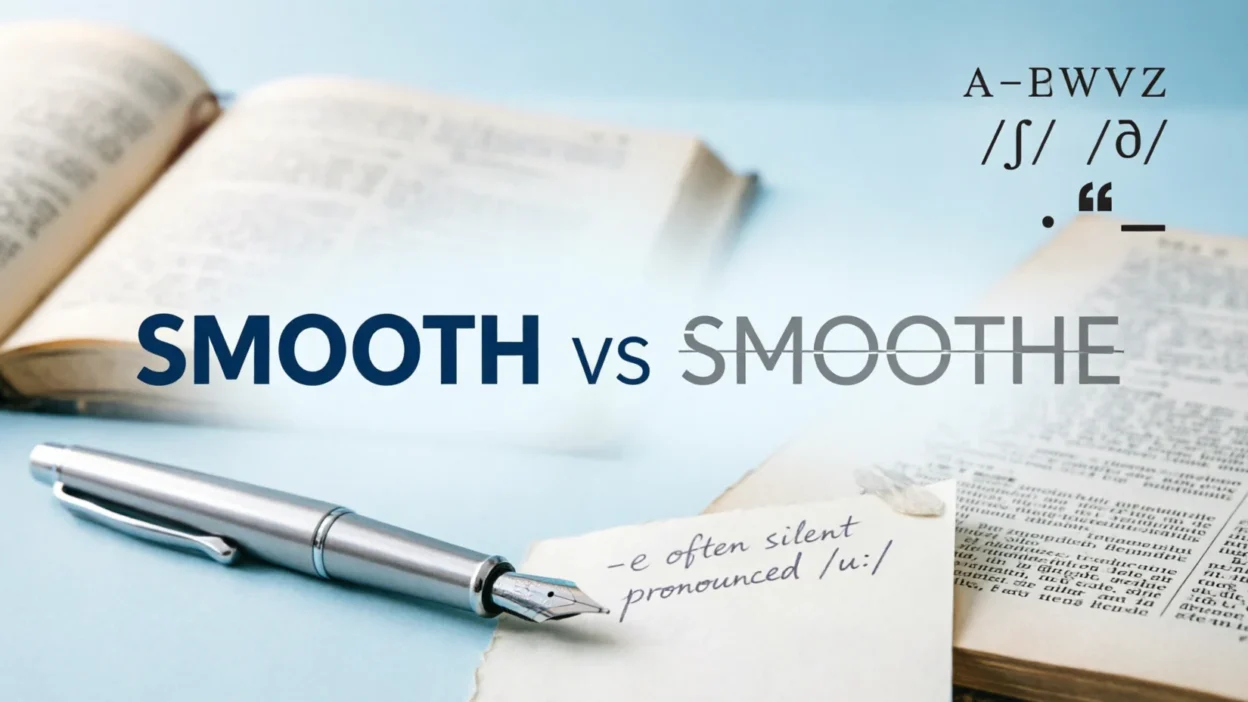
If you are wondering if smooth or smoothe is correct, the standard English spelling is smooth. It can be an adjective, verb, or noun depending on how it is used. Smoothe is generally considered a nonstandard or obsolete spelling and is not normally used in modern English. For example, we write, “This fabric feels smooth,” and “She smoothed the paper.”
The confusion often comes from the pronunciation and from the way English forms verbs. Some learners expect a verb ending in -e, especially when they see words such as breathe, move, or close. However, smooth already functions as a verb without adding an extra e. Learning the correct spelling is useful for students, writers, ESL learners, and anyone who wants to avoid a common spelling mistake.
Quick Answer
Smooth is the correct and standard spelling in modern English. It can describe something even, soft, calm, or effortless, and it can also mean to make something smoother. Smoothe is not normally used in contemporary standard English. Write smooth, smooths, smoothed, and smoothing.
Why Do People Confuse “Smooth” and “Smoothe”?
People may write smoothe because they assume the verb needs a final -e. This can happen because many English verbs end in -e, such as bake, move, and use.
However, smooth is already a complete word. When used as a verb, it does not need an extra e.
- Correct: Please smooth the surface.
- Incorrect in standard modern English: Please smoothe the surface.
The correct forms include:
- smooth
- smooths
- smoothed
- smoothing
Is “Smooth” the Correct Word?
Yes. Smooth is the standard spelling used in modern English.
It can describe a surface that has no roughness:
The table has a smooth surface.
It can also describe something calm or effortless:
We had a smooth journey.
As a verb, it means to make something even, flat, or less rough:
She smoothed the wrinkles from her dress.
What About “Smoothe”?
Smoothe is not the usual spelling in contemporary standard English. You may occasionally encounter it in historical texts, dictionaries discussing older forms, names, or unusual contexts, but it is not the spelling you should normally choose in modern writing.
For everyday English, use smooth.
Smooth vs. Smoothe: Comparison Table
| Word | Standard Modern English? | Common Use | Example |
| smooth | Yes | Adjective, verb, noun | The surface is smooth. |
| smoothe | No, generally nonstandard/obsolete | Rare or historical usage | Avoid it in ordinary modern writing. |
When Should You Use “Smooth”?
Use smooth when you mean something is even, soft, polished, calm, or effortless.
As an adjective
- The road is smooth.
- She has smooth skin.
- The sauce has a smooth texture.
- He gave a smooth presentation.
As a verb
- Smooth the paper before folding it.
- She smoothed her dress.
- He smoothed the surface with his hand.
As a noun
The noun smooth is less common but can occur in specific expressions or technical contexts.
10+ Examples of “Smooth”
- The stone feels smooth.
- She has smooth hair.
- The machine provides a smooth performance.
- We had a smooth flight.
- Please smooth the paper.
- He smoothed the blanket.
- She smoothed the wrinkles from her shirt.
- The cream leaves your skin feeling smooth.
- The road became smooth after the repairs.
- The meeting went smoothly.
- He used a tool to smooth the wood.
- Their transition into the new system was smooth.
Notice that the verb remains smooth rather than becoming smoothe.
Common Mistakes With Smooth
Mistake 1: Adding an unnecessary “e”
❌ She smoothe the paper.
✅ She smooths the paper.
Mistake 2: Writing “smoothe” as the base verb
❌ Please smoothe the surface.
✅ Please smooth the surface.
Mistake 3: Confusing “smooth” and “smoothly”
Smooth is commonly an adjective, while smoothly is an adverb.
- The process was smooth.
- The process went smoothly.
Mistake 4: Confusing “smooth” with “soothe”
Soothe is a different word. It means to calm, comfort, or relieve.
- The lotion smooths the skin.
- Her voice soothes the baby.
Memory Trick: Remember “Smooth”
A simple way to remember the spelling is:
Smooth = S-M-O-O-T-H
Think of the two o’s as a smooth path through the middle of the word. There is no extra “e” at the end.
Remember:
Smooth is smooth without an extra e.
American vs. British English
There is no important American-versus-British spelling difference between smooth and smoothe in standard modern English.
Both American and British English normally use:
- smooth
- smooths
- smoothed
- smoothing
- smoothly
So whether you are writing for an American or British audience, smooth is the appropriate standard spelling.
Similar Words to Smooth
Several words are related to smooth, but they have different meanings.
- Soothe — to calm or comfort someone.
- Polish — to make something shiny or refined.
- Flatten — to make something flat.
- Even — to make something level or uniform.
- Refine — to improve something by making it more precise or polished.
- Silky — very soft and smooth in texture.
- Sleek — smooth, polished, and often stylish in appearance.
For example:
The fabric is smooth.
The music soothes me.
These words may sound somewhat similar, but they should not be confused.
Final Verdict: Smooth or Smoothe?
Smooth is the correct spelling for normal modern English. It works as an adjective and verb and appears in forms such as smooths, smoothed, smoothing, and smoothly.
Smoothe should generally be avoided in contemporary standard writing. If you are writing an essay, email, article, school assignment, or professional document, choose smooth.
FAQs:
Is “smooth” or “smoothe” correct?
Smooth is the standard modern English spelling. Smoothe is generally considered nonstandard or obsolete and should normally be avoided in contemporary writing.
Is “smoothe” a real word?
Smoothe can be found in some historical or unusual uses, but it is not the standard modern spelling. In ordinary contemporary English, use smooth.
Is “smooth” a verb?
Yes. Smooth can be a verb meaning to make something even, flat, or less rough.
She smoothed the paper with her hand.
What is the past tense of smooth?
The past tense is smoothed, not smoothe.
He smoothed the surface carefully.
What is the present participle of smooth?
The present participle is smoothing.
She is smoothing the fabric.
Is “smoothly” related to “smooth”?
Yes. Smoothly is the adverb formed from smooth. It commonly describes an action or process that happens easily or without problems.
Everything went smoothly.
What is the difference between smooth and soothe?
Smooth means to make something even or to describe something without roughness. Soothe means to calm, comfort, or relieve.
This cream smooths the skin.
Her words soothed him.
Remember This
Smooth = correct standard spelling
Smoothe = generally avoid in modern English
Use smooth for surfaces, textures, movements, processes, and actions:
Smooth the paper.
The surface is smooth.
The project went smoothly.
Conclusion
When choosing between smooth and smoothe, use smooth in modern standard English. It is a versatile word that can function as an adjective, verb, and, in some contexts, a noun. Its common forms include smooths, smoothed, smoothing, and smoothly.
Although smoothe may appear in older or unusual sources, it is not the normal spelling for contemporary English. Remember that the correct verb is simply smooth, without an extra e. This small spelling detail can help make your everyday writing clearer and more accurate.