
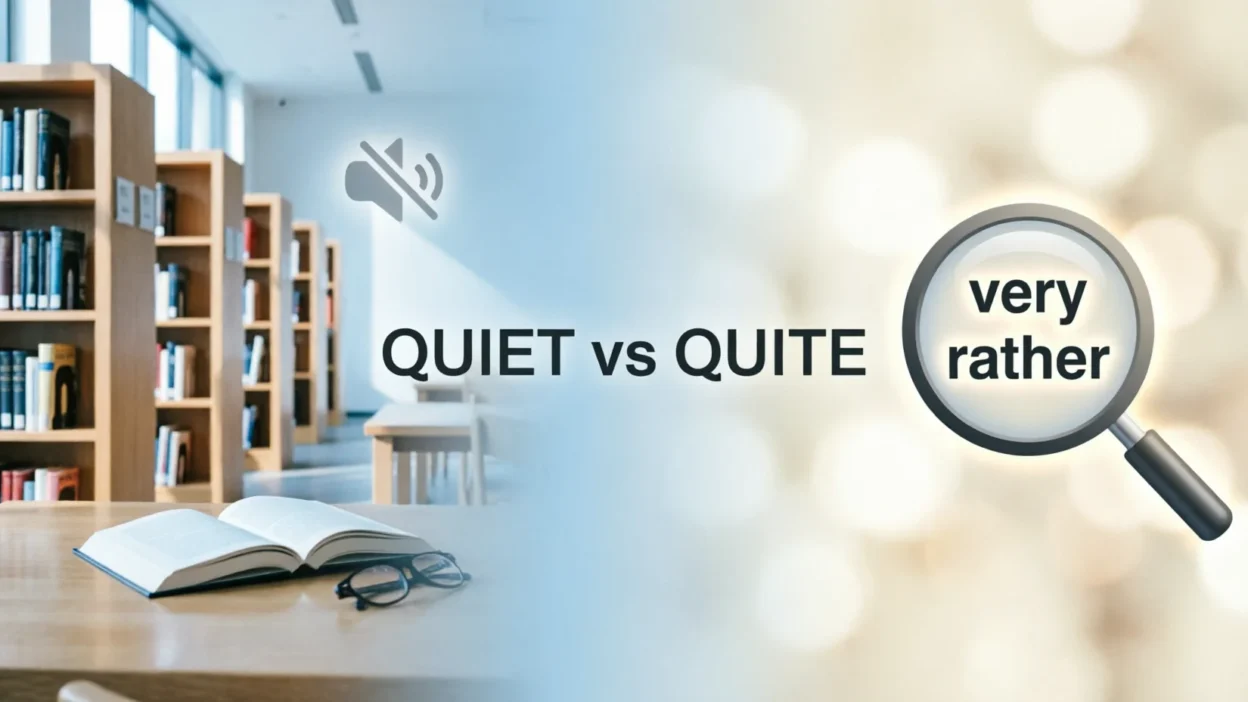
If you are confused about quiet or quite, you are not alone. These two words look and sound similar, but they have completely different meanings and grammatical uses. Quiet means making little or no noise, while quite usually means “fairly,” “rather,” or “completely,” depending on the context.
For example, “The library is quiet” means there is little noise, while “The movie was quite interesting” means the movie was fairly or very interesting.
Understanding the difference between quiet and quite is important for clear English writing and speaking. A small spelling mistake can change the meaning of an entire sentence. In this guide, you will learn the meanings, pronunciations, grammar, examples, common mistakes, and an easy memory trick to help you choose the correct word every time.
Quick Answer
Quiet means having little or no noise, while quite is an adverb meaning fairly, rather, very, or completely, depending on the sentence. Use quiet when talking about sound or silence: “Please be quiet.” Use quite to modify an adjective, adverb, or verb: “She is quite happy.”
Why Do People Confuse Quiet and Quite?
People often confuse quiet and quite because they contain the same four letters, with only the position of e and i changing.
They also sound somewhat similar when spoken quickly. However, their meanings are very different:
- Quiet → related to silence or little noise.
- Quite → describes degree, extent, or intensity.
- Quiet is commonly an adjective.
- Quite is an adverb.
A useful way to avoid confusion is to focus on the meaning rather than just the spelling.
What Does “Quiet” Mean?
Quiet means having little or no noise. It can describe a person, place, situation, or period of time.
It can also describe someone who does not talk much.
Examples of “Quiet”
- The classroom is quiet.
- Please keep quiet during the exam.
- We live on a quiet street.
- He is a quiet person.
- The baby is finally quiet.
- I enjoy spending time in quiet places.
Quiet can also be used as a verb:
Please quiet the children.
Here, quiet means to make someone or something less noisy.
What Does “Quite” Mean?
Quite is an adverb. It is used to show degree or intensity.
Depending on context and variety of English, it can mean fairly, rather, very, or completely.
Examples of “Quite”
- The test was quite easy.
- She is quite talented.
- I am quite tired today.
- That restaurant is quite popular.
- He speaks English quite well.
- The answer is quite clear.
The exact strength of quite depends on the context and the adjective or expression it modifies.
Quiet vs Quite: Comparison Table
| Word | Meaning | Part of Speech | Example |
| Quiet | Having little or no noise | Adjective | The room is quiet. |
| Quiet | Make less noisy | Verb | Please quiet the children. |
| Quite | Fairly, rather, very, or completely | Adverb | The book is quite interesting. |
| Quite | To a certain degree or extent | Adverb | I quite understand. |
When Should You Use “Quiet”?
Use quiet when you are talking about noise, silence, calmness, or someone who does not speak much.
Use “quiet” for:
- A silent room
- A peaceful neighborhood
- A person who talks little
- A calm environment
- Reducing noise
For example:
The library is quiet.
This means the library has very little noise.
My brother is quiet.
This means your brother does not talk very much.
When Should You Use “Quite”?
Use quite when you want to modify another word and express degree or extent.
It commonly appears before adjectives and adverbs.
Use “quite” with:
- Adjectives: quite good
- Adverbs: quite slowly
- Descriptions: quite beautiful
- Opinions: quite interesting
- Expressions of degree: quite difficult
For example:
The exam was quite difficult.
Here, quite tells us about the degree of difficulty.
Quiet or Quite: 12+ Examples
Here are practical examples that show the difference clearly:
- Please be quiet in the library.
- This is a quiet neighborhood.
- The children became quiet after lunch.
- She is a very quiet student.
- The park is usually quiet in the morning.
- The movie was quite interesting.
- He is quite good at mathematics.
- The journey was quite long.
- I am quite sure about the answer.
- This question is quite difficult.
- She speaks quite clearly.
- The room became quiet after everyone left.
- We were quite surprised by the result.
- He prefers a quiet place to study.
Notice that quiet describes noise or a lack of noise, while quite describes degree.
Common Mistakes with Quiet and Quite
One of the most common mistakes is using quite when you mean quiet.
Incorrect:
Please be quite.
Correct:
Please be quiet.
The first sentence does not mean “stop making noise.” Quiet is the correct word.
Another common mistake is reversing the words:
Incorrect:
The movie was quiet interesting.
Correct:
The movie was quite interesting.
Here, quite modifies the adjective interesting.
More Examples
❌ It is a quite street.
✅ It is a quiet street.
❌ She is quiet talented.
✅ She is quite talented.
❌ Please remain quite.
✅ Please remain quiet.
Easy Memory Trick for Quiet vs Quite
Here is a simple trick:
Quiet = silence.
Think of the “e” at the end as helping the word “settle down” into silence.
Quite = degree.
Think of quite as a word that tells you how much or to what extent.
You can also remember:
Quiet has “quiet” sounds. Quite has “quite a lot” of something.
When the sentence is about noise, choose quiet.
When the sentence is about degree, choose quite.
American vs British English
The meanings of quiet are generally the same in American and British English.
Quite, however, can sometimes differ in strength depending on context and variety of English. In British English, quite can often mean “fairly” or “rather,” while in some contexts it can mean “completely” or “very.”
For example:
The film was quite good.
Depending on the speaker and context, this may suggest that the film was fairly good or very good.
The safest approach is to consider the surrounding words and the speaker’s intended meaning.
Similar Words to Quiet
Several words are related to quiet, but they are not always interchangeable.
- Silent — completely or almost completely without sound
- Calm — peaceful and without disturbance
- Peaceful — free from noise, conflict, or disturbance
- Still — not moving or making a disturbance
- Mute — not producing sound or speech
For example:
The room was silent.
This generally suggests an even stronger absence of sound than quiet.
Similar Words to Quite
Depending on the context, words similar to quite include:
- Fairly
- Rather
- Very
- Completely
- Really
- Somewhat
However, these words are not always exact replacements. The meaning of quite depends heavily on the sentence.
For example:
The test was quite difficult.
Possible alternatives include:
The test was rather difficult.
or
The test was fairly difficult.
The exact meaning can change slightly.
Final Verdict: Quiet or Quite?
The correct word depends on what you mean.
Use quiet when talking about little or no noise, silence, calmness, or someone who does not talk much.
Use quite when expressing degree or extent, usually before an adjective or adverb.
Remember:
- Quiet = little or no noise
- Quite = fairly, rather, very, or completely
- Quiet can be an adjective or verb.
- Quite is an adverb.
So, if you want someone to stop making noise, say:
“Please be quiet.”
If you want to describe the degree of something, say:
“The book is quite interesting.”
FAQs:
Is it “be quiet” or “be quite”?
The correct phrase is “be quiet.” It means to stop making noise or to remain silent. Quite does not have this meaning.
Is quiet an adjective or an adverb?
Quiet is most commonly an adjective, as in “a quiet room.” It can also be used as a verb, as in “quiet the baby.”
Is quite an adjective?
No. Quite is an adverb. It commonly modifies adjectives and adverbs, as in “quite interesting” or “quite slowly.”
What is the difference between quiet and quite?
Quiet relates to silence or low noise. Quite expresses degree or extent and can mean fairly, rather, very, or completely depending on context.
How do you pronounce quiet and quite?
Quiet is generally pronounced with two syllables, approximately “KWY-uht.” Quite is pronounced with one syllable, approximately “KWYTE.”
Can quiet be a verb?
Yes. Quiet can be a verb meaning to make something or someone less noisy, as in “The teacher tried to quiet the class.”
Does quite mean very?
Sometimes. Quite can mean “very” in certain contexts, but its exact strength depends on the sentence, variety of English, and surrounding words.
Is “quite good” positive?
Usually, yes. Quite good generally indicates that something is good to a noticeable degree, although the exact strength can vary with context and speaker.
Remember This
Quiet = no or little noise.
Quite = degree or extent.
If you can replace the word with silent or not noisy, choose quiet.
If you can replace it with fairly, rather, very, or completely, quite may be the correct choice.
Conclusion
The difference between quiet and quite is simple once you connect each word with its meaning. Quiet describes a lack of noise, a peaceful environment, or someone who does not talk much. Quite is an adverb used to express degree or extent, and its meaning can range from “fairly” or “rather” to “very” or “completely,” depending on context.
The easiest way to remember the difference is to ask yourself what the sentence is describing. If it concerns sound or silence, use quiet. If it describes how much, how strongly, or to what extent, use quite. With these simple rules and examples, you can confidently choose the correct word in everyday English.

Evelyn Mia is a passionate language writer and vocabulary enthusiast at Synomity.com, specializing in synonyms, word meanings, and language learning. She creates informative content that helps readers expand vocabulary and communicate more effectively.