Looking for solstice synonyms can help you understand and describe this important astronomical event in different ways.
The word solstice has a specific scientific meaning, so it does not have many perfect one-word synonyms.
However, several related terms can describe its timing, seasonal meaning, astronomical position, or connection to the changing length of daylight.
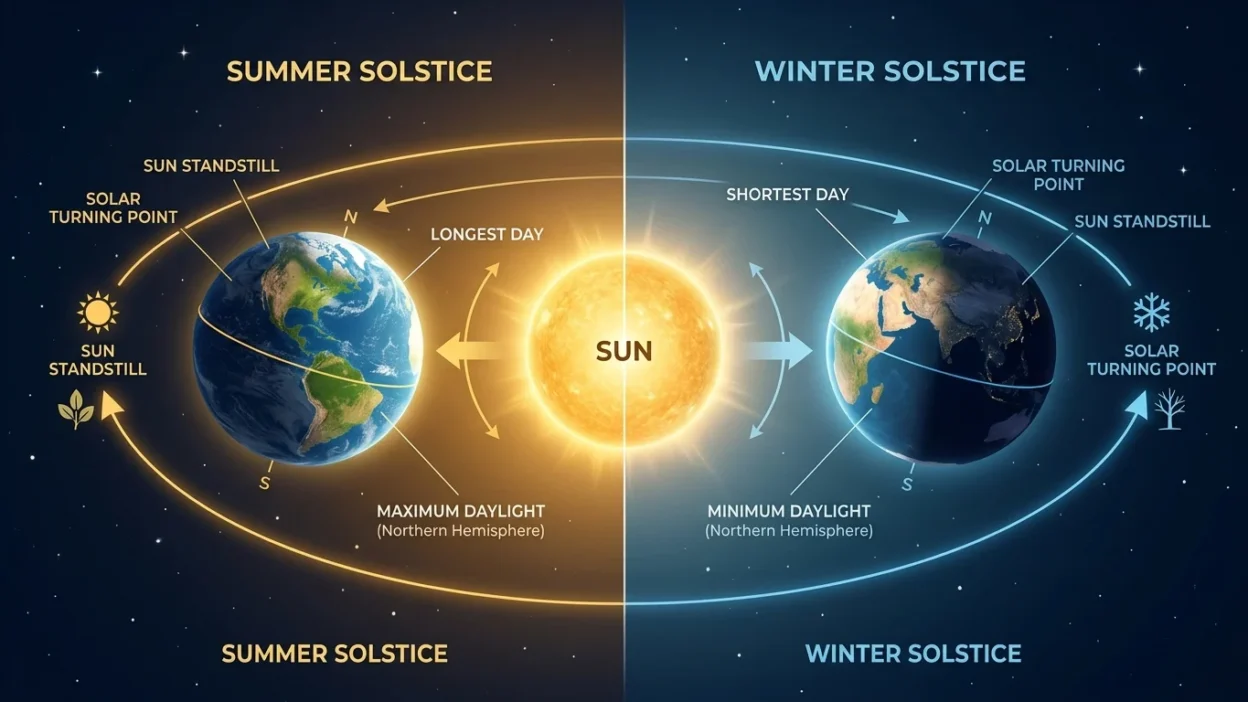
A solstice occurs twice each year, around June and December. It marks the time when one hemisphere experiences its longest day or shortest day of the year.
The June event is commonly called the summer solstice, while the December event is known as the winter solstice.
This guide explains 30 synonyms, near-synonyms, and closely related terms connected with solstice.
Each term includes a simple meaning, an example sentence, and the best context for using it.
This makes the article useful for students, ESL learners, writers, content creators, and anyone who wants to improve their vocabulary about seasons and astronomy.
What Does Solstice Mean?
Simple Definition of Solstice
A solstice is one of the two times each year when the Sun reaches its greatest apparent distance north or south of the equator. These events produce the longest day or the shortest day of the year in each hemisphere.
In simple English, a solstice is a special point in the year when daylight reaches its maximum or minimum length.
Example Sentence
Many people celebrate the summer solstice because it brings the longest day of the year.
Tone and Usage Context
The word solstice is mainly used in scientific, educational, astronomical, cultural, and literary contexts. It sounds formal and precise.
For example:
- Scientific: The winter solstice occurs when one hemisphere is tilted farthest away from the Sun.
- Educational: The solstice marks an important seasonal change.
- Literary: The golden light of the solstice filled the landscape.
Because solstice is a specialized astronomical term, many alternatives are related expressions rather than exact synonyms.
30 Solstice Synonyms and Related Terms
1. Seasonal Turning Point
Meaning: A significant point when one season changes into another phase.
Example sentence: The summer solstice is often viewed as a seasonal turning point.
Best usage context: Use this phrase in general, educational, or descriptive writing.
2. Solar Turning Point
Meaning: A major point in the yearly movement of the Sun’s apparent position.
Example sentence: The winter solstice represents an important solar turning point.
Best usage context: Best for astronomy-related explanations.
3. Sun Turning Point
Meaning: A point when the Sun appears to reach an extreme position before changing direction.
Example sentence: Ancient observers carefully watched the sun turning point each year.
Best usage context: Useful for simple explanations and historical writing.
4. Sun Standstill
Meaning: A period when the Sun appears to stop moving northward or southward before reversing direction.
Example sentence: The term sun standstill helps explain the origin of the word solstice.
Best usage context: Best for astronomy and etymology discussions.
5. Solar Standstill
Meaning: The apparent pause in the Sun’s movement at its northernmost or southernmost position.
Example sentence: The solar standstill marks an important moment in the annual solar cycle.
Best usage context: Suitable for scientific and educational writing.
6. Longest Day
Meaning: The day with the greatest amount of daylight in a particular year.
Example sentence: The summer solstice is commonly known as the longest day of the year.
Best usage context: Use when referring specifically to the summer solstice.
7. Shortest Day
Meaning: The day with the least amount of daylight in a particular year.
Example sentence: The winter solstice is often called the shortest day.
Best usage context: Use when describing the winter solstice.
8. Midyear Solar Event
Meaning: A solar event occurring around the middle of the year.
Example sentence: The June solstice is an important midyear solar event.
Best usage context: Useful for educational and descriptive writing.
9. Midwinter Solar Event
Meaning: A solar event that occurs during the middle of winter.
Example sentence: The December solstice is a significant midwinter solar event.
Best usage context: Best for discussions of the winter solstice.
10. Seasonal Extreme
Meaning: A point representing an extreme in seasonal daylight or solar position.
Example sentence: The solstice is a seasonal extreme in the annual cycle of daylight.
Best usage context: Useful in scientific and analytical writing.
11. Solar Extreme
Meaning: A point when the Sun reaches an apparent northernmost or southernmost position.
Example sentence: The solstice occurs at a solar extreme in the Sun’s yearly apparent path.
Best usage context: Best for astronomy and science writing.
12. Annual Solar Milestone
Meaning: An important point in the yearly cycle of the Sun and seasons.
Example sentence: The summer solstice is an annual solar milestone recognized around the world.
Best usage context: Useful for educational and general-interest content.
13. Seasonal Milestone
Meaning: An important point that marks progress through the seasons.
Example sentence: The winter solstice is an important seasonal milestone.
Best usage context: Suitable for blogs, articles, and educational writing.
14. Solar Cycle Marker
Meaning: An event that marks a stage in the yearly cycle of the Sun.
Example sentence: The solstice acts as a solar cycle marker for changing daylight patterns.
Best usage context: Best for science and astronomy explanations.
15. Astronomical Milestone
Meaning: An important event or point in the movement of celestial bodies.
Example sentence: The solstice is an important astronomical milestone every year.
Best usage context: Useful in formal scientific writing.
16. Celestial Turning Point
Meaning: A major change or reversal in the apparent movement of a celestial object.
Example sentence: The solstice can be described as a celestial turning point.
Best usage context: Best for astronomy, educational, and literary writing.
17. Solar Reversal Point
Meaning: A point when the apparent northward or southward movement of the Sun changes direction.
Example sentence: The solstice marks a solar reversal point in the Sun’s apparent annual path.
Best usage context: Useful in technical explanations.
18. Seasonal Peak
Meaning: A point representing the highest or lowest level of a seasonal feature.
Example sentence: The summer solstice marks the seasonal peak of daylight.
Best usage context: Best for explaining the longest or shortest daylight period.
19. Daylight Peak
Meaning: The point when daylight reaches its greatest annual length.
Example sentence: The June solstice represents the daylight peak in the Northern Hemisphere.
Best usage context: Use specifically for the summer solstice.
20. Daylight Minimum
Meaning: The point when daylight reaches its shortest annual length.
Example sentence: The December solstice marks the daylight minimum in the Northern Hemisphere.
Best usage context: Use when describing the winter solstice.
21. Solar Season Marker
Meaning: A solar event that helps mark the beginning or development of a seasonal period.
Example sentence: The solstice is an important solar season marker.
Best usage context: Suitable for educational and cultural writing.
22. Astronomical Season Marker
Meaning: An astronomical event used to identify a major seasonal point.
Example sentence: The solstice serves as an astronomical season marker.
Best usage context: Best for astronomy and geography lessons.
23. Seasonal Boundary
Meaning: A point that helps separate one seasonal phase from another.
Example sentence: Many calendars treat the solstice as an important seasonal boundary.
Best usage context: Useful in general and educational writing.
24. Solar Calendar Marker
Meaning: An astronomical event used to track the yearly calendar.
Example sentence: Ancient civilizations used the solstice as a solar calendar marker.
Best usage context: Best for history, culture, and astronomy topics.
25. Yearly Solar Event
Meaning: A solar event that occurs once during the annual cycle.
Example sentence: The solstice is a yearly solar event that affects the length of daylight.
Best usage context: Suitable for simple science explanations.
26. Annual Celestial Event
Meaning: A recurring event involving the movement or position of a celestial body.
Example sentence: The solstice is an annual celestial event observed across the world.
Best usage context: Use in astronomy and general educational writing.
27. Sun Cycle Marker
Meaning: A point that marks a stage in the apparent yearly cycle of the Sun.
Example sentence: The solstice serves as a useful sun cycle marker.
Best usage context: Best for beginner-friendly explanations.
28. Seasonal Peak Point
Meaning: A point at which a seasonal condition reaches its highest or lowest level.
Example sentence: The summer solstice is the seasonal peak point for daylight hours.
Best usage context: Useful for explanatory writing.
29. Solar Seasonal Event
Meaning: An event involving the Sun that is connected to seasonal change.
Example sentence: The winter solstice is a major solar seasonal event.
Best usage context: Suitable for science, culture, and educational content.
30. Astronomical Turning Point
Meaning: A significant point in the apparent movement of a celestial body.
Example sentence: The solstice is an astronomical turning point in the annual solar cycle.
Best usage context: Best for formal and educational writing.
Comparison Guide: When to Use Different Solstice Synonyms
| Related Term | Main Idea | Best Use |
|---|---|---|
| Solstice | Precise astronomical event | Scientific and standard writing |
| Sun standstill | Apparent pause in the Sun’s movement | Astronomy and etymology |
| Longest day | Maximum daylight | Summer solstice |
| Shortest day | Minimum daylight | Winter solstice |
| Seasonal turning point | Change in seasonal phase | General writing |
| Solar turning point | Change in the Sun’s apparent movement | Astronomy |
| Solar standstill | Apparent pause of the Sun | Technical science writing |
| Seasonal milestone | Important point in the yearly cycle | Blogs and educational writing |
| Astronomical milestone | Important celestial event | Formal science writing |
| Daylight peak | Maximum annual daylight | Summer solstice |
| Daylight minimum | Minimum annual daylight | Winter solstice |
| Celestial turning point | Significant astronomical change | Astronomy and literary writing |
Solstice vs. Equinox: What Is the Difference?
A solstice and an equinox are both important astronomical events, but they are not the same.
A solstice occurs when one hemisphere experiences its longest or shortest day of the year.
An equinox occurs when day and night are approximately equal in length.
Simple Comparison
- Solstice: Longest or shortest daylight period.
- Equinox: Nearly equal day and night.
The summer and winter solstices mark the two extreme points of annual daylight. The spring and autumn equinoxes mark periods of nearly balanced daylight and darkness.
Summer Solstice and Winter Solstice
Summer Solstice
The summer solstice is the longest day of the year in a particular hemisphere. It occurs when that hemisphere is tilted most toward the Sun.
For example, the June solstice is the summer solstice in the Northern Hemisphere.
Winter Solstice
The winter solstice is the shortest day of the year in a particular hemisphere. It occurs when that hemisphere is tilted farthest away from the Sun.
For example, the December solstice is the winter solstice in the Northern Hemisphere.
Because the seasons are opposite in the two hemispheres, a summer solstice in one hemisphere occurs at the same time as a winter solstice in the other.
How to Choose the Right Synonym for Solstice
The best alternative depends on your purpose, audience, and tone.
For Scientific and Academic Writing
Use:
- Solstice
- Solar standstill
- Solar turning point
- Astronomical milestone
- Astronomical turning point
- Solar cycle marker
These terms are best when accuracy and technical meaning are important.
For Simple Explanations
Use:
- Longest day
- Shortest day
- Seasonal milestone
- Yearly solar event
- Sun cycle marker
- Seasonal turning point
These expressions are easier for beginners and ESL learners.
For Summer Solstice Descriptions
Use:
- Longest day
- Daylight peak
- Seasonal peak
- Solar extreme
- Annual solar milestone
These terms emphasize the maximum amount of daylight.
For Winter Solstice Descriptions
Use:
- Shortest day
- Daylight minimum
- Midwinter solar event
- Seasonal extreme
- Solar turning point
These terms are useful when discussing the year’s minimum daylight.
For Historical and Cultural Writing
Use:
- Solar calendar marker
- Seasonal boundary
- Seasonal milestone
- Solar seasonal event
- Annual celestial event
These expressions work well when discussing ancient calendars, traditions, celebrations, and cultural practices.
For Literary or Descriptive Writing
Use:
- Celestial turning point
- Seasonal turning point
- Solar milestone
- Seasonal peak
- Astronomical turning point
These phrases can make writing sound more vivid without losing the main idea.
Why Context Matters When Using Solstice Synonyms
The word solstice has a very specific astronomical meaning. As a result, most alternatives are not exact replacements.
For example, longest day describes the result of the summer solstice but does not describe the complete astronomical event itself. Similarly, seasonal milestone is a broad phrase that can refer to many important points in the year.
Scientific Example
The summer solstice occurs when the Northern Hemisphere is tilted most toward the Sun.
This sentence requires the precise term solstice.
Simple Example
The summer solstice is the longest day of the year.
This version is easier for beginners.
Descriptive Example
The summer solstice marks a powerful seasonal turning point.
This sentence uses a related expression for a more literary tone.
Common Questions About Solstice Synonyms
What is the closest synonym for solstice?
There is no perfect everyday synonym for solstice. Solar standstill is one of the closest related expressions because the word solstice refers to the apparent standing still of the Sun before its apparent movement changes direction.
What is another word for summer solstice?
Depending on the context, related expressions include longest day, daylight peak, summer solar event, and seasonal turning point.
What is another word for winter solstice?
Related expressions include shortest day, daylight minimum, midwinter solar event, and seasonal turning point.
Is equinox a synonym for solstice?
No. An equinox is a different astronomical event. An equinox occurs when day and night are approximately equal in length, while a solstice marks the longest or shortest day of the year.
Is sun standstill a synonym for solstice?
It is a close related expression, but it is not always used as a direct replacement. It describes the apparent pause in the Sun’s movement that gives the word solstice its meaning.
Why are there not many exact solstice synonyms?
Because solstice is a specialized astronomical term. Technical words often have fewer exact synonyms because changing the word can change the scientific meaning.
Final Thoughts on Solstice Synonyms
Understanding solstice synonyms is useful for improving vocabulary, writing clearly, and explaining astronomical ideas in different ways. The word solstice itself is the most accurate term for the astronomical event, but related expressions can help you communicate its meaning to different audiences.
The key is to choose a term that matches your meaning. Use solstice when you need scientific precision, and use a related phrase when you want to emphasize daylight, seasonal change, cultural importance, or the Sun’s apparent movement.

Evelyn Mia is a passionate language writer and vocabulary enthusiast at Synomity.com, specializing in synonyms, word meanings, and language learning. She creates informative content that helps readers expand vocabulary and communicate more effectively.