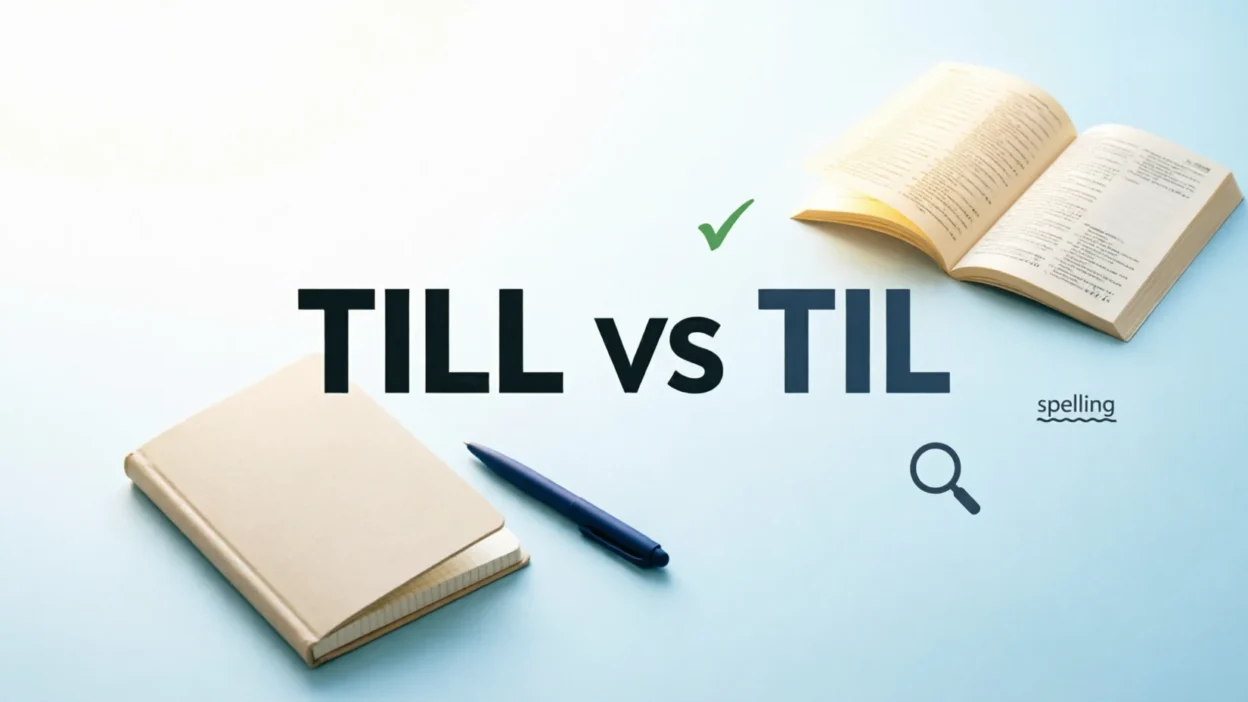
If you are wondering if “till” or “til” is correct, the answer is simple: “till” is the standard English word when you mean “up to a particular time.” For example, “I will wait till Monday” is correct. “Til” is sometimes used informally as a shortened form of “until,” especially in casual writing, but it is not the standard spelling in formal English. There is also “’til,” which is a traditional informal contraction of “until.”
The confusion happens because “till” and “until” have the same meaning in many sentences, while “til” looks like a natural shortened version. For students, ESL learners, and anyone trying to improve their English writing, knowing when each form is appropriate can prevent spelling and usage mistakes. This guide explains till vs. til, their meanings, correct usage, examples, and the difference between “till,” “until,” and “’til.”
Quick Answer
“Till” is the standard spelling when you mean “until” or “up to a particular time.” “Til” is commonly seen in informal writing but is generally not preferred in standard English. “’Til” is an informal contraction of “until.” For formal writing, use “till” or “until.”
Why Do People Confuse “Till” and “Til”?
People often confuse these words because “till” and “until” have the same meaning when referring to time.
For example:
- I will stay till 6 p.m.
- I will stay until 6 p.m.
Both sentences are correct.
The confusion increases because some people shorten “until” to “til” in casual writing. However, dropping the apostrophe does not make “til” the preferred standard spelling.
What Does “Till” Mean?
Till is a standard English word that can function as a preposition or conjunction. When referring to time, it means “until” or “up to the time when something happens**.
Examples of “Till”
- Wait till I come back.
- The shop is open till 9 p.m.
- She worked till midnight.
- Stay here till tomorrow.
- I didn’t know the truth till yesterday.
“Till” can be used naturally in both everyday and standard written English.
What Does “Til” Mean?
Til is commonly used as an informal shortening of “until,” particularly in casual writing, social media, song titles, advertising, and conversational contexts.
However, “til” is generally not the preferred form in formal standard English.
If you want to write clearly and conventionally, choose:
- until
- till
- ’til when an informal contraction is appropriate
Instead of plain til.
Till vs. Til: Comparison Table
| Word | Meaning | Standard English? | Best Use |
| till | Until; up to a time | Yes | General and formal writing |
| til | Informal shortening of until | Informal | Casual writing |
| ’til | Informal contraction of until | Informal | Casual or stylistic writing |
| until | Up to a particular time | Yes | Formal and general writing |
When Should You Use “Till”?
Use till when you mean “until” or “up to a certain time.”
Use “till” for time
- Wait till Friday.
- I will stay till noon.
- Don’t leave till I arrive.
- The office remains open till 5 p.m.
Is “Till” Formal Enough?
Yes. Till is a standard English word, not simply an incorrect shortening of “until.”
For example:
We waited till the rain stopped.
This is grammatically correct.
If you want a slightly more formal tone, you can use until:
We waited until the rain stopped.
When Should You Use “Til”?
Use til only when you intentionally want an informal or stylistic form.
For everyday formal writing, it is safer to avoid it.
Informal examples
- See you til tomorrow!
- I can’t wait til Friday.
- Stay strong til the end.
For standard writing, change these to:
- See you till tomorrow!
- I can’t wait until Friday.
- Stay strong till the end.
10+ Examples of “Till” and “Til”
Here are practical examples to make the difference easier to understand.
- I will wait till you arrive.
- She stayed at work till 8 p.m.
- Don’t open the door till I tell you.
- We played outside till sunset.
- He worked till midnight.
- The library is open till Saturday.
- I’ll be here till you return.
- They waited till the bus arrived.
- We won’t know the answer till tomorrow.
- She didn’t understand it till later.
- He promised to stay till the end.
- I can’t wait til the weekend. (informal)
In the final example, “til” is understandable, but “till” or “until” is preferable in standard writing.
Common Mistakes with “Till” and “Til”
Mistake 1: Assuming “til” is the standard spelling
❌ I will wait til Monday.
✅ I will wait till Monday.
Or:
✅ I will wait until Monday.
Mistake 2: Thinking “till” is incorrect
Some learners believe that till is a shortened or incorrect form of “until.” It is not. Till is an established standard English word.
Mistake 3: Using “til” in formal writing
In an academic essay, business document, or formal letter, use till or until instead.
Mistake 4: Confusing “’til” with “til”
’Til is an informal contraction. The apostrophe indicates that letters have been omitted from “until.”
Memory Trick: Think “TILL = Until”
A simple way to remember the correct standard spelling is:
TILL = UNTIL
Both can mean “up to a particular time.”
For example:
Wait till I call you.
Think of “till” as a complete standard word, not merely a shortened form.
If you see “til”, remember that it is generally an informal form and should be avoided in formal writing.
American English vs. British English
Both American and British English use till and until.
There is no major American-versus-British spelling difference that makes til the standard form in one variety.
For example, both varieties can use:
- I will stay till Monday.
- I will stay until Monday.
The informal ’til can also appear in casual or stylistic writing in both varieties.
Similar Words: Till, Until, and ’Til
These three forms are closely related but differ in standard usage.
Till
A standard word meaning until.
I’ll wait till noon.
Until
A standard word meaning up to a particular time.
I’ll wait until noon.
’Til
An informal contraction of until.
I’ll wait ’til noon.
Til
A commonly seen informal spelling without the apostrophe. It is best avoided when you want standard, polished English.
Final Verdict: Till or Til?
Till is the correct standard choice when you mean “until.”
Until is equally correct and is often a good choice in formal writing.
’Til is acceptable as an informal contraction when a casual or stylistic tone is intended.
Til, without the apostrophe, is commonly encountered informally, but it is not the preferred standard spelling.
So, if you are unsure, remember:
Use “till” or “until” in standard English.
FAQs:
Is “till” or “til” correct?
Till is the standard English spelling when you mean “until.” “Til” is commonly used informally, but it is generally better to use “till” or “until” in standard writing.
Is “til” a real word?
“Til” is widely used as an informal spelling of “until,” but it is not generally the preferred standard form. In formal writing, use till or until.
Is “’til” correct?
Yes. ’Til is an informal contraction of “until.” It can be used in casual or stylistic writing, but until or till is usually preferable in formal writing.
Is “till” a proper English word?
Yes. Till is a standard English word. When used to refer to time, it means “until” or “up to a particular time.”
Is “till” more informal than “until”?
Both are standard, but until can sometimes sound more formal or neutral. “Till” is also completely acceptable in ordinary writing and speech.
Can I use “till” in an academic essay?
Yes, but until may be a more natural choice in some formal contexts. “Till” itself is not grammatically incorrect or nonstandard.
Which is correct: “till tomorrow” or “til tomorrow”?
“Till tomorrow” is the standard form. “Til tomorrow” is informal and should generally be avoided in formal writing.
Remember This
- ✅ Till = standard English
- ✅ Until = standard English
- ✅ ’Til = informal contraction
- ⚠️ Til = informal spelling; avoid it in formal writing
- Till and until can usually be used interchangeably when referring to time.
Conclusion
The main difference between till and til is standard usage. Till is a fully established English word meaning “until,” while til is commonly used as an informal shortening. If you are writing an essay, email, article, application, or other polished text, till or until is the safer choice.
Remember that ’til is also found in informal English and can be appropriate when a casual style is intended. When in doubt, simply choose until. It is clear, standard, and widely accepted in both American and British English.

John Morrison is a dedicated content writer at Synomity.com, focused on synonyms, vocabulary development, and word meanings. He creates clear, educational resources that help readers improve language skills and communicate with confidence.