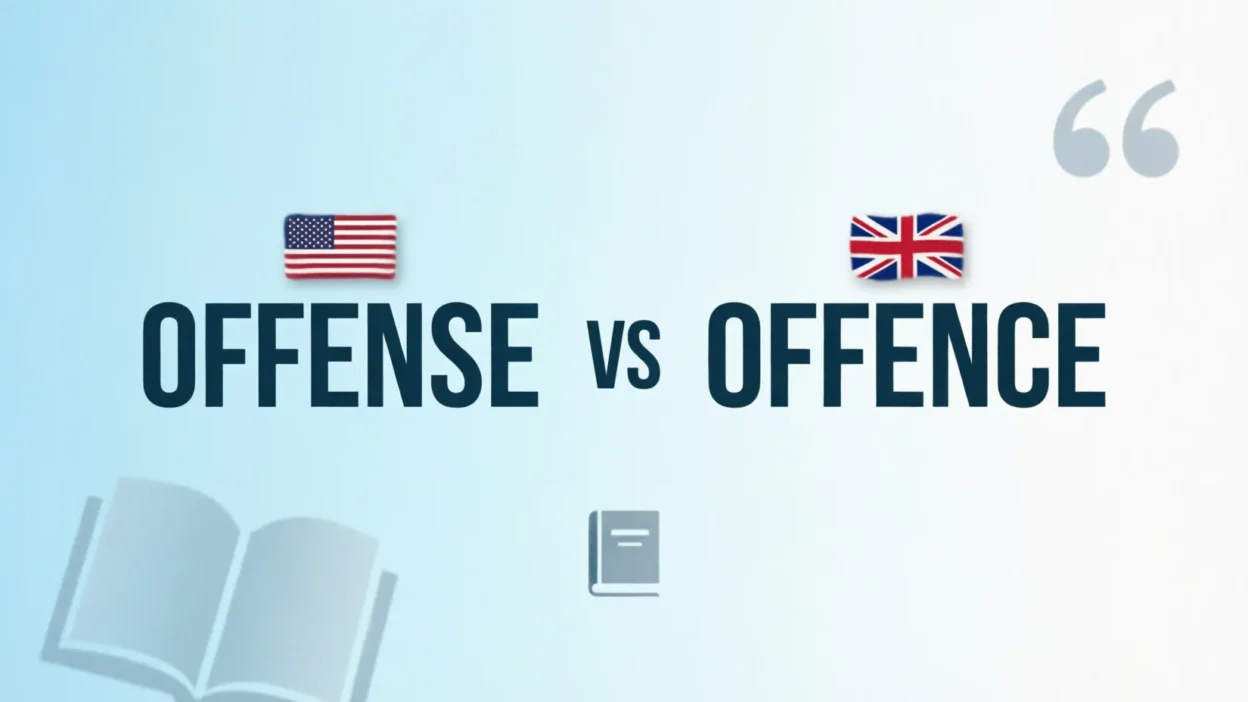
If you are wondering if offense or offence is correct, the answer is: both spellings are correct. The difference depends mainly on the variety of English you are using. Offense is the standard spelling in American English, while offence is the standard spelling in British English and is also common in other varieties influenced by British English.
Both words have the same meaning and pronunciation. They can refer to an act that breaks a law or rule, something that causes hurt or insult, or a team’s attacking play in sports. Choosing the right spelling is therefore mostly about following the English variety consistently.
Quick Answer
Offense is the preferred American English spelling, while offence is preferred in British English. They have the same meaning, pronunciation, and grammatical function. Use offense for American audiences and offence for British audiences or contexts that follow British spelling conventions.
Why Do People Confuse Offense and Offence?
People often confuse these spellings because the difference is only one letter: s versus c.
The pronunciation is essentially the same, and both forms come from the same word. The main distinction is regional spelling.
- Offense → American English
- Offence → British English
- Both → noun
- Both → same basic meaning
- Both → pronounced the same way
The same spelling pattern appears in other words:
- defense / defence
- license / licence
- pretense / pretence
This makes the difference easier to recognize once you understand the spelling pattern.
What Does “Offense” Mean?
Offense is the standard American English spelling of the noun. It can describe a crime, an insult, something that causes hurt feelings, or an attacking strategy in sports.
Examples
- He was charged with a serious offense.
- Her comment caused offense.
- The basketball team has a strong offense.
- No offense, but I disagree with you.
In American English, offense is the spelling you will normally see in newspapers, books, websites, legal writing, and everyday communication.
What Does “Offence” Mean?
Offence is the standard British English spelling of the same noun.
It has exactly the same core meanings as offense.
Examples
- He committed a criminal offence.
- She took offence at his remark.
- The team needs to improve its offence.
- This is a serious offence under the law.
You will commonly encounter offence in British English and in countries and institutions that follow British spelling conventions.
Offense vs Offence: Comparison Table
| Feature | Offense | Offence |
| English variety | American English | British English |
| Meaning | Same | Same |
| Pronunciation | Same | Same |
| Part of speech | Noun | Noun |
| Common use | U.S. English | U.K. English |
| Example | a criminal offense | a criminal offence |
| Related spelling | defense | defence |
When Should You Use “Offense”?
Use offense when writing in American English.
It is especially appropriate when your audience is primarily in the United States.
Examples
- The police investigated the offense.
- He was arrested for a minor offense.
- The comment caused considerable offense.
- I meant no offense.
- The team’s offense scored quickly.
- This is a federal offense.
- She apologized for giving offense.
- The player strengthened the team’s offense.
- The law defines the offense clearly.
- He did not intend to cause offense.
- The coach changed the team’s offense.
- The court considered the seriousness of the offense.
When Should You Use “Offence”?
Use offence when writing in British English.
It is also appropriate when following a style guide or institution that uses British spelling.
Examples
- He was convicted of a criminal offence.
- She took offence at the remark.
- The offence was reported to the police.
- I hope you take no offence.
- The team has a powerful offence.
- This is a serious offence.
- The law describes the offence in detail.
- He apologized for causing offence.
- The player improved the team’s offence.
- The court examined the nature of the offence.
- They were accused of committing an offence.
- The manager changed the team’s offence.
Common Mistakes With Offense and Offence
1. Mixing English varieties
One common mistake is switching between American and British spellings in the same piece of writing.
For example, if you write defence, you may want to use offence as well when following British English.
2. Thinking one spelling is wrong
Neither spelling is universally wrong.
Offense is correct in American English, while offence is correct in British English.
3. Confusing “offense” with “offend”
The noun is offense/offence, while the verb is offend.
- His words offended me.
- His words caused offense.
4. Confusing it with “offensive”
The adjective is offensive.
- That remark was offensive.
- The remark caused offense.
Memory Trick
A simple way to remember the difference is:
American = offense with S
British = offence with C
You can also connect it with another familiar pair:
defense → American
defence → British
So:
- American: defense, offense
- British: defence, offence
American vs British English
The main distinction is geographical and stylistic.
In American English, the spelling with -se is standard:
- offense
- defense
In British English, the spelling with -ce is standard:
- offence
- defence
The same regional pattern can appear in related words, although not every word follows exactly the same rule.
If you are writing for an international audience, choose one variety and use it consistently throughout your article or document.
Similar Words
Understanding related words can help you use offense/offence correctly.
- Offend — to cause someone to feel hurt, insulted, or upset.
- Offensive — causing offense or likely to insult.
- Offender — a person who commits an offense or offence.
- Offending — causing harm, annoyance, or offense.
- Defense/Defence — protection against attack or accusation.
- Crime — an act that violates criminal law.
- Violation — an act of breaking a rule, law, or agreement.
- Insult — a statement or action that shows disrespect.
Example
The offender committed a criminal offence, which was considered serious under the law.
Final Verdict: Offense or Offence?
Both offense and offence are correct spellings.
The difference is primarily based on the variety of English:
- Offense = American English
- Offence = British English
Neither form changes the meaning. If you are writing for an American audience, choose offense. If you are writing for a British audience, choose offence.
The most important thing is consistency. Do not switch between American and British spelling without a reason.
FAQs:
Is “offense” or “offence” correct?
Both are correct. Offense is the standard American English spelling, while offence is the standard British English spelling.
Is “offense” American or British?
Offense is primarily the American English spelling. British English generally uses offence.
Is “offence” British English?
Yes. Offence is the standard spelling in British English and is also used in other varieties that follow British spelling conventions.
Do offense and offence have the same meaning?
Yes. They have the same meaning and pronunciation. The difference is mainly a matter of regional spelling.
Which spelling should I use in the USA?
Use offense when writing in American English.
Which spelling should I use in the UK?
Use offence when writing in British English.
Is “defense” related to “offense”?
Yes. Both are commonly used as American/British spelling pairs:
- American: defense, offense
- British: defence, offence
How do you pronounce offense and offence?
They are normally pronounced the same way: uh-FENS. The spelling changes, but the pronunciation does not.
Remember This
Offense = American English 🇺🇸
Offence = British English 🇬🇧
Same meaning. Same pronunciation. Different regional spelling.
If you remember “S for American, C for British,” you can quickly choose the correct form.
Both spellings are completely acceptable when used in the appropriate English variety. The key is to match your spelling to your audience and remain consistent throughout your writing.
Conclusion
The choice between offense and offence is not a question of right versus wrong. Offense is the preferred American English spelling, while offence is the preferred British English spelling. Both forms describe the same idea and are pronounced the same way.
When writing for American readers, choose offense. For British readers or contexts using British spelling, choose offence. Once you know this regional difference, choosing between the two becomes simple and natural.

Lucas Smith is a skilled language writer at Synomity.com, passionate about synonyms, vocabulary enrichment, and word meanings. He develops engaging content that helps readers strengthen communication skills and expand their understanding of language.