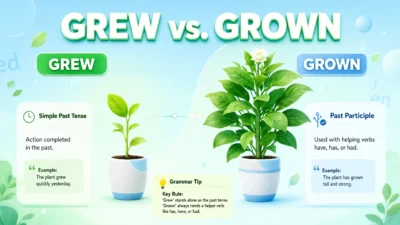
Have you ever wondered if to use showed or shown when talking about something in the past? Both words come from the verb show, which means to let someone see something, present information, or demonstrate how something works. However, they are not interchangeable in every sentence. Understanding their grammatical roles will help you speak and write English more accurately.
The main difference between showed and shown is that showed is the simple past tense of show, while shown is its past participle. You can use showed to describe a completed action, such as “She showed me her new phone.” In contrast, shown usually appears with a helping verb, as in “She has shown me her new phone.”
This distinction is important for students, English learners, and anyone who wants to improve their grammar. Once you understand how these two forms work, choosing the correct word becomes much easier.
Quick Answer: Showed or Shown?
Showed is the simple past tense of show, while shown is the past participle. Use showed for a completed action: “He showed me the picture.” Use shown with helping verbs such as has, have, or had: “He has shown me the picture.” In standard English, these forms follow different grammatical patterns.
Why Do People Confuse Showed and Shown?
People often confuse these words because they are two forms of the same irregular verb. Many English verbs form their past tense and past participle in the same way, such as walked and walked. However, show has different forms: showed and shown.
Another reason for the confusion is that both words refer to actions that happened in the past. Their meanings are closely related, but their grammatical functions differ.
Compare these sentences:
- Correct: She showed us the way.
- Correct: She has shown us the way.
- Incorrect in standard English: She has showed us the way.
The first sentence uses the simple past tense. The second uses the present perfect tense, which requires the past participle shown in standard usage.
First Word: Showed
Showed is the simple past tense of the verb show. It describes an action that happened and was completed in the past.
Use showed when explaining what someone presented, demonstrated, revealed, or allowed another person to see.
Examples of Showed in Sentences
- My brother showed me his new bicycle.
- The teacher showed us how to solve the problem.
- She showed great courage during the competition.
- They showed us the photographs from their vacation.
- He showed me where to find the information.
In each sentence, showed describes an action that occurred in the past.
Is Showed a Verb?
Yes. Showed is the simple past form of the verb show. It can describe presenting an object, explaining something visually, revealing information, or demonstrating a skill.
For example:
- The guide showed us the museum.
- The results showed a clear improvement.
- She showed her friends how to use the app.
Can You Use Showed Without a Helping Verb?
Yes. In a simple past sentence, showed normally stands on its own without a helping verb.
For example:
- Correct: He showed me his drawing.
- Incorrect: He shown me his drawing.
You can also use showed with a direct object or other sentence elements, depending on the meaning.
Second Word: Shown
Shown is the past participle of the verb show. It is generally used with helping verbs to form perfect tenses and passive constructions.
Common helping verbs used with shown include has, have, had, is, are, was, and were, depending on the tense and sentence structure.
Examples of Shown in Sentences
- She has shown excellent leadership skills.
- They have shown us the correct procedure.
- He had shown me the report before the meeting.
- The painting was shown at the local gallery.
- The results have shown significant progress.
In these examples, shown works with another verb to complete the grammatical structure.
Is Shown a Verb?
Yes. Shown is a verb form, specifically the past participle of show. It can appear in perfect tenses and passive sentences.
For example:
- I have shown my work to the teacher.
- The new product was shown on television.
- The documents had been shown to the manager.
Can You Use Shown Without a Helping Verb?
In standard English, shown generally needs a helping verb when it functions as a past participle in a sentence.
For example:
- Correct: I have shown him the answer.
- Incorrect in standard English: I shown him the answer.
However, shown can appear after a noun or in a shortened phrase, such as “the picture shown above.” Here, it functions as a participle describing the picture.
Showed vs. Shown: Comparison Table
| Feature | Showed | Shown |
| Verb form | Simple past tense | Past participle |
| Base verb | Show | Show |
| Common use | Completed past action | Perfect tenses and passive voice |
| Helping verb required? | Not usually in simple past | Usually required in perfect or passive constructions |
| Example | She showed me the letter. | She has shown me the letter. |
| Another example | He showed his skills. | His skills were shown clearly. |
The easiest distinction to remember is that showed usually works independently as the main past-tense verb, while shown generally follows a helping verb.
When to Use Each: Showed or Shown
Choosing between these words becomes easier when you identify the tense and structure of your sentence.
When to Use Showed
Use showed when describing a completed past action.
Examples:
- Yesterday, I showed my teacher the assignment.
- The coach showed the players a new technique.
- She showed me her favorite book.
- The experiment showed an unexpected result.
You can often use showed with time expressions such as yesterday, last week, earlier, and two days ago.
When to Use Shown
Use shown when forming perfect tenses or passive constructions.
Examples:
- I have shown you the instructions.
- She had shown them the way before we arrived.
- The movie was shown at the festival.
- The correct answer has been shown on the screen.
Remember that the helping verb determines the grammatical structure. The word shown does not normally replace showed in a simple past sentence.
12 Examples of Showed and Shown in Sentences
Here are practical examples that demonstrate the difference between the two forms.
Examples Using Showed
- She showed me her new dress.
She presented the dress in the past. - The teacher showed us a useful video.
The teacher presented the video during a lesson. - He showed great patience with the children.
He demonstrated patience in the past. - They showed us around their new house.
They gave us a tour. - The test showed that I needed more practice.
The test revealed information. - My friend showed me how to bake a cake.
My friend demonstrated the process.
Examples Using Shown
- I have shown you the correct answer.
The action is connected to the present. - She has shown remarkable improvement.
Her improvement has been demonstrated. - They had shown us the building before it closed.
The action happened before another past event. - The documentary was shown last night.
The documentary was presented to an audience. - The results have been shown to the committee.
The results were presented, using the present perfect passive. - The photograph shown above is very old.
Here, shown above describes the photograph.
These examples show that both forms relate to the verb show, but their grammatical roles are different.
Common Mistakes With Showed and Shown
Even fluent English speakers sometimes encounter confusion when using irregular verbs. These are some common mistakes to avoid.
Mistake 1: Using Shown in the Simple Past
Incorrect: He shown me his new car.
Correct: He showed me his new car.
Why? The sentence describes a completed past action without a helping verb, so showed is the appropriate form.
Mistake 2: Using Showed Instead of Shown After Has
Incorrect in standard English: She has showed me the report.
Correct: She has shown me the report.
Why? The present perfect tense uses has or have followed by the past participle.
Mistake 3: Using Showed Instead of Shown After Had
Incorrect in standard English: They had showed us the results.
Correct: They had shown us the results.
Why? The past perfect tense follows the pattern had + past participle.
Mistake 4: Confusing Active and Passive Sentences
Incorrect: The film was showed yesterday.
Correct: The film was shown yesterday.
Why? A standard passive construction uses a form of be followed by the past participle.
Mistake 5: Assuming Every Past-Related Sentence Uses Shown
Incorrect: Yesterday, she has shown me the picture.
Better: Yesterday, she showed me the picture.
Why? A specific finished time such as yesterday normally calls for the simple past in this context.
Memory Trick: How to Remember Showed vs. Shown
Use this simple trick:
Showed = Did it. Shown = Has, have, had, or was/were it.
- Showed: He showed me the map.
- Shown: He has shown me the map.
- Shown: The map was shown to everyone.
Remember the common verb pattern:
Show → Showed → Shown
- Base form: show
- Simple past: showed
- Past participle: shown
You can also compare show with another irregular verb:
- Write → wrote → written
- Speak → spoke → spoken
- Show → showed → shown
Practicing these three-part verb patterns can make English grammar easier to remember.
Showed or Shown in American vs. British English
The distinction between showed and shown is essentially the same in American and British English.
Both varieties use showed as the simple past tense and shown as the past participle in standard constructions.
- He showed me the document.
- He has shown me the document.
Examples in British English:
- He showed me the document.
- He has shown me the document.
You may occasionally encounter showed as a past participle, particularly in informal speech or nonstandard usage. However, shown is the standard and safest choice after has, have, and had in formal writing and most edited English.
Similar Words to Showed and Shown
Learning other irregular verbs can help you understand why showed and shown have different grammatical roles.
| Base Verb | Simple Past | Past Participle | Example |
| Go | Went | Gone | She has gone home. |
| Write | Wrote | Written | He has written a letter. |
| Speak | Spoke | Spoken | They have spoken to us. |
| Break | Broke | Broken | I have broken the glass. |
| Take | Took | Taken | She has taken the book. |
| Give | Gave | Given | He has given me advice. |
| See | Saw | Seen | We have seen the movie. |
| Show | Showed | Shown | They have shown us the way. |
These verbs demonstrate a common pattern in English: the simple past and past participle may look different, so it is important to learn both forms.
Final Verdict: Which Is Correct, Showed or Shown?
Both showed and shown are correct words. The right choice depends on how the word functions in your sentence.
Use showed for a completed past action:
- She showed me her homework.
- The teacher showed us an example.
Use shown with the appropriate helping verb in perfect tenses and passive constructions:
- She has shown me her homework.
- An example was shown to the class.
If you are unsure which form to use, check whether the sentence needs a simple past-tense verb or a past participle. This small grammar check will help you choose the correct form.
FAQs:
1. Is it showed or shown?
Both are correct. Showed is the simple past tense of show, while shown is its past participle. Use showed in “I showed him the picture” and shown in “I have shown him the picture.”
2. Is shown the past tense of show?
No. Shown is the past participle. The simple past tense is showed. For example, “She showed me the results” is simple past, while “She has shown me the results” is present perfect.
3. Is it has showed or has shown?
Has shown is the standard form in English. The present perfect tense follows the pattern has + past participle. For example, “He has shown great progress” is correct in standard English.
4. Is it had showed or had shown?
Had shown is the standard form. The past perfect tense uses had + past participle. For example, “They had shown us the room before the guests arrived.”
5. Is it was showed or was shown?
Was shown is the standard passive construction. For example, “The documentary was shown on television.” The word shown follows the helping verb was.
6. Can showed and shown be used interchangeably?
No. They have related meanings but different grammatical functions. Showed is used for simple past actions, while shown is generally used with helping verbs in perfect tenses and passive constructions.
7. What are the three forms of the verb show?
The three principal forms are show, showed, shown. Show is the base form, showed is the simple past tense, and shown is the past participle.
Remember This
- Show = base form: I show my work.
- Showed = simple past: I showed my work yesterday.
- Shown = past participle: I have shown my work.
The key rule is simple: use showed for a straightforward past action and shown in standard perfect-tense and passive constructions.
Conclusion
Understanding the difference between showed and shown is easier when you remember their grammatical roles. Showed is the simple past tense of show and describes an action completed in the past. For example, “She showed me her new phone.” You can use it without a helping verb in an ordinary simple past sentence.
Shown, on the other hand, is the past participle. It usually appears with helping verbs, as in “She has shown me her new phone” or “The phone was shown to the class.” Practice these examples and remember the pattern show, showed, shown. With regular practice, you will be able to choose the correct form confidently in everyday conversations, school assignments, and professional writing.

Lucas Smith is a skilled language writer at Synomity.com, passionate about synonyms, vocabulary enrichment, and word meanings. He develops engaging content that helps readers strengthen communication skills and expand their understanding of language.