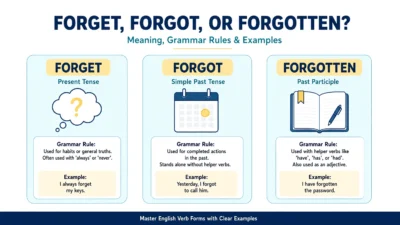

Understanding the past tense of write can be confusing, especially when choosing between wrote and written. The correct form depends on how the verb is used in a sentence. The simple past tense of write is “wrote,” while the past participle is “written.” Both words are correct, but they serve different grammatical purposes.
The verb write is an irregular verb, which means it does not form its past tense by simply adding -ed. Instead, its main forms are write, wrote, and written. You use wrote when describing an action completed in the past, such as “She wrote a letter yesterday.”
You use written with helping verbs such as has, have, had, or was in the appropriate grammatical construction, as in “She has written a letter.” In this guide, you will learn how to use wrote and written correctly, understand common mistakes, and see practical examples that make the difference easy to remember.
Quick Answer
The past tense of write is wrote. The past participle is written. Use wrote for a completed past action and written with auxiliary verbs such as has, have, and had. For example, “I wrote a story yesterday” and “I have written a story” are both correct.
Why Do People Confuse Write, Wrote, and Written?
People often confuse these words because they are three forms of the same irregular verb. Unlike regular verbs such as walk, walked, and walked, the verb write changes its spelling in the past tense and past participle.
The main difference is grammatical:
- Write: The base form or present-tense form.
- Wrote: The simple past tense.
- Written: The past participle.
For example:
- I write in my journal every day.
- I wrote in my journal yesterday.
- I have written in my journal today.
Learning these three forms will help you avoid common grammar mistakes in writing and speaking.
First Word: What Does Write Mean?
Write is the base form of the verb. It means to form letters, words, or other symbols to communicate information, ideas, or feelings.
You can use write when talking about present habits, general facts, future actions, or after certain helping verbs and infinitive markers.
Examples:
- I write emails every morning.
- Please write your name on the form.
- She wants to write a novel.
- They will write a report tomorrow.
- You should write down the instructions.
Remember that write is not normally used by itself to describe a completed action in the past. For that, you generally need wrote or a construction using written.
Second Word: What Does Wrote Mean?
Wrote is the simple past tense of write. Use it to describe an action that happened and was completed in the past.
Examples:
- I wrote a letter last night.
- She wrote a beautiful poem.
- He wrote his assignment before dinner.
- They wrote a report last week.
Notice that wrote does not need did or have to express a simple past action.
Correct: She wrote a message yesterday.
Incorrect: She written a message yesterday.
Also incorrect: She did wrote a message yesterday.
After did, use the base form write: “She did write a message yesterday.” In ordinary affirmative sentences, however, “She wrote a message yesterday” is more natural.
Third Form: What Does Written Mean?
Written is the past participle of write. It is generally used with auxiliary verbs to form perfect tenses and passive constructions.
Examples:
- I have written three pages.
- She has written a short story.
- They had written the report before the meeting.
- The letter was written by my brother.
- The instructions have been written clearly.
In standard English, written usually cannot replace wrote in a simple past sentence.
Incorrect: I written a letter yesterday.
Correct: I wrote a letter yesterday.
Correct: I have written a letter.
The helping verb makes the grammatical difference.
Write vs. Wrote vs. Written: Comparison Table
| Word | Grammatical form | When to use it | Example |
| Write | Base form | Present, infinitives, commands | I write every day. |
| Wrote | Simple past | A completed past action | I wrote yesterday. |
| Written | Past participle | Perfect tenses and passive voice | I have written a page. |
When Should You Use Each Word?
When to Use Write
Use write for habits, general statements, instructions, and actions following modal verbs such as will, can, and should.
Examples:
- I write articles for my website.
- Can you write your address here?
- She will write to you tomorrow.
- They should write a summary.
When to Use Wrote
Use wrote when describing an action completed in the past, often with expressions such as yesterday, last night, last year, or two days ago.
Examples:
- He wrote a book last year.
- We wrote our answers during the exam.
- She wrote to her friend yesterday.
When to Use Written
Use written after helping verbs in perfect tenses or in passive constructions.
Examples:
- I have written my homework.
- She had written the email before lunch.
- The book was written in simple English.
- The report has been written by the manager.
12 Examples of Write in Different Sentences
These examples show how the three forms work in everyday English.
- Present: I write in my notebook every morning.
- Simple past: I wrote in my notebook yesterday.
- Present perfect: I have written five pages today.
- Past perfect: She had written the letter before I arrived.
- Future: He will write a new article tomorrow.
- Negative past: They did not write their names on the list.
- Question: Did you write this poem?
- Passive voice: The story was written by a famous author.
- Present habit: My sister writes short stories.
- Modal verb: You should write your answers clearly.
- Present perfect question: Have you written the report?
- Passive perfect: The invitations have been written and sent.
Each sentence uses the form that matches its grammatical structure.
Common Mistakes When Using Write, Wrote, and Written
Here are some mistakes to watch out for.
| Incorrect sentence | Correct sentence |
| I written a letter yesterday. | I wrote a letter yesterday. |
| She has wrote a story. | She has written a story. |
| They did wrote the report. | They did write the report. |
| He had wrote an email. | He had written an email. |
| I have write my homework. | I have written my homework. |
| The book was wrote by her. | The book was written by her. |
Why do these mistakes happen?
The main reason is using the wrong verb form after a helping verb or in a simple past sentence.
Remember these patterns:
- Simple past: subject + wrote
- Present perfect: subject + has/have + written
- Past perfect: subject + had + written
- Passive voice: subject + was/were + written
One additional point: “I have written my homework” is grammatically possible, but “I have done my homework” is often more natural when referring to completing schoolwork.
Memory Trick: How to Remember Wrote and Written
Use this simple trick:
Yesterday = Wrote. Have or Had = Written.
- Yesterday, I wrote a letter.
- I have written a letter.
- I had written a letter before she arrived.
This shortcut works for many everyday sentences, although written also appears in passive constructions, such as “The letter was written yesterday.”
Another way to remember the forms is to say them aloud:
Write → Wrote → Written
Repeat the sequence a few times and create one sentence with each form. Practicing the words in context will help you remember them more easily.
American vs. British English: Is There a Difference?
There is no difference between American and British English when it comes to the standard forms of the verb write.
Both varieties use:
- Write as the base form.
- Wrote as the simple past tense.
- Written as the past participle.
Examples in both varieties:
- American English: I wrote an email yesterday.
- British English: I wrote an email yesterday.
- American English: I have written the report.
- British English: I have written the report.
Some other English verbs have different preferred forms in American and British English, but write, wrote, and written remain the same in both.
Similar Words and Other Irregular Verbs
Understanding other irregular verbs can help you learn the pattern of write, wrote, and written.
| Base form | Simple past | Past participle |
| Speak | Spoke | Spoken |
| Break | Broke | Broken |
| Choose | Chose | Chosen |
| Drive | Drove | Driven |
| Ride | Rode | Ridden |
| Give | Gave | Given |
| Take | Took | Taken |
| Eat | Ate | Eaten |
| See | Saw | Seen |
| Begin | Began | Begun |
These verbs do not all follow exactly the same spelling pattern, but they share one important feature: their past-tense forms must be learned rather than created by simply adding -ed.
Final Verdict: Is It Write, Wrote, or Written?
All three forms are correct, but you must use them in the right grammatical context.
- Write is the base form: “I write every day.”
- Wrote is the simple past tense: “I wrote yesterday.”
- Written is the past participle: “I have written today.”
If you are describing a completed action at a specific time in the past, choose wrote. If you are using has, have, or had to form a perfect tense, choose written. For present habits, instructions, and many future constructions, use write.
FAQs:
1. What is the past tense of write?
The simple past tense of write is wrote. For example, “I wrote a letter yesterday.” It is an irregular verb, so you do not form its simple past by adding -ed.
2. Is it wrote or written?
Both are correct, but they have different grammatical uses. Use wrote for the simple past and written as the past participle. For example, “She wrote a story” and “She has written a story.”
3. Is written the past tense of write?
Not in the usual grammatical sense. Written is the past participle, while wrote is the simple past tense. You can say “I wrote a letter” or “I have written a letter.”
4. Is it “I have wrote” or “I have written”?
The correct form is “I have written.” The present perfect tense uses have or has followed by the past participle. Therefore, “I have wrote” is incorrect in standard English.
5. What is the past participle of write?
The past participle of write is written. It is used in perfect tenses, such as “She has written a book,” and passive constructions, such as “The book was written by her.”
6. Is “I did write” correct?
Yes. “I did write” is grammatically correct because did is followed by the base form write. This construction often adds emphasis. For example, “I did write to him, but he never replied.”
7. What are the three forms of write?
The three principal forms are write – wrote – written. Use write as the base form, wrote for the simple past, and written as the past participle.
Remember This
- Write = base form.
- Wrote = simple past tense.
- Written = past participle.
- Use wrote for a completed past action.
- Use written after has, have, or had in perfect tenses.
- Use written in passive constructions, such as “The letter was written yesterday.”
- After did, use write, not wrote or written.
Conclusion
Learning the past tense of write is easier when you understand the difference between wrote and written. Although both words refer to writing in the past, they serve different grammatical purposes. Use wrote to describe a completed past action, such as “I wrote a message yesterday.” Use written with the appropriate helping verb, as in “I have written a message.”
The best way to remember these forms is to practice them in everyday sentences. Read examples, write your own sentences, and pay attention to the helping verbs you use. With regular practice, you will become more confident about choosing the correct form of write in essays, emails, conversations, and other types of writing.

John Morrison is a dedicated content writer at Synomity.com, focused on synonyms, vocabulary development, and word meanings. He creates clear, educational resources that help readers improve language skills and communicate with confidence.