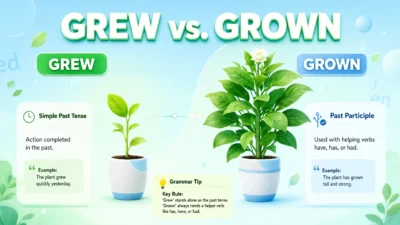
Have you ever wondered if to use woke or woken when talking about waking up? Both words come from the verb wake, and both are correct, but they are used in different grammatical situations. Understanding the difference between woke vs. woken will help you write clearer sentences and speak English more confidently.
The main difference is that woke is the simple past tense of wake, while woken is the past participle. Use woke when describing an action that happened in the past, such as “I woke up early yesterday.”
Use woken with helping verbs such as have, has, or had, as in “I have woken up early every day this week.” The verb wake is irregular, so its past forms do not follow the usual pattern of adding -ed. Once you understand how these forms work with other verbs, choosing the correct word becomes much easier.
Quick Answer: Woke vs. Woken
Woke is the simple past tense of wake, while woken is its past participle. Use woke for a completed past action: “She woke up late.” Use woken with a helping verb: “She has woken up late all week.” Both forms are correct when used in the appropriate grammatical structure.
Why Do People Confuse Woke and Woken?
People often confuse these words because they describe the same basic action: stopping sleep and becoming awake. Their meanings are closely related, but their grammatical functions are different.
English has many irregular verbs with different past-tense and past-participle forms. For example, we say speak, spoke, and spoken. Similarly, the forms of wake are wake, woke, and woken.
The most important distinction is whether the sentence describes a past action directly or uses a perfect-tense construction.
- Woke: “I woke up at six yesterday.”
- Woken: “I have woken up at six every day this week.”
Remember that the helping verb often determines which form you need.
What Does Woke Mean?
Woke is the simple past tense of the verb wake. It describes an action that happened in the past, such as waking up from sleep or causing someone to become awake.
How to Use Woke in a Sentence
Use woke when describing a past event without needing a perfect-tense helping verb.
Examples:
- I woke up early this morning.
- She woke when the alarm rang.
- He woke his brother before school.
- We woke up to the sound of rain.
- The baby woke several times last night.
In these sentences, woke tells the reader that the action happened in the past.
The word woke can also function as an adjective or have a broader social meaning related to awareness of social and political issues. These uses are separate from its role as the past tense of wake.
What Does Woken Mean?
Woken is the past participle of the verb wake. It usually appears with helping verbs such as have, has, and had. It can also appear in passive constructions with forms of be.
How to Use Woken in a Sentence
Use woken in perfect-tense constructions or appropriate passive constructions.
Examples:
- I have woken up early all week.
- She has woken up from a deep sleep.
- They had woken before the sun came up.
- The noise has woken the baby.
- He was woken by a loud alarm.
Notice that woken usually does not stand alone as the main verb in a standard past-tense sentence.
Incorrect: “I woken up at seven yesterday.”
Correct: “I woke up at seven yesterday.”
Correct: “I have woken up at seven every day this week.”
Woke vs. Woken: Comparison Table
| Feature | Woke | Woken |
| Verb form | Simple past tense | Past participle |
| Base verb | Wake | Wake |
| Common use | Past actions | Perfect and passive constructions |
| Common pattern | Subject + woke | Subject + have/has/had + woken |
| Example | I woke at six. | I have woken at six all week. |
| Helping verb required? | Not usually | Usually, in standard verb constructions |
| Passive example | Not the usual form | I was woken by the noise. |
When Should You Use Woke or Woken?
Choosing between woke and woken becomes simple when you identify the verb structure in your sentence.
Use Woke for a Simple Past Action
Choose woke when you are talking about an action that happened in the past.
Examples:
- I woke up late yesterday.
- My sister woke me at seven.
- The children woke when the storm began.
- We woke before sunrise.
A specific past-time expression, such as yesterday, last night, or two hours ago, often appears with this form.
Use Woken With Have, Has, or Had
Choose woken when the sentence uses the present perfect or past perfect tense.
Examples:
- I have woken up early recently.
- She has woken from her nap.
- They had woken before the guests arrived.
These forms connect a past action to another time or event.
Use Woken in Passive Sentences
Use woken when the subject receives the action of waking someone.
Examples:
- I was woken by the telephone.
- She was woken by her alarm.
- We were woken by the thunder.
In these examples, the people did not necessarily wake themselves; something else caused them to wake up.
12 Examples of Woke vs. Woken in Sentences
Here are practical examples showing how each form works in everyday English.
Examples Using Woke
- I woke up at six o’clock yesterday.
- She woke when she heard her name.
- My father woke me before school.
- We woke to a beautiful sunrise.
- The dog woke everyone with its barking.
- He woke suddenly in the middle of the night.
Examples Using Woken
- I have woken up early all week.
- She has woken from her afternoon nap.
- They had woken before the electricity went out.
- The loud music has woken the neighbors.
- I was woken by a phone call.
- We had already woken when the alarm rang.
These examples demonstrate the key pattern: woke commonly appears as the simple past tense, while woken appears in perfect-tense and passive constructions.
Common Mistakes When Using Woke and Woken
Even experienced English learners sometimes mix up these verb forms. Here are the mistakes to watch for.
Mistake 1: Using Woken Without a Helping Verb
Incorrect: “I woken up early yesterday.”
Correct: “I woke up early yesterday.”
For an ordinary simple past sentence, use woke, not woken.
Mistake 2: Using Woke After Have or Has
Incorrect: “She has woke up already.”
Correct: “She has woken up already.”
The standard present perfect construction uses has woken.
Mistake 3: Using Woke After Had
Incorrect: “They had woke before sunrise.”
Correct: “They had woken before sunrise.”
The past perfect construction uses had woken.
Mistake 4: Confusing Woke Up With Woken Up
Both phrases can be correct, but their grammatical structures differ.
- “He woke up late.” — Simple past.
- “He has woken up late.” — Present perfect.
Do not choose a form just because it sounds familiar. Check whether the sentence needs a simple past verb or a past participle.
Mistake 5: Thinking Woke and Woken Are Interchangeable
Although both forms come from wake, they are not freely interchangeable in standard English.
Incorrect: “I have woken up at seven yesterday.”
Better: “I woke up at seven yesterday.”
The simple past is generally preferred when a finished past time is specified.
What Is an Easy Memory Trick for Woke vs. Woken?
Use this simple pattern to remember the three principal forms of the verb:
Wake → Woke → Woken
- Wake: Present — “I wake up early.”
- Woke: Past — “I woke up early yesterday.”
- Woken: Past participle — “I have woken up early.”
Here is another useful memory trick:
No perfect-tense helping verb? Usually use woke for the past. Have, has, or had? Use woken.
This shortcut works for many everyday sentences. Remember that woken can also be used in passive constructions, such as “I was woken by the noise.”
Woke vs. Woken in American and British English
The distinction between woke and woken is essentially the same in American and British English. Both varieties use woke as the simple past tense and woken as the past participle.
| Situation | American English | British English |
| Simple past | I woke up early. | I woke up early. |
| Present perfect | I have woken up early. | I have woken up early. |
| Past perfect | I had woken up early. | I had woken up early. |
| Passive construction | I was woken by the alarm. | I was woken by the alarm. |
There can be differences in how frequently speakers use the simple past or present perfect in particular contexts, but the standard forms remain the same.
For learners, the important lesson is that you do not need to memorize separate American and British spellings for these two words.
Similar Words to Woke and Woken
Understanding other irregular verbs can help you recognize the same grammatical pattern.
| Base verb | Simple past | Past participle |
| Wake | Woke | Woken |
| Speak | Spoke | Spoken |
| Break | Broke | Broken |
| Choose | Chose | Chosen |
| Freeze | Froze | Frozen |
| Steal | Stole | Stolen |
| Drive | Drove | Driven |
| Write | Wrote | Written |
For example:
- “I spoke to her yesterday.” / “I have spoken to her.”
- “He broke the glass.” / “He has broken the glass.”
- “She chose a book.” / “She has chosen a book.”
These verbs follow similar patterns, although not all irregular verbs use the same endings. Learning them in groups can make English grammar easier to remember.
Final Verdict: Woke or Woken?
Both woke and woken are correct, but you must use them in the right grammatical structure.
- Use woke for a simple past action: “I woke up late yesterday.”
- Use woken with perfect-tense helping verbs: “I have woken up late all week.”
- Use woken in passive constructions: “I was woken by the alarm.”
If you remember only one rule, remember this: woke is the simple past tense, and woken is the past participle.
FAQs:
1. Is woke or woken grammatically correct?
Both are grammatically correct. Woke is the simple past tense of wake, while woken is its past participle. The correct choice depends on how the verb is used in the sentence.
2. Is it “I woke up” or “I woken up”?
“I woke up” is correct when describing a simple past action. For example, “I woke up at seven yesterday.” You can also say, “I have woken up,” when using the present perfect tense.
3. Should I say “I have woke” or “I have woken”?
In standard English, say “I have woken.” The present perfect tense uses have plus the past participle. Since woken is the past participle of wake, it is the correct form here.
4. Is “had woken” correct English?
Yes. “Had woken” is the past perfect form of wake. For example, “I had woken before my alarm rang.” It describes an action that happened before another event in the past.
5. Is “I was woke up” correct?
In standard English, the usual passive construction is “I was woken up.” For example, “I was woken up by a loud noise.” Some speakers use other forms informally or dialectally, but was woken up is the safest choice in formal writing.
6. What is the past tense of wake?
The simple past tense of wake is woke. For example, “She woke up early yesterday.” The past participle is woken, as in “She has woken up early every day this week.”
7. Can woke be an adjective?
Yes. Besides being the past tense of wake, woke can be used as an adjective describing awareness of social and political issues. This meaning is different from its grammatical use in sentences such as “I woke up early.”
Remember This
- Wake = present tense.
- Woke = simple past tense.
- Woken = past participle.
- I woke up yesterday. = Simple past.
- I have woken up. = Present perfect.
- I was woken by the alarm. = Passive construction.
Conclusion
The difference between woke and woken is mainly about grammar, not meaning. Both words come from the verb wake, but they perform different roles in a sentence. Use woke to describe a past action, such as waking up yesterday, and use woken with helping verbs or in passive constructions.
With a little practice, choosing between these forms becomes much easier. Remember the sequence wake, woke, woken, read the sentence carefully, and check if it needs a simple past verb or a past participle. By following this rule and reviewing the examples above, you can use both words accurately in everyday conversation, schoolwork, and professional writing.

Lucas Smith is a skilled language writer at Synomity.com, passionate about synonyms, vocabulary enrichment, and word meanings. He develops engaging content that helps readers strengthen communication skills and expand their understanding of language.