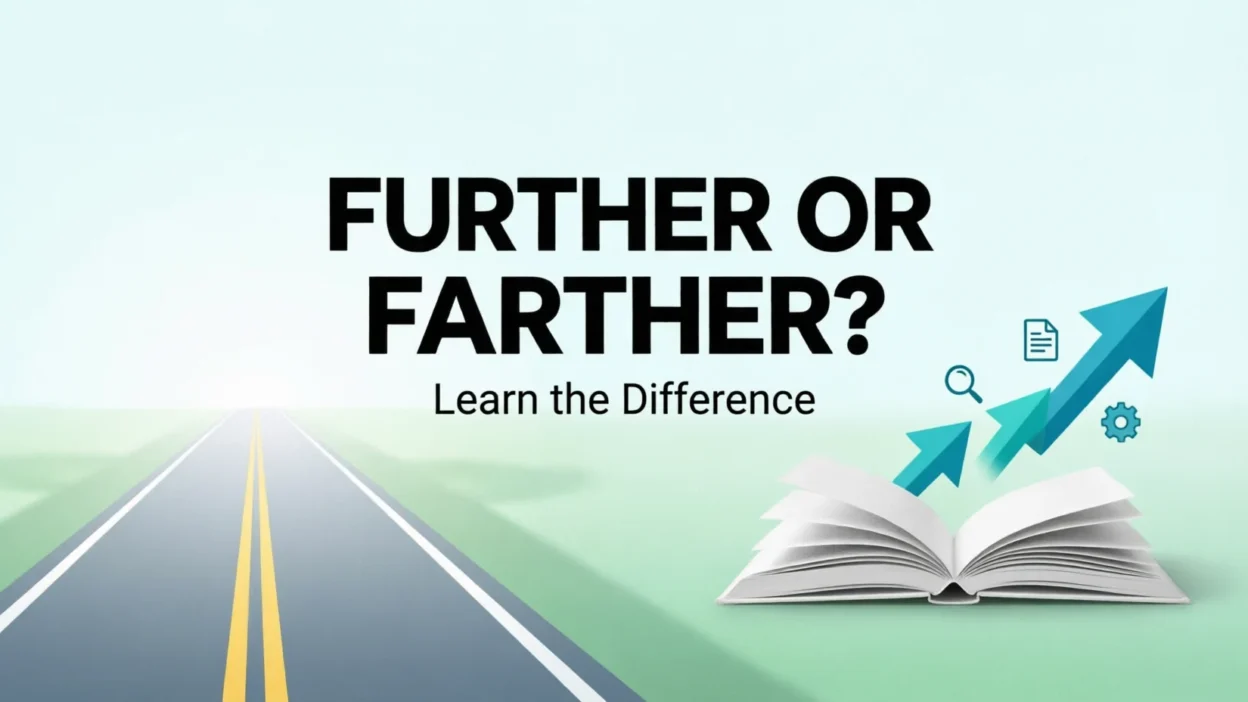
Choosing between further or farther can be confusing because both words are used to talk about distance, progress, and how much something continues. However, there is a helpful distinction: farther is traditionally used for physical distance, while further is generally used for figurative distance, additional information, or a greater degree.
For example, “We walked farther down the road” refers to physical distance, while “We need further information” means we need more information.
Although these words sometimes overlap in modern English, understanding their usual uses will help you choose the right word in school assignments, professional writing, emails, and everyday conversations. The difference is especially useful when describing travel, discussing ideas, explaining progress, or asking someone to continue a task.
In this guide, you will learn the meanings of further and farther, how to use each word correctly, and which spelling fits common expressions. You will also find practical examples, simple memory tricks, and answers to frequently asked questions.
Quick Answer
Use farther when referring to physical distance, such as “The store is farther away.” Use further for figurative distance, additional information, or a greater degree, as in “We need further discussion.” In everyday English, the two words sometimes overlap, especially when talking about distance.
Why Do People Confuse Further and Farther?
People confuse these words because they have similar spellings, similar pronunciations, and overlapping meanings. Both can describe something that extends beyond a current point or goes to a greater extent.
The traditional distinction is based on the type of distance:
- Farther: physical distance that can be measured, such as miles, meters, or steps.
- Further: figurative distance, additional information, or progress toward a goal.
For example, you might travel farther along a road but investigate a problem further. However, you may also hear further used for physical distance, and this usage is widely accepted.
The easiest approach is to remember the traditional rule while recognizing that real-world usage is sometimes flexible.
First Word: Further
Further means “to a greater extent,” “additional,” or “beyond the current point.” It is commonly used when discussing ideas, information, progress, or actions that continue.
Examples:
- We need further information before making a decision.
- She wants to further her education.
- Let’s discuss this matter further.
- The company plans to further improve its services.
Further can also function as an adjective, adverb, or verb, depending on how it is used in a sentence.
Common Uses of Further
1. Additional information
Use further when asking for or referring to more details.
Example: Please contact us if you need further assistance.
2. Continued discussion or investigation
Use it when an activity needs to continue or develop.
Example: The police investigated the matter further.
3. Progress or advancement
Use further to describe helping something develop or move forward.
Example: The training program will further your career.
4. A greater degree
Use it to indicate that something happens to a greater extent.
Example: The new evidence further strengthened her argument.
Second Word: Farther
Farther usually refers to a greater physical distance. It is especially useful when comparing how far people or objects travel or how far away places are.
Examples:
- We walked farther than we planned.
- The school is farther from my house than the library.
- Can you throw the ball farther?
- Their campsite was farther up the mountain.
In these examples, farther describes measurable or physical distance.
Common Uses of Farther
1. Travel distance
Example: We drove farther than expected.
2. Distance between places
Example: The airport is farther away than the train station.
3. Movement or reach
Example: Stretch your arm a little farther.
4. Comparing physical locations
Example: Their house is farther down the street.
Remember that farther is the traditional choice for physical distance, but further can also be correct in many distance-related contexts.
Further vs. Farther: Comparison Table
| Feature | Further | Farther |
|---|---|---|
| Main meaning | Additional or to a greater extent | At a greater physical distance |
| Physical distance | Sometimes used | Traditional preferred choice |
| Figurative meaning | Common | Less common |
| Additional information | Correct | Usually incorrect |
| Progress or development | Common | Uncommon |
| Example | We need further research. | We walked farther today. |
When to Use Each Word
When to Use Further
Choose further when you mean more, additional, continued, or to a greater degree.
Use it in these situations:
- More information: We requested further details.
- Additional help: Please call if you need further assistance.
- Continued discussion: We will discuss the issue further.
- Education and career development: She wants to further her career.
- Greater extent: This decision could further complicate the problem.
Common expressions include further information, further assistance, further discussion, further research, and further development.
When to Use Farther
Choose farther when referring to physical distance, especially when comparing locations or movement.
Use it in these situations:
- Walking: We walked farther than yesterday.
- Driving: They drove farther than planned.
- Geographical distance: The village is farther from the city.
- Throwing or reaching: He threw the ball farther than I did.
- Physical comparisons: The second marker is farther down the path.
A practical tip: if you can measure the distance in meters, kilometers, miles, or steps, farther is often the clearest choice.
12 Examples of Further and Farther in Sentences
Here are practical examples to help you understand the difference.
| Sentence | Why it is correct |
|---|---|
| We walked farther into the forest. | Refers to physical distance. |
| I need further information about the course. | Means additional information. |
| She ran farther than her brother. | Compares running distance. |
| Let us discuss this further tomorrow. | Means continue the discussion. |
| The hotel is farther from the beach. | Compares physical locations. |
| The teacher provided further instructions. | Means additional instructions. |
| He wants to further his education. | Means advance his education. |
| The hikers traveled farther than expected. | Refers to physical travel. |
| We need further research before publishing. | Means additional research. |
| The new policy may further increase costs. | Means increase costs to a greater extent. |
| Can you move the chair farther away? | Refers to physical distance. |
| The manager requested further clarification. | Means more explanation. |
More Examples in Everyday English
- Further: No further action is required.
- Farther: The next gas station is farther down the highway.
- Further: I would like to learn more about this topic.
- Farther: We had to travel farther to find a restaurant.
These examples show how the intended meaning determines which word is most appropriate.
Common Mistakes With Further and Farther
Even experienced English speakers sometimes use these words interchangeably. The most helpful way to avoid mistakes is to focus on what you want to express.
Mistake 1: Using Farther for Additional Information
Incorrect for the intended meaning: I need farther information.
Correct: I need further information.
Why? The sentence asks for additional information, not information at a greater physical distance.
Mistake 2: Using Further When Farther Is More Precise
Less precise under the traditional distinction: We walked further down the road.
More precise: We walked farther down the road.
The first sentence is also acceptable in modern English. However, farther makes the physical-distance meaning especially clear.
Mistake 3: Confusing Further With Furthering
These forms are related but serve different grammatical purposes.
- Further: We need further discussion.
- Further (verb): The program will further our goals.
- Furthering (verb form): She is furthering her education.
Mistake 4: Assuming the Rule Has No Exceptions
It is too strict to say that further can never describe physical distance. Many speakers use it that way, and reputable dictionaries recognize this overlap.
For clear formal writing, the traditional guideline remains useful: use farther for physical distance and further for additional or figurative meanings.
Memory Trick: How to Remember Further vs. Farther
Use these simple memory tricks to remember which word to choose.
Farther = Far away
Both words begin with far. Connect farther with physical distance.
Example: The station is farther away.
Further = Further information
Remember common expressions such as further details, further assistance, and further research.
Example: Please provide further details.
Here is an easy rule to keep in mind:
- Talking about how far you travel? Choose farther.
- Talking about more information or continued progress? Choose further.
If both words seem possible, consider whether one makes your intended meaning clearer.
American vs. British English: Further or Farther?
Both further and farther are used in American and British English. The traditional distinction between physical and figurative distance is taught in both varieties, but everyday usage overlaps.
| Context | American English | British English |
|---|---|---|
| Physical distance | Farther is traditional | Farther is traditional |
| Additional information | Further | Further |
| Continued discussion | Further | Further |
| Physical distance using further | Also common | Also common |
Examples:
- American English: We drove farther north.
- British English: We drove farther north.
- Both varieties: Please contact us for further information.
There is no separate American-versus-British spelling rule for these words. The main difference to remember is their usual meaning, not their regional spelling.
Similar Words: Farther, Further, Furthermore, and More
Several English words can express distance, addition, or continuation. Understanding how they differ can help you choose the most natural expression.
1. Farther
Used mainly for physical distance.
Example: The finish line is farther away than it looks.
2. Further
Used for additional information, continuation, progress, and sometimes physical distance.
Example: We need to investigate the issue further.
3. Furthermore
Means “in addition” and introduces another supporting point. It is not normally used to describe physical distance.
Example: The plan is affordable. Furthermore, it is easy to implement.
4. More
A general word meaning an additional amount or quantity.
Example: I need more time to finish the assignment.
5. Beyond
Means on the other side of a point or outside a limit.
Example: The village lies beyond the hills.
Quick comparison: Use farther for physical distance, further for additional information or progress, furthermore to introduce another point, more for an additional amount, and beyond for something past a boundary or limit.
Final Verdict: Further or Farther?
Both further and farther are correct English words, but they are traditionally used in different ways.
- Farther is the preferred choice for physical distance: “We traveled farther than expected.”
- Further is the preferred choice for additional information, continued discussion, or progress: “We need further explanation.”
Remember that further can also refer to physical distance, so the distinction is a useful guideline rather than an absolute rule. When you want to make your writing clear and precise, choose the word that best communicates your intended meaning.
FAQs:
1. Is further or farther correct?
Both are correct. Farther traditionally refers to physical distance, while further usually means additional, continued, or to a greater extent. The best choice depends on the meaning of your sentence.
2. What is the easiest way to remember further vs. farther?
Remember farther = far away and further = further information. Use farther for physical distance and further for additional details, discussion, or progress.
3. Can further be used for physical distance?
Yes. Although farther is traditionally preferred for physical distance, further is also widely used and accepted in this context. For example, “We walked further down the road” is acceptable English.
4. Is farther more correct than further?
Neither word is universally more correct. Farther is more precise when describing measurable physical distance, while further is generally the better choice for additional information or figurative meanings.
5. Should I write further information or farther information?
Write further information. This is the standard expression because further means additional in this context. “Farther information” is not the usual expression in standard English.
6. Is it further along or farther along?
Both expressions can be correct. Use farther along when emphasizing physical distance along a road, path, or route. Further along can also refer to physical distance and is especially common when discussing progress or stages in a process.
7. Are further and farther different in British and American English?
The words are used in both varieties of English, with broadly similar meanings. The traditional distinction between physical distance and additional or figurative meaning is useful in both, although actual usage overlaps.
Remember This
- Farther: Usually refers to physical distance.
- Further: Usually means additional, continued, or to a greater extent.
- Further information: The correct expression for additional details.
- Farther away: A clear expression for greater physical distance.
- Both words can describe distance: Modern English allows some overlap.
- No spelling difference: Both forms are standard in American and British English.
Conclusion
Understanding the difference between further and farther can make your English writing clearer and more natural. Although both words can refer to distance, farther is traditionally used for physical distance, while further is commonly used for additional information, continued discussion, and progress.
Knowing these typical uses helps you choose the right word in everyday conversations, academic assignments, and professional communication.
The easiest way to remember the distinction is to connect farther with “far away” and further with “further information.” Keep in mind that the words sometimes overlap, especially when describing distance.
Rather than treating the rule as absolute, focus on the meaning you want to communicate. With regular practice, choosing between these two words will become much easier.