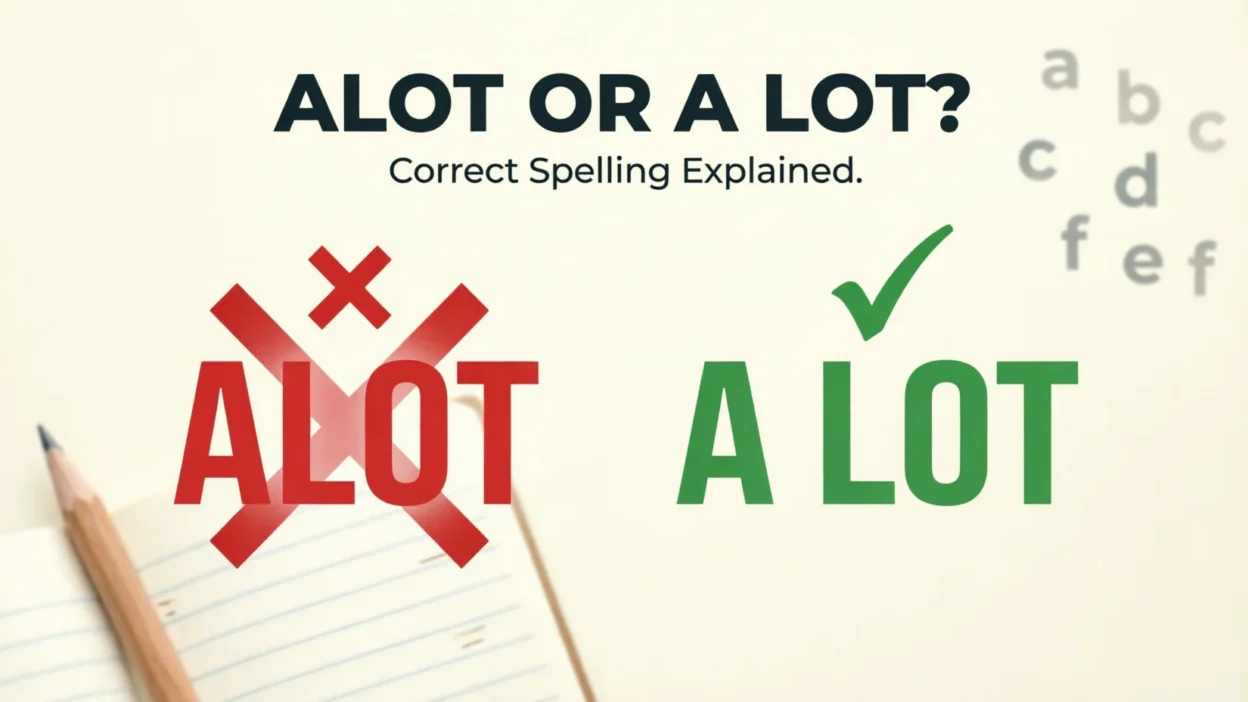
If you are wondering if to write “alot” or “a lot,” the correct spelling is “a lot.” The two-word phrase is used to mean “much,” “many,” or “a large amount.” For example, “I have a lot of homework” is correct, while “I have alot of homework” is incorrect in standard English.
This mistake is common because a lot sounds like a single word when spoken naturally. People may also confuse it with other expressions, such as allot, which is a real English word with a different meaning.
Learning the difference will help you write more clearly in school assignments, emails, social media posts, and everyday conversations. If you are an English learner, a student, or a fluent speaker, remembering that a lot contains two separate words is a simple way to avoid this common spelling error.
Quick Answer
A lot is the correct spelling when you mean “much,” “many,” or “a large amount.” Alot is a misspelling in standard English. For example, write “She reads a lot of books,” not “She reads alot of books.” Always keep a and lot as two separate words.
Why Do People Confuse Alot and A Lot?
People often confuse alot and a lot because the phrase is pronounced naturally as one connected unit. When speaking quickly or typing informally, it may seem like the words belong together.
Another reason is that English contains many compound words written as one word, such as another and anyone. Writers may assume that a lot follows the same pattern.
However, standard English keeps the expression as two words. The confusion can also arise because allot is a correctly spelled word, although it has a different meaning.
The key rule is simple: when you mean “much” or “many,” write a lot.
First Word: Alot
Alot is an incorrect spelling of the phrase “a lot” when referring to a large amount or number. It is not accepted as the standard form in formal English writing.
You may see alot in text messages, online comments, social media posts, or informal writing. In most cases, the writer simply forgot to put a space between a and lot.
- Incorrect: I learned alot from my teacher.
- Incorrect: She has alot of friends.
- Incorrect: We enjoyed the trip alot.
Correct these sentences by writing a lot instead:
- I learned a lot from my teacher.
- She has a lot of friends.
- We enjoyed the trip a lot.
Remember that even if a spelling mistake is common online, that does not make it correct in standard English.
Second Word: A Lot
A lot is the correct two-word expression used to mean “a large amount,” “many,” or “to a great degree,” depending on the sentence.
It can describe quantities, frequency, or the extent to which something happens.
Examples:
- Quantity: We have a lot of food.
- Number: A lot of people attended the event.
- Frequency: He travels a lot.
- Degree: I like this book a lot.
- Change or progress: She has improved a lot.
The expression a lot is common in everyday English and is generally suitable for both conversation and ordinary writing. In highly formal writing, you may sometimes choose a more precise alternative, such as many, much, considerably, or a great deal, depending on the context.
Alot vs. A Lot: Comparison Table
| Feature | Alot | A lot |
|---|---|---|
| Correct spelling | No | Yes |
| Number of words | One | Two |
| Meaning | No standard meaning intended here | Much, many, or to a great degree |
| Formal writing | Incorrect | Correct |
| Example | I exercise alot. | I exercise a lot. |
| Best choice | Avoid it | Use it |
When Should You Use Each Form?
When to Use Alot
In standard English, do not use alot when you mean “much,” “many,” or “a great deal.” Correct it to a lot in essays, reports, emails, assignments, and everyday messages.
If you are editing someone else’s writing, look for alot and replace it with the two-word expression whenever that is the intended meaning.
When to Use A Lot
Use a lot when talking about a large quantity, a high number, frequent activity, or a strong degree.
Examples:
- For things you can count: She owns a lot of books.
- For uncountable things: We need a lot of water.
- For frequency: They practice a lot.
- For degree: This lesson helped me a lot.
- For people or objects in large numbers: A lot of students joined the club.
One useful grammar tip: when a lot comes before a noun, it is often followed by of.
- Correct: A lot of students arrived early.
- Correct: We have a lot of time.
- Correct: I study a lot.
12 Examples of Alot vs. A Lot in Sentences
Here are 12 examples showing how to correct the spelling mistake.
| Incorrect sentence | Correct sentence |
|---|---|
| I learned alot today. | I learned a lot today. |
| She has alot of work. | She has a lot of work. |
| We saw alot of birds. | We saw a lot of birds. |
| He talks alot. | He talks a lot. |
| They need alot of help. | They need a lot of help. |
| I enjoyed the movie alot. | I enjoyed the movie a lot. |
| There are alot of choices. | There are a lot of choices. |
| My brother reads alot. | My brother reads a lot. |
| We spent alot of money. | We spent a lot of money. |
| She practices alot every day. | She practices a lot every day. |
| A lot of people came to the party. | A lot of people came to the party. |
| I appreciate it alot. | I appreciate it a lot. |
The last two examples illustrate correct usage. In particular, a lot can appear at the beginning or end of a sentence, depending on what you want to express.
More Correct Examples
- My parents help me a lot.
- There is a lot of traffic this morning.
- We learned a lot about history.
- He has a lot to say about the topic.
- A lot has changed since last year.
These sentences show that a lot can refer to quantity, experience, frequency, and change.
Common Mistakes With Alot and A Lot
The most common mistake is combining a and lot into one word. However, writers sometimes confuse a lot with allot or use it in places where a more precise word would improve their writing.
Watch out for these errors:
- Writing “alot” instead of “a lot”: Incorrect: “I miss you alot.” Correct: “I miss you a lot.”
- Confusing “a lot” with “allot”: Allot is a real verb meaning to distribute or assign something. Example: “The teacher will allot ten minutes for the quiz.”
- Forgetting “of” before a noun: In ordinary quantity expressions, write “a lot of books,” not “a lot books.”
- Using “a lot” too frequently in formal writing: Repeating it can make writing vague. Depending on the meaning, consider numerous, much, frequently, or significantly.
- Assuming “a lot” always refers to countable things: It can refer to both countable nouns and uncountable nouns, as in “a lot of apples” and “a lot of water.”
The easiest way to avoid these errors is to check whether you mean a large amount or number. If you do, the correct form is usually a lot.
Memory Trick: How to Remember A Lot
A simple trick is to remember that “a lot” has two words, just like “a little.”
Both expressions use the article a followed by another word:
- A lot of books
- A little time
- A lot of work
- A little patience
You can also use this sentence to remember the rule:
“A lot of space keeps a lot correct.”
When you proofread, look for alot. If you find it being used to mean “much” or “many,” insert a space between a and lot.
Try this quick practice:
- I have ___ homework today.
- She travels ___ for work.
- We saw ___ animals at the zoo.
The correct answer in all three cases is a lot.
American vs. British English: Is There a Difference?
There is no spelling difference between American and British English when using a lot. Both varieties use the two-word form.
| Variety of English | Correct form | Example |
|---|---|---|
| American English | A lot | I learned a lot. |
| British English | A lot | I learned a lot. |
| Australian English | A lot | I learned a lot. |
| Canadian English | A lot | I learned a lot. |
Although pronunciation and some vocabulary choices vary across these varieties, the standard spelling remains the same.
You may encounter alot in writing from any region, but it is considered a spelling error when the intended expression is a lot.
Similar Words: A Lot, Allot, and Lots
Several English expressions look or sound similar to a lot, but their meanings and grammatical uses are different.

A lot — a large amount or number
Use this expression for quantity, frequency, or degree.
Example: She has a lot of books.

Allot — to assign or distribute
This is a verb used when giving someone a share of something or setting aside an amount of time or resources.
Example: We will allot 20 minutes for discussion.

Lots — a plural form used informally to mean many or much
Often appears in the expression lots of.
Example: There are lots of apples in the basket.
You may also use alternatives such as many, much, plenty of, numerous, or a great deal of. The best choice depends on the sentence and how formal you want to sound.
Final Verdict: Alot or A Lot?
A lot is correct; alot is incorrect in standard English. Use a lot when you mean a large amount, a large number, or a great degree.
For example, write “I learned a lot from the experience,” not “I learned alot from the experience.”
Remember that allot is a separate, correctly spelled verb meaning to assign or distribute. Keeping these words distinct will help you write accurately and confidently.
FAQs:
1. Is it alot or a lot?
A lot is the correct spelling when you mean “much,” “many,” or “a large amount.” Alot is a spelling mistake in standard English. Always write the expression as two separate words.
2. Why is a lot written as two words?
A lot is a phrase made up of the article a and the noun lot. In standard usage, these words remain separate when the phrase means a large amount or number.
3. Is alot ever a real word?
No, alot is not the standard spelling of the expression meaning “much” or “many.” It may appear in informal writing as a mistake, but it should be corrected to a lot.
4. What is the difference between a lot and allot?
A lot means a large amount, number, or degree. Allot is a verb meaning to assign or distribute something.
Examples:
- We have a lot of time.
- The manager will allot time for each presentation.
5. Is a lot formal or informal?
A lot is acceptable in everyday conversation and ordinary writing. In more formal or academic writing, you may sometimes prefer precise alternatives such as numerous, considerably, or a great deal, depending on the context.
6. Is a lot the same in American and British English?
Yes. American, British, Australian, and Canadian English all use a lot as the standard spelling. There is no regional spelling difference for this expression.
7. Should I write a lot of or alot of?
Write a lot of when referring to a large quantity or number.
Correct: “She has a lot of friends.”
Incorrect: “She has alot of friends.”
When a lot is used without a noun, you do not need of, as in “Thank you a lot” or “I exercise a lot.”
Remember This
- A lot is correct.
- Alot is a misspelling in standard English.
- Use a lot to mean much, many, or to a great degree.
- Write a lot of books and a lot of water.
- Allot is a different word meaning to assign or distribute.
- American and British English use the same spelling.
Conclusion
Knowing if to write alot or a lot is a simple but useful part of improving your English. The correct form is a lot, written as two words. You can use it to describe quantities, numbers, frequency, and the degree to which something happens. For example, “I learned a lot” and “We have a lot of work” are both correct.
To avoid this common mistake, remember the two-word rule and check your writing before sharing or submitting it. If you need a more precise expression for formal writing, consider alternatives such as many, much, numerous, or a great deal. With regular practice, choosing the correct form will become natural.

John Morrison is a dedicated content writer at Synomity.com, focused on synonyms, vocabulary development, and word meanings. He creates clear, educational resources that help readers improve language skills and communicate with confidence.