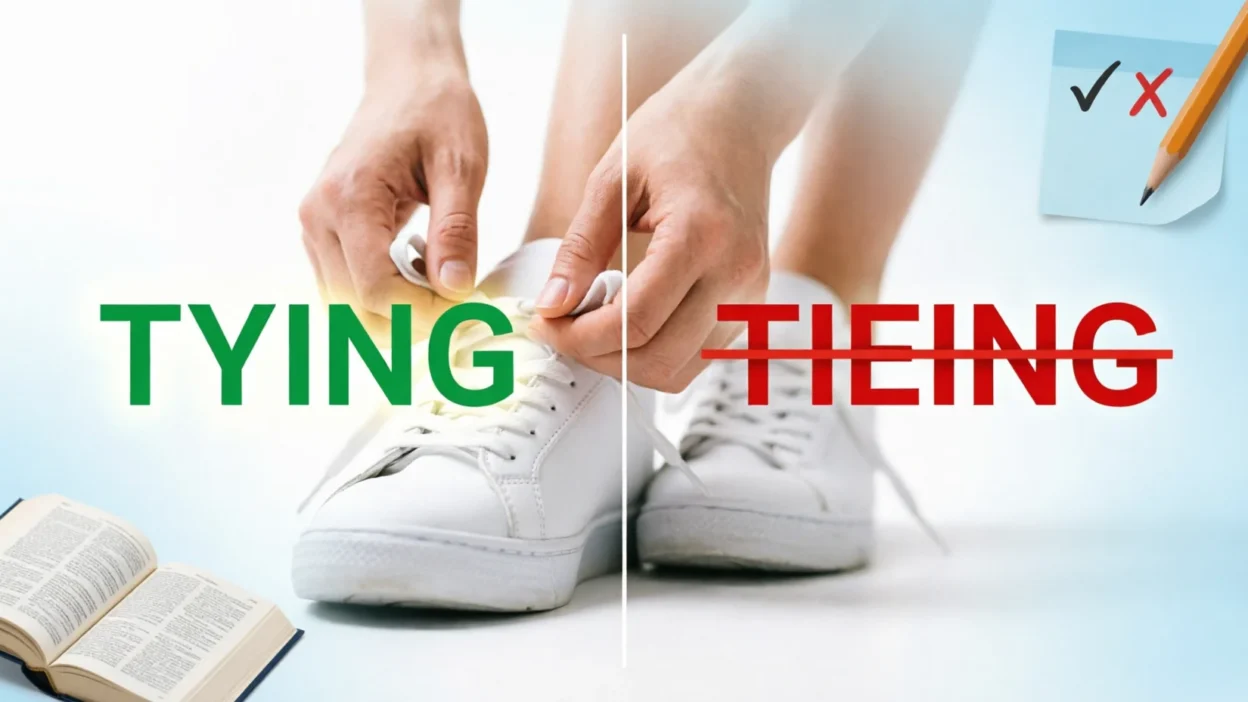
When you want to add -ing to the verb tie, the correct spelling is tying, not tieing. For example, “She is tying her shoes” is correct, while “She is tieing her shoes” is incorrect.
This spelling can be confusing because many English verbs simply keep their spelling before adding -ing, such as playing from play and reading from read. However, verbs ending in -ie follow a special spelling pattern. When -ing is added, -ie changes to y, giving us tying.
Understanding this small rule can help students, ESL learners, writers, and anyone learning English avoid a common spelling mistake. In this guide, we will compare tying and tieing, explain why people confuse them, and provide practical examples you can use in everyday English.
Quick Answer
Tying is the correct spelling, while tieing is incorrect in standard English. The verb tie becomes tying when the -ing ending is added. The same spelling pattern appears in words such as lying from lie and dying from die.
Why Do People Confuse “Tying” and “Tieing”?
The confusion happens because English has several different rules for forming words with -ing.
For many verbs, you simply add -ing:
- play → playing
- read → reading
- jump → jumping
- work → working
Because tie + ing appears to produce tieing, some learners naturally assume that this is the correct spelling.
However, tie ends in -ie, and verbs ending in -ie generally change -ie to y before adding -ing.
So:
tie + ing → tying
Not:
tie + ing → tieing
First Word: Tying
Tying is the correct present participle and gerund form of the verb tie.
The word tying can describe fastening, connecting, securing, or attaching something with a knot, string, rope, ribbon, or similar material.
Examples
- She is tying her shoelaces.
- He is tying a ribbon around the gift.
- I am tying the rope securely.
- They were tying the boxes together.
Tying can also be used in figurative expressions.
- The story is tying everything together.
- These ideas are tying the two topics together.
Second Word: Tieing
Tieing is not the standard spelling of the -ing form of tie.
Although it may look logical because the base word is tie, standard English changes ie to y before adding -ing.
❌ tieing
✅ tying
For formal writing, schoolwork, professional communication, and standard English usage, use tying.
Tying vs Tieing: Comparison Table
| Word | Correct? | Explanation | Example |
|---|---|---|---|
| tying | ✅ Yes | Standard -ing form of tie | She is tying her shoes. |
| tieing | ❌ No | Incorrect standard spelling | She is tieing her shoes. |
The important point is simple: tie → tying.
When Should You Use “Tying”?
Use tying whenever you need the -ing form of the verb tie.
Common situations include:
- fastening shoelaces
- making a knot
- securing something with rope
- attaching objects
- connecting ideas or events
- describing an action happening now
For example:
Here, tying shows an action that is happening at the moment.
You can also use it after certain verbs:
In this sentence, tying functions as a gerund.
10+ Examples of “Tying”
Here are practical examples showing how tying is used correctly:
- She is tying her shoelaces.
- I am tying the package with string.
- He was tying a knot in the rope.
- They are tying the chairs together.
- Mom is tying a ribbon around the present.
- The sailor is tying the boat to the dock.
- She spent several minutes tying her hair.
- He is tying the balloons together.
- We are tying the branches with a rope.
- The final chapter is tying the story together.
- She learned how to make a tying knot for the activity.
- They are tying the plants to wooden supports.
Common Mistakes With “Tying”
The most common mistake is writing tieing instead of tying.
Incorrect
Correct
Another mistake is forgetting that the spelling changes when the -ing suffix is added.
Remember:
tie → tying
The spelling does not remain tie before -ing.
A Simple Memory Trick
Use this easy rule:
Words ending in -ie often change -ie to y before -ing.
For example:
- tie → tying
- lie → lying
- die → dying
Think of it as:
IE + ING → Y + ING
So:
TIE + ING → TYING
This makes tying much easier to remember.
American vs British English
There is no standard American-versus-British spelling difference between tying and tieing.
Both American English and British English use:
tying
For example:
- American English: “He is tying his shoes.”
- British English: “He is tying his shoes.”
Regional differences can affect some English spellings, such as color/colour or center/centre, but tying follows the same standard spelling in both varieties.
Similar Words to “Tying”
Several other words follow a similar spelling pattern.
Lie → Lying
The verb lie becomes lying.
Die → Dying
The verb die becomes dying.
Tie → Tying
The verb tie becomes tying.
These examples help show why tieing is not the standard spelling.
Final Verdict
The correct spelling is tying.
Tying = correct ✅
Tieing = incorrect ❌
When the verb tie takes the -ing ending, its final -ie changes to y:
tie → tying
This is the same general spelling pattern seen in lie → lying and die → dying. If you are writing an essay, email, school assignment, article, or social media post, choose tying.
FAQs:
Is “tying” or “tieing” correct?
Tying is correct. Tieing is not the standard spelling of the -ing form of tie.
Why is “tying” spelled without the “e”?
The word tie ends in -ie. Before adding -ing, the ie changes to y, producing tying.
Is “tieing” ever correct?
In standard modern English, tieing is not the accepted spelling for the -ing form of tie. Use tying instead.
What is the past tense of “tie”?
The past tense of tie is tied.
What is the present participle of “tie”?
The present participle is tying.
Is “tying” used in American English?
Yes. Tying is the standard spelling in American English.
Is “tying” used in British English?
Yes. British English also uses tying.
What are other words like “tying”?
Similar examples include lying from lie and dying from die. These words also change -ie to y before -ing.
Remember This
The easiest rule is:
Tie → Tying
Never write tieing when you mean the standard -ing form of tie.
Also remember:
- tie → tying
- lie → lying
- die → dying
The -ie ending changes to y before -ing.
Conclusion
Choosing between tying and tieing is simple once you know the spelling rule. Tying is the correct standard form of the verb tie when adding -ing. The ending -ie changes to y, giving us tying rather than tieing.
This pattern is useful beyond one word. Remembering tie → tying, lie → lying, and die → dying can help you recognize similar spelling changes in English. Whenever you are unsure, use tying for the -ing form of tie.

Lucas Smith is a skilled language writer at Synomity.com, passionate about synonyms, vocabulary enrichment, and word meanings. He develops engaging content that helps readers strengthen communication skills and expand their understanding of language.