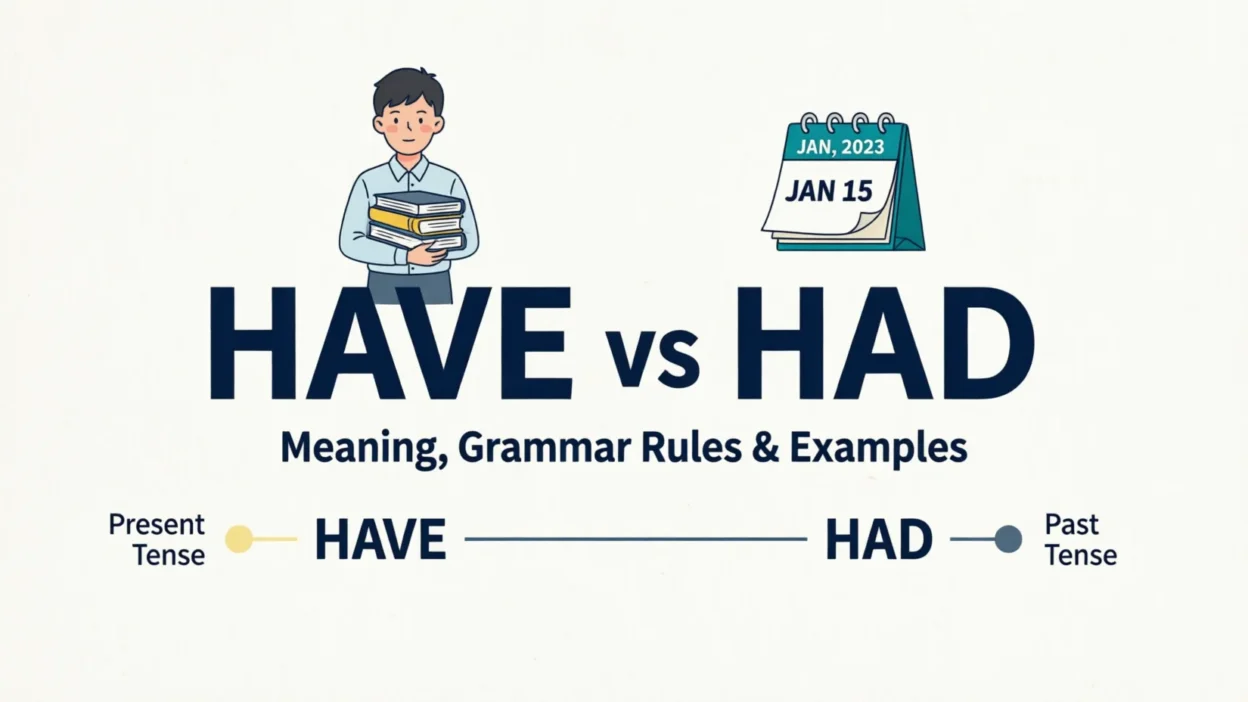
Have or had—which word should you use in a sentence? Both words are forms of the verb “have,” but they are used in different situations. Understanding the difference between have and had can help you speak and write English more naturally, if you are a student, an English learner, or someone improving everyday communication.
Have is generally used in the present tense, while had is the past-tense form of “have.” For example, “I have a new phone” describes something you possess now, whereas “I had a new phone” describes possession in the past. However, these words also appear in perfect tenses, questions, and expressions about experiences or obligations.
The correct choice depends on the subject, the time being discussed, and the sentence structure. In this guide, you will learn when to use have and had, explore practical examples, and discover simple tricks to avoid common grammar mistakes.
Quick Answer: Have vs. Had
Have is used for present possession, experiences, and certain present-perfect constructions. Had is the past-tense form of have and also serves as the past participle in perfect tenses. For example, “I have a car” describes present possession, while “I had a car” describes past possession. Both words can also be used as helping verbs.
Why Do People Confuse Have and Had?
People often confuse have and had because both words come from the same verb and can express possession, experiences, actions, and relationships.
The main difference is their grammatical use:
- Have commonly describes something in the present.
- Had commonly describes something in the past.
- Have can act as a helping verb in the present perfect tense.
- Had can act as a helping verb in the past perfect tense.
For example:
- I have finished my homework. (Present perfect)
- I had finished my homework before dinner. (Past perfect)
The first sentence connects a completed action to the present. The second describes an action completed before another event in the past.
1. What Does Have Mean?
Have is a verb used to express possession, relationships, experiences, conditions, and actions. It is commonly used with the subjects I, you, we, and they, as well as plural nouns.
With he, she, it, and singular third-person nouns, the simple present form is usually has, not have.
Examples of Have
- I have a new laptop.
- You have a beautiful garden.
- We have two English classes today.
- They have many books.
- I have a headache.
- We have visited that museum before.
How to Use Have in a Sentence
Use have in the present tense when describing possession, experiences, or situations that are true now.
1. To show possession
- I have a blue bicycle.
- They have a large house.
2. To describe experiences or conditions
- We have a meeting today.
- I have a cold.
3. As a helping verb in the present perfect tense
- I have completed my assignment.
- They have already eaten lunch.
4. To describe obligations with “have to”
- I have to finish my work.
- We have to leave early.
Remember that have changes to has with third-person singular subjects in the simple present: “She has a car,” not “She have a car.”
2. What Does Had Mean?
Had is the simple past form of have. It is used with all subjects to talk about possession, experiences, conditions, or situations in the past. It is also the past participle of have, so it appears in past perfect constructions.
Examples of Had
- I had a bicycle when I was young.
- She had a difficult day yesterday.
- We had dinner at eight o’clock.
- They had a great time at the party.
- He had a fever last night.
- I had finished the work before the meeting started.
How to Use Had in a Sentence
Use had to describe past situations or to form particular verb tenses.
1. To describe past possession
- I had a red bag in school.
- She had a small apartment before moving.
2. To describe past experiences
- We had a wonderful holiday.
- He had a long conversation with his teacher.
3. As a helping verb in the past perfect tense
- I had completed my homework before dinner.
- They had left before we arrived.
4. To describe past obligations with “had to”
- I had to wake up early yesterday.
- We had to cancel the trip.
Unlike have and has, had does not change according to the subject in the past tense.
Have vs. Had: Comparison Table
| Feature | Have | Had |
| Main grammatical use | Present-tense form | Past-tense and past participle form |
| Simple possession | I have a phone. | I had a phone. |
| Time reference | Usually present | Usually past |
| With I, you, we, they | Have | Had |
| With he, she, it | Has in the simple present | Had |
| Present perfect | I have finished. | Not used as the auxiliary here |
| Past perfect | Not used as the auxiliary here | I had finished. |
| Obligation | I have to study. | I had to study. |
The simplest distinction is that have usually relates to the present, while had usually relates to the past. Their exact meaning depends on the tense and sentence structure.
When Should You Use Have or Had?
Choosing the correct word depends on whether you are talking about the present, the past, or an action connected to another time.
Use Have for Present Situations
Use have when describing possession, experiences, or situations that are true now.
Examples:
- I have a new job.
- We have enough food.
- They have three children.
- I have a question.
Remember that he, she, and it generally take has in simple present sentences.
Use Had for Past Situations
Use had when describing something that existed or happened in the past.
Examples:
- I had a toy car when I was little.
- She had a meeting yesterday.
- We had a lot of homework last week.
- They had a house near the beach.
Use Have in the Present Perfect Tense
Have also works as a helping verb with a past participle to describe past actions connected to the present.
Examples:
- I have finished my work.
- We have seen this movie.
- They have lived here for five years.
Use Had in the Past Perfect Tense
Had is used with a past participle to describe an action that happened before another past event.
Examples:
- I had eaten before he arrived.
- She had left when I called.
- They had completed the project before the deadline.
Use Have or Had With “To”
The expressions have to and had to describe obligations.
- I have to study tonight. (Present obligation)
- I had to study last night. (Past obligation)
14 Examples of Have and Had in Sentences
Here are practical examples that show how both words work in everyday English.
- Have: I have a new notebook for my English class.
- Had: I had a notebook like this last year.
- Have: We have enough time to finish the assignment.
- Had: We had enough time before the bus arrived.
- Have: They have two dogs and a cat.
- Had: They had a dog when they lived in the village.
- Have: I have already completed my homework.
- Had: I had completed my homework before my friend visited.
- Have: We have lunch at noon every day.
- Had: We had lunch at a restaurant yesterday.
- Have: I have to call my teacher today.
- Had: I had to call my teacher yesterday.
- Have: You have made excellent progress.
- Had: You had made excellent progress before changing your study routine.
Notice that have often relates to the present or present perfect, while had describes past situations or helps form the past perfect tense.
Common Mistakes With Have and Had
Understanding common errors will help you use these words more accurately.
Mistake 1: Using Have With He, She, or It
Incorrect: She have a new phone.
Correct: She has a new phone.
Why? In simple present sentences, he, she, and it usually take has.
Mistake 2: Using Had for Present Possession
Incorrect: I had a car now.
Correct: I have a car now.
Why? If you are describing something you possess now, have is generally appropriate.
Mistake 3: Using Have Instead of Had for a Past Event
Incorrect: I have a headache yesterday.
Correct: I had a headache yesterday.
Why? Yesterday refers to a finished time in the past, so had is appropriate for this simple past meaning.
Mistake 4: Confusing Have and Had in Perfect Tenses
Incorrect: I had finished my work, and now I am still doing it yesterday.
Correct: I had finished my work before the meeting started yesterday.
Why? The past perfect is used to show that one past action was completed before another past event.
Mistake 5: Using Have After Did in a Past Question
Incorrect: Did you had breakfast?
Correct: Did you have breakfast?
Why? The auxiliary did already marks the past tense, so the main verb returns to its base form, have.
Mistake 6: Using Had After Have in the Wrong Construction
Incorrect: I have had a car yesterday.
Correct: I had a car yesterday.
Why? When describing possession at a specific, finished past time, the simple past is normally used. However, “I have had a car for five years” is correct when the situation continues into the present.
An Easy Memory Trick for Have vs. Had
Use this simple rule:
Have = Present. Had = Past.
Think about the time you are describing:
- Now: I have a pen.
- Yesterday: I had a pen.
- Completed action connected to now: I have finished my work.
- Completed action before another past event: I had finished my work before dinner.
Another helpful trick is to look for time expressions:
- Words like now, today, and currently may indicate a present situation.
- Words like yesterday, last year, and when I was young often indicate a past situation.
These clues are helpful, but context matters. For example, “I have lived here for five years” describes a situation that began in the past and continues now.
Have or Had in American vs. British English
Have and had follow the same basic grammatical rules in American and British English. Both varieties use have for present-tense forms with I, you, we, and they, and had for the past tense.
| Situation | American English | British English |
| Present possession | I have a car. | I have a car. |
| Past possession | I had a car. | I had a car. |
| Present perfect | I have just finished. | I have just finished. |
| Past perfect | I had already eaten. | I had already eaten. |
| Present possession with got | I have a car. / I’ve got a car. | I have a car. / I’ve got a car. |
One small difference is that British English often uses have got to describe possession in everyday conversation, while American English commonly uses both have and have got.
For example:
- American English: I have a new phone.
- British English: I’ve got a new phone.
Both are correct, and both varieties use had when referring to past possession.
Similar Words That Are Easy to Confuse
Have and had are related to several other English verb forms that learners sometimes mix up.
Have vs. Has
Both are present-tense forms of have.
- Have: I have a book.
- Has: She has a book.
Use has with he, she, it, and singular third-person nouns in simple present sentences.
Had vs. Have Had
These expressions can describe different time relationships.
- Had: I had a dog when I was a child.
- Have had: I have had this dog for three years.
The first describes past possession. The second usually means the possession began in the past and continues into the present.
Have vs. Had in Perfect Tenses
- Have finished: I have finished the task.
- Had finished: I had finished the task before the meeting began.
Have finished is present perfect, while had finished is past perfect.
Did vs. Had
Did is the past form of do. Had is the past form of have.
- Did: Did you call your friend?
- Had: Had you eaten before you left?
In the first question, did is the auxiliary and call remains in its base form. In the second, had is used as the auxiliary in a past perfect question.
Final Verdict: Which One Is Correct?
Both have and had are correct English words, but the right choice depends on the meaning and tense of your sentence.
Use have for present possession, certain present situations, and present perfect constructions. Use had for past possession, past experiences, and past perfect constructions.
For example:
- Correct: I have a new computer.
- Correct: I had a computer when I was in school.
- Correct: I have completed the assignment.
- Correct: I had completed the assignment before the class started.
Remember that have also changes to has with third-person singular subjects in the simple present. Learning these basic rules will help you write more clearly and avoid common grammar mistakes.
FAQs:
1. What is the difference between have and had?
Have is commonly used for present possession and in the present perfect tense. Had is the past-tense form of have and is also used in the past perfect tense. For example, “I have a car” describes present possession, while “I had a car” describes past possession.
2. When should I use have instead of had?
Use have when describing something you possess now, a current situation, or an action connected to the present through the present perfect tense. For example, “I have a question” and “I have finished my homework” are both correct.
3. Is had past tense or present tense?
Had is the simple past form of have. It is also the past participle used in perfect tenses. For example, “I had a bicycle” describes past possession, while “I had ridden a bicycle before” uses had as a helping verb.
4. Should I say “I have” or “I had”?
Use “I have” when describing a present situation and “I had” when describing a past situation. For example, “I have a job” means you currently have one, while “I had a job” usually means you had one in the past.
5. Is “I have had” grammatically correct?
Yes. “I have had” is the present perfect form of have. For example, “I have had this phone for two years” means you got the phone in the past and still have it now.
6. Can we use had with every subject?
Yes. Had is used with all subjects in the simple past and past perfect constructions. You can say “I had,” “you had,” “he had,” “she had,” “we had,” and “they had.”
7. Is have or had correct in American and British English?
Both words are used in the same basic way in American and British English. The main difference is not regional spelling but the tense, meaning, and grammatical structure of the sentence.
Remember This
- Have usually refers to the present.
- Had usually refers to the past.
- Has is used with he, she, and it in the simple present.
- Have + past participle forms the present perfect.
- Had + past participle forms the past perfect.
- After did, use have rather than had: “Did you have breakfast?”
The easiest rule is to check when the situation happened and whether you are describing possession or forming a perfect tense.
Conclusion
Have and had are essential English verbs used to describe possession, experiences, conditions, obligations, and completed actions. Although both come from the same verb, they serve different purposes depending on the tense and sentence structure. Have is commonly associated with the present, while had is used for past situations and past perfect constructions.
To choose correctly, pay attention to the time being discussed, the subject of the sentence, and the verb pattern. Practice with everyday examples such as “I have a book,” “I had a book,” and “I have finished my work.” With regular practice, you will become more confident using have and had in conversations, school assignments, and professional writing.

John Morrison is a dedicated content writer at Synomity.com, focused on synonyms, vocabulary development, and word meanings. He creates clear, educational resources that help readers improve language skills and communicate with confidence.