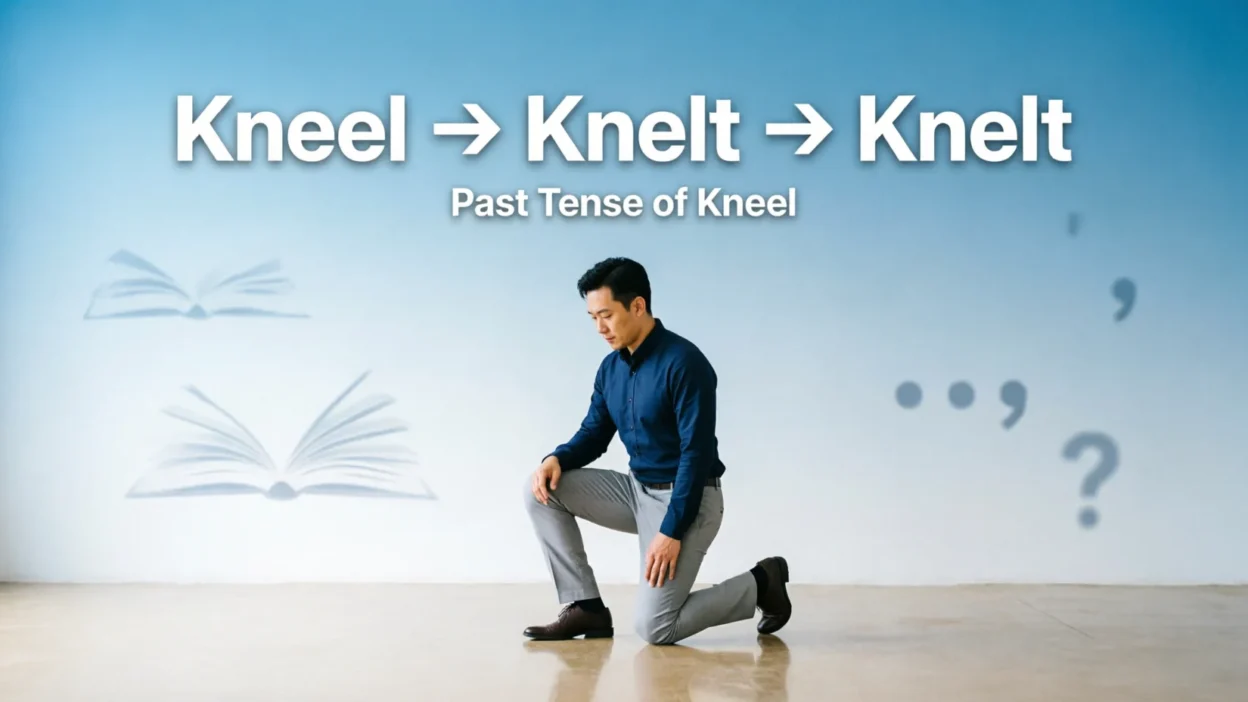
Have you ever wondered what the past tense of kneel is? The two common forms are knelt and kneeled. Both are correct English words, and both describe the action of bending one or both knees and lowering your body toward the ground. However, their usage can vary depending on the speaker, region, and writing style.
For example, you can say, “He knelt beside the bed” or “He kneeled beside the bed.” Both sentences are grammatically correct. Knelt is a traditional irregular past-tense form that is especially common in British English, while kneeled is a regular form often used in American English.
You may encounter either form in books, conversations, religious contexts, and everyday writing. In this guide, you will learn the past tense and past participle of kneel, discover how to use each form, and explore practical examples that make the difference easy to understand.
Quick Answer: What Is the Past Tense of Kneel?
The past tense of kneel is knelt or kneeled. Both forms are correct. Knelt is the irregular form, while kneeled follows the regular pattern of adding -ed. For example, “She knelt to tie her shoe” and “She kneeled to tie her shoe” are both grammatically acceptable.
Why Do People Confuse the Past Tense of Kneel?
People sometimes find the past tense of kneel confusing because English has two accepted forms of the same verb.
Many English verbs form their past tense by adding -ed, such as walked and jumped. However, some verbs have irregular past-tense forms, such as felt, kept, and slept.
Kneel has both patterns:
- Knelt: The irregular past-tense form.
- Kneeled: The regular past-tense form.
Both forms can describe the same action. The choice often depends on regional preferences, personal habits, or the style of the text.
For example:
- The soldier knelt before the memorial.
- The soldier kneeled before the memorial.
Neither sentence is inherently incorrect.
1. What Does Knelt Mean?
Knelt is the irregular simple past tense and past participle of the verb kneel. It describes someone who bent their knees and lowered their body, either for a short moment or for a longer period.
Knelt is widely used in written and spoken English and is particularly familiar in British English.
Examples of Knelt
- She knelt beside her grandmother.
- He knelt on the floor to pick up the coin.
- The player knelt after scoring the winning goal.
- They had knelt in silence before the ceremony began.
- The child knelt beside the garden flowers.
How to Use Knelt in a Sentence
Use knelt when describing an action that happened in the past.
For example:
- Simple past: He knelt beside the chair.
- Past perfect: He had knelt beside the chair before anyone noticed.
- Present perfect: He has knelt in that position before.
Remember that knelt can function as both the simple past tense and the past participle. The helping verb determines which tense is being used.
2. What Does Kneeled Mean?
Kneeled is the regular past-tense and past-participle form of kneel. It has the same basic meaning as knelt: to have bent the knees and lowered the body.
Because kneeled follows the regular -ed pattern, some English speakers find it easier to recognize and use.
Examples of Kneeled
- She kneeled beside the injured dog.
- He kneeled to tie his shoelaces.
- The artist kneeled while painting the lower part of the wall.
- They had kneeled on the grass to examine the flowers.
- The child kneeled beside the toy box.
How to Use Kneeled in a Sentence
Use kneeled when describing a completed action in the past or when the form is required as a past participle.
For example:
- Simple past: She kneeled beside the window.
- Past perfect: She had kneeled there for several minutes.
- Present perfect: She has kneeled on this mat before.
Kneeled is correct in standard English. You do not need to avoid it simply because knelt is also common.
Kneel, Knelt, or Kneeled: Comparison Table
| Verb form | Word | Example |
|---|---|---|
| Base form | Kneel | I kneel to pray. |
| Simple past | Knelt | I knelt beside the bed. |
| Simple past | Kneeled | I kneeled beside the bed. |
| Past participle | Knelt | I have knelt here before. |
| Past participle | Kneeled | I have kneeled here before. |
| Present participle | Kneeling | I am kneeling on the floor. |
| Third-person singular | Kneels | She kneels every morning. |
The important point is that both knelt and kneeled can serve as the simple past and past participle of kneel.
When Should You Use Knelt or Kneeled?
Choosing between the two forms is usually a matter of preference, regional usage, and consistency.
Use Knelt for a Traditional Irregular Form
Knelt is a good choice when you prefer the traditional irregular form or are following a style that favors it.
Examples:
- The knight knelt before the king.
- She knelt beside the hospital bed.
- The worshippers knelt in prayer.
Use Kneeled for the Regular Form
Kneeled is also correct and may feel more natural to speakers who prefer regular past-tense verbs.
Examples:
- He kneeled to examine the broken wheel.
- She kneeled on the carpet to speak to the child.
- The photographer kneeled to capture the picture.
Which Form Should You Choose?
For most everyday writing, you can use either form. If you are writing for a particular publication, school, or organization, follow its preferred style. Otherwise, choose the form that sounds natural to you and use it consistently within the same piece of writing.
12 Examples of the Past Tense of Kneel in Sentences
Here are 12 examples showing how knelt and kneeled work in everyday English.
- Knelt: The boy knelt to tie his shoes.
- Kneeled: The boy kneeled to tie his shoes.
- Knelt: She knelt beside her sleeping baby.
- Kneeled: He kneeled to pick up the fallen keys.
- Knelt: The athlete knelt on the field after the match.
- Kneeled: The artist kneeled while arranging the decorations.
- Knelt: They had knelt before the ceremony started.
- Kneeled: She had kneeled beside the flower bed for several minutes.
- Knelt: The doctor knelt beside the injured patient.
- Kneeled: The child kneeled on the mat to play with blocks.
- Knelt: He has knelt at this memorial many times.
- Kneeled: She has kneeled on the floor during the exercise before.
These examples show that the two past forms can often be substituted for each other without changing the basic meaning.
Common Mistakes With Kneel Past Tense
Although both forms are correct, there are a few mistakes worth avoiding.
Mistake 1: Using “Kneel” for a Completed Past Action
Incorrect: Yesterday, she kneel beside the bed.
Correct: Yesterday, she knelt beside the bed.
Also correct: Yesterday, she kneeled beside the bed.
Why? A completed past action normally requires the simple past tense.
Mistake 2: Writing “Kneeld”
Incorrect: He kneeld to pick up the paper.
Correct: He knelt to pick up the paper.
Also correct: He kneeled to pick up the paper.
Why? The accepted forms are knelt and kneeled, not kneeld.
Mistake 3: Using “Kneeling” as the Simple Past
Incorrect: Last night, he kneeling beside the chair.
Correct: Last night, he knelt beside the chair.
Also correct: Last night, he kneeled beside the chair.
Why? Kneeling is the -ing form, not the simple past tense.
Mistake 4: Forgetting the Helping Verb
Incorrect: She has kneel beside the tree.
Correct: She has knelt beside the tree.
Also correct: She has kneeled beside the tree.
Why? After has, use a past participle.
Mistake 5: Assuming Kneeled Is Always Wrong
Incorrect assumption: Kneeled is never correct English.
Correct understanding: Both knelt and kneeled are accepted past-tense and past-participle forms.
Why? English permits both the irregular and regular forms of this verb.
An Easy Memory Trick for Kneel Past Tense
Use this simple trick to remember the forms of kneel:
Kneel → Knelt or Kneeled → Kneeling
Remember these patterns:
- Knelt: The shorter, irregular form.
- Kneeled: The regular form with -ed.
- Kneeling: The -ing form used for an ongoing action.
You can also remember the sentence:
“Yesterday, I knelt or kneeled; today, I kneel.”
For example:
- Today: I kneel beside the garden.
- Yesterday: I knelt beside the garden.
- Yesterday: I kneeled beside the garden.
- Right now: I am kneeling beside the garden.
Both past forms are correct, so the easiest approach is to choose one and use it consistently.
Kneel Past Tense in American vs. British English
Both knelt and kneeled are used in American and British English, although preferences can vary.
| Feature | American English | British English |
|---|---|---|
| Irregular past form | Knelt | Knelt |
| Regular past form | Kneeled | Kneeled |
| General usage | Both forms occur | Both forms occur |
| Example | He knelt by the door. | He knelt by the door. |
| Alternative example | He kneeled by the door. | He kneeled by the door. |
Knelt is often associated with traditional usage and is especially familiar in British writing. Kneeled is also used in both varieties. These are tendencies rather than strict rules, so neither form belongs exclusively to one country.
Similar Verbs With Different Past-Tense Forms
Kneel is one of several English verbs that have more than one accepted past-tense form or an irregular form that learners need to remember.
Lean: Leaned or Leant
Both leaned and leant are accepted past-tense forms.
- She leaned against the wall.
- She leant against the wall.
Learn: Learned or Learnt
Both learned and learnt are correct, although preferences differ by region.
- I learned a new skill.
- I learnt a new skill.
Dream: Dreamed or Dreamt
Both forms are accepted.
- He dreamed about traveling.
- He dreamt about traveling.
Burn: Burned or Burnt
Both forms are used, with regional and contextual differences.
- The wood burned slowly.
- The wood burnt slowly.
These examples show that English sometimes allows both regular and irregular forms. When in doubt, check the usage expected in your context and remain consistent.
Final Verdict: Is It Knelt or Kneeled?
The past tense of kneel is knelt or kneeled. Both are correct, and both can also function as past participles.
Use knelt if you prefer the traditional irregular form. Use kneeled if you prefer the regular -ed form. Neither is automatically wrong, and both can be used in everyday writing.
For example:
- She knelt beside the child.
- She kneeled beside the child.
Both sentences communicate the same action. The key is to understand the forms, use the correct tense, and maintain consistency in your writing.
FAQs:
1. What is the past tense of kneel?
The past tense of kneel is knelt or kneeled. Both forms are correct. For example, “He knelt beside the chair” and “He kneeled beside the chair” are both grammatically acceptable.
2. Is it knelt or kneeled?
Both knelt and kneeled are correct past-tense forms of kneel. Knelt is the irregular form, while kneeled is the regular form. You can use either in standard English.
3. What is the past participle of kneel?
The past participle of kneel is knelt or kneeled. Both work with helping verbs such as has, have, and had. For example, “She has knelt here before” and “She has kneeled here before” are both correct.
4. Is kneeled grammatically correct?
Yes, kneeled is grammatically correct. It is the regular past-tense and past-participle form of kneel. Although knelt is also common, kneeled is not a spelling mistake.
5. Is knelt more common in British or American English?
Knelt is traditionally associated with British usage, but it is also widely used in American English. Kneeled occurs in both varieties as well. The choice is not a strict regional rule.
6. What is the difference between kneel, knelt, and kneeling?
Kneel is the base form, knelt is an irregular past form, and kneeling is the present participle or -ing form. Kneeled is an alternative regular past form. For example, “I kneel,” “I knelt,” and “I am kneeling.”
7. Is “I have kneeled” correct?
Yes. “I have kneeled” is grammatically correct because kneeled can function as the past participle of kneel. “I have knelt” is also correct.
Remember This
- Present tense: Kneel
- Past tense: Knelt or kneeled
- Past participle: Knelt or kneeled
- Present participle: Kneeling
- Both past forms are correct in standard English.
- Choose a form that suits your writing and use it consistently.
The easiest rule is to remember that kneel has two accepted past forms: knelt and kneeled.
Conclusion
The past tense of kneel can be either knelt or kneeled. Knelt is the irregular form, while kneeled follows the regular pattern of adding -ed. Both words describe the same action and are accepted in standard English. Understanding these forms will help you write more accurately and recognize them when reading books, articles, or everyday messages.
When deciding which form to use, consider your preferred style, the context, and any guidelines you need to follow. You do not need to worry that kneeled is always incorrect or that knelt is the only acceptable choice. Remember the pattern—kneel, knelt or kneeled, kneeling—and you will be able to use this verb confidently.

Lucas Smith is a skilled language writer at Synomity.com, passionate about synonyms, vocabulary enrichment, and word meanings. He develops engaging content that helps readers strengthen communication skills and expand their understanding of language.