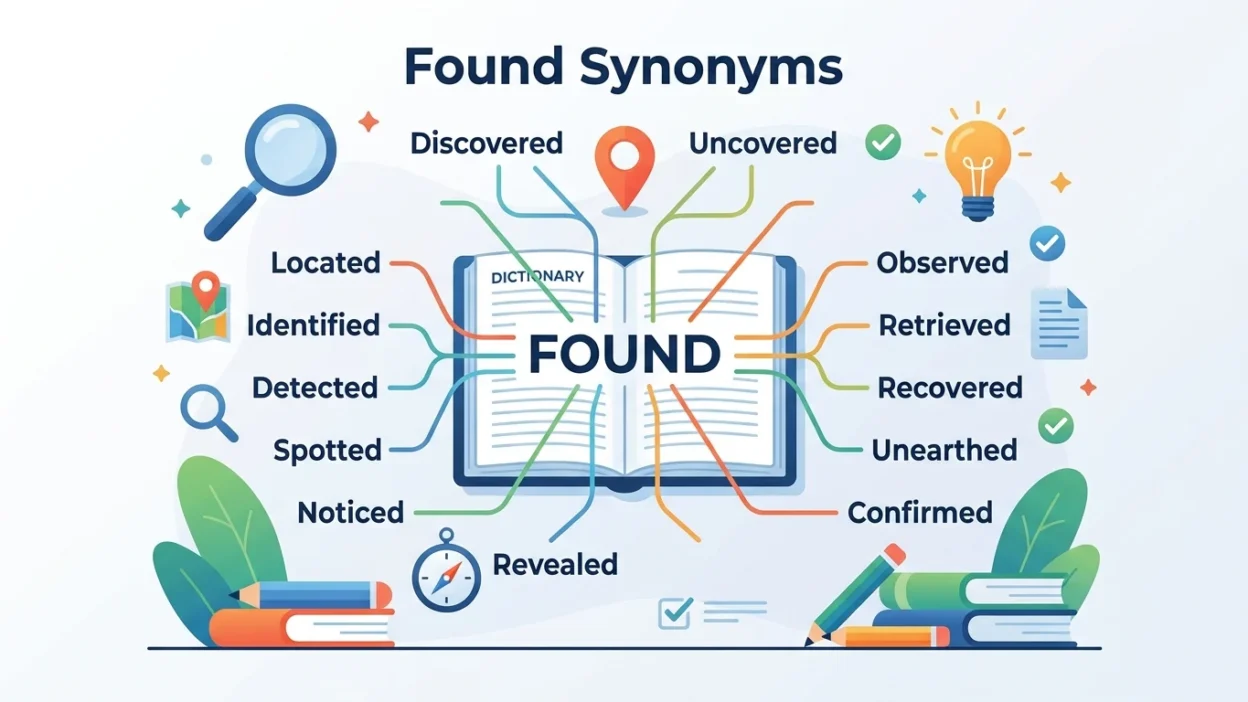
The word “found” is one of the most frequently used verbs in English. It usually means discovering something, locating an object, or realizing a fact.
Because it appears in conversations, essays, emails, stories, and professional writing, knowing different found synonyms can help make your vocabulary richer and your writing more engaging.
Using a variety of synonyms also prevents repetition. Whether you’re a student writing assignments, an ESL learner improving English, a writer creating stories, or a content creator producing blogs, choosing the right alternative to “found” can make your sentences more precise and natural.
In this guide, you’ll learn the meaning of “found,” explore 30 useful synonyms, understand when to use each one, and discover practical tips for selecting the best word for different situations.
What Does “Found” Mean?
Simple Meaning
The word “found” is the past tense of “find.” It means to discover, locate, notice, identify, or come across something or someone. It can also mean realizing information or making a discovery.
Tone
The word “found” has a neutral tone and works well in formal, informal, academic, and professional writing.
Usage Context
Use “found” when talking about discovering an object, person, place, information, or solution.
Example:
I finally found my missing keys under the sofa.
30 Found Synonyms
1. Discovered
Meaning: Came across something for the first time.
Example: Scientists discovered a new species in the rainforest.
Best Usage Context: Research, exploration, and general writing.
2. Located
Meaning: Found the exact position of something.
Example: The rescue team located the missing hikers.
Best Usage Context: Maps, navigation, and official reports.
3. Detected
Meaning: Noticed the presence of something.
Example: The machine detected a small error.
Best Usage Context: Science and technology.
4. Identified
Meaning: Recognized or confirmed something.
Example: Police identified the suspect quickly.
Best Usage Context: Investigations and research.
5. Spotted
Meaning: Saw or noticed something.
Example: We spotted dolphins near the beach.
Best Usage Context: Casual conversations and storytelling.
6. Noticed
Meaning: Became aware of something.
Example: She noticed a mistake in the report.
Best Usage Context: Everyday English.
7. Observed
Meaning: Watched carefully.
Example: Researchers observed changes over several months.
Best Usage Context: Academic and scientific writing.
8. Unearthed
Meaning: Found something hidden.
Example: Archaeologists unearthed ancient tools.
Best Usage Context: Archaeology and history.
9. Recovered
Meaning: Found something that was lost.
Example: The police recovered the stolen bicycle.
Best Usage Context: Law enforcement and news.
10. Retrieved
Meaning: Brought back something.
Example: He retrieved his bag from the locker.
Best Usage Context: Formal and professional writing.
11. Encountered
Meaning: Met unexpectedly.
Example: We encountered heavy traffic on the way home.
Best Usage Context: Narratives and reports.
12. Came Across
Meaning: Found by chance.
Example: I came across an interesting article online.
Best Usage Context: Informal writing.
13. Ran Into
Meaning: Met unexpectedly.
Example: I ran into an old friend yesterday.
Best Usage Context: Casual conversations.
14. Tracked Down
Meaning: Found after searching.
Example: She tracked down the original document.
Best Usage Context: Investigations.
15. Pinpointed
Meaning: Located exactly.
Example: Engineers pinpointed the source of the problem.
Best Usage Context: Technical writing.
16. Recognized
Meaning: Identified from previous knowledge.
Example: I recognized her voice immediately.
Best Usage Context: General English.
17. Realized
Meaning: Understood something.
Example: He realized his mistake too late.
Best Usage Context: Ideas and understanding.
18. Learned
Meaning: Became aware through information.
Example: She learned the truth yesterday.
Best Usage Context: Education and communication.
19. Established
Meaning: Determined or proved.
Example: The investigation established the facts.
Best Usage Context: Formal reports.
20. Verified
Meaning: Confirmed as true.
Example: Officials verified the information.
Best Usage Context: Professional writing.
21. Confirmed
Meaning: Proved correct.
Example: The doctor confirmed the diagnosis.
Best Usage Context: Medical and official writing.
22. Revealed
Meaning: Made known.
Example: The survey revealed surprising results.
Best Usage Context: Reports and journalism.
23. Exposed
Meaning: Brought into public view.
Example: The investigation exposed fraud.
Best Usage Context: News and investigative writing.
24. Uncovered
Meaning: Found something hidden.
Example: Detectives uncovered new evidence.
Best Usage Context: Investigations.
25. Obtained
Meaning: Successfully got something.
Example: She obtained the required documents.
Best Usage Context: Formal communication.
26. Gathered
Meaning: Collected information.
Example: Researchers gathered valuable data.
Best Usage Context: Research and surveys.
27. Collected
Meaning: Brought together items.
Example: Volunteers collected donations.
Best Usage Context: General writing.
28. Acquired
Meaning: Gained possession of something.
Example: The company acquired new technology.
Best Usage Context: Business writing.
29. Secured
Meaning: Successfully obtained.
Example: He secured a scholarship.
Best Usage Context: Professional and educational writing.
30. Attained
Meaning: Achieved after effort.
Example: She attained her career goals.
Best Usage Context: Formal and motivational writing.
Comparison Guide: When to Use Different Found Synonyms
Discovering Something New
| Synonym | Best Used For |
|---|---|
| Discovered | New findings |
| Unearthed | Hidden objects |
| Uncovered | Hidden information |
| Came Across | Chance discoveries |
| Spotted | Seeing something |
Finding a Person or Object
| Synonym | Best Used For |
|---|---|
| Located | Exact location |
| Retrieved | Getting something back |
| Recovered | Lost items |
| Tracked Down | Long searches |
| Pinpointed | Precise location |
Finding Information
| Synonym | Best Used For |
|---|---|
| Identified | Recognition |
| Verified | Confirming facts |
| Confirmed | Proving truth |
| Established | Official findings |
| Revealed | Sharing information |
How to Choose the Right Synonym
For Academic Writing
Use identified, verified, established, observed, and discovered. These words sound formal and are suitable for essays, research papers, and reports.
For Everyday Conversation
Choose noticed, spotted, came across, ran into, and found. These expressions sound natural in daily communication.
For Professional Writing
Words like located, confirmed, retrieved, secured, and obtained fit business emails, reports, and official documents.
For Storytelling
Use encountered, unearthed, tracked down, revealed, and came across to make stories more interesting and descriptive.
For Scientific or Technical Writing
Select detected, observed, identified, verified, and pinpointed because they provide precision and clarity.
Common Mistakes to Avoid
Using “Found” Too Often
Repeating “found” throughout your writing can make it sound repetitive. Replace it with suitable alternatives when appropriate.
Confusing Discovery with Achievement
Words like attained and secured describe achieving something, not simply discovering it. Use them only when the context matches.
Ignoring Tone
Formal synonyms such as verified or established may sound unnatural in casual conversations. Likewise, informal phrases like ran into are not suitable for academic papers.
Tips to Improve Your Vocabulary
Read Different Types of Content
Reading books, blogs, newspapers, and magazines exposes you to a wider range of synonyms.
Learn Words Through Examples
Understanding words in complete sentences makes them easier to remember.
Practice Rewriting Sentences
Replace “found” with different synonyms and observe how the meaning or tone changes.
Match the Context
Always choose the synonym that best fits the situation, audience, and purpose of your writing.
Conclusion
Learning found synonyms is an easy way to improve your English vocabulary and writing skills. While “found” is a useful and versatile word, alternatives such as discovered, located, identified, noticed, retrieved, and verified can make your writing more precise and engaging.
Whether you’re writing essays, creating blog posts, preparing reports, or improving your everyday English, selecting the right synonym helps communicate your ideas more clearly. Practice using these alternatives in different contexts, and your writing will become more natural, varied, and effective.

John Morrison is a dedicated content writer at Synomity.com, focused on synonyms, vocabulary development, and word meanings. He creates clear, educational resources that help readers improve language skills and communicate with confidence.