
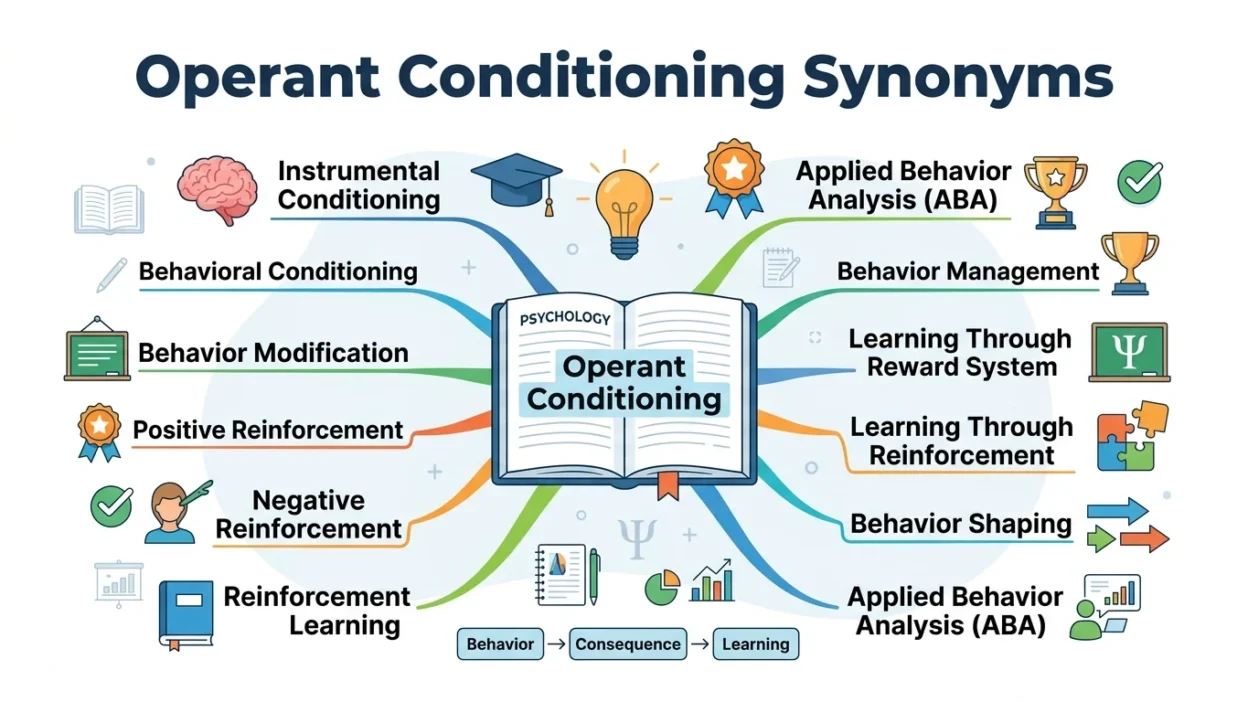
Operant conditioning is one of the most important concepts in psychology and behavioral science.
It explains how behavior is influenced by rewards and consequences. While the exact phrase has a specific scientific meaning, many people search for operant conditioning synonyms to better understand similar terms used in psychology, education, animal training, and everyday communication.
Learning related words and expressions can help students, ESL learners, writers, and content creators communicate psychological concepts more clearly. Although many of these terms are not perfect synonyms, they are closely related and are often used in similar contexts depending on the discussion.
In this guide, you’ll learn the meaning of operant conditioning, explore 30 related synonyms and equivalent expressions, understand when to use each one, and discover how to choose the most appropriate term for different situations.
What Does “Operant Conditioning” Mean?
Simple Meaning
Operant conditioning is a learning process in which behavior is strengthened or weakened through rewards, punishments, or consequences. People and animals learn to repeat behaviors that bring positive outcomes and avoid behaviors that lead to negative outcomes.
Tone
The phrase has a formal and academic tone. It is commonly used in psychology, education, behavior analysis, and animal training.
Usage Context
Use operant conditioning when discussing how consequences influence behavior.
Example:
A teacher used operant conditioning by rewarding students who completed their homework on time.
30 Operant Conditioning Synonyms and Related Terms
1. Behavioral Conditioning
Meaning: Training behavior through consequences.
Example: Behavioral conditioning helped improve classroom behavior.
Best Usage Context: General psychology.
2. Instrumental Conditioning
Meaning: Another scientific name for operant conditioning.
Example: Instrumental conditioning explains how rewards influence actions.
Best Usage Context: Academic psychology.
3. Behavior Modification
Meaning: Changing behavior using reinforcement.
Example: The therapist used behavior modification techniques.
Best Usage Context: Counseling and education.
4. Reinforcement Learning
Meaning: Learning through rewards and consequences.
Example: Children benefit from reinforcement learning.
Best Usage Context: Psychology and artificial intelligence.
5. Positive Reinforcement
Meaning: Rewarding desired behavior.
Example: Praise is a form of positive reinforcement.
Best Usage Context: Education and parenting.
6. Negative Reinforcement
Meaning: Encouraging behavior by removing something unpleasant.
Example: Wearing a seatbelt stops the warning sound through negative reinforcement.
Best Usage Context: Psychology.
7. Reward-Based Learning
Meaning: Learning through rewards.
Example: Dogs respond well to reward-based learning.
Best Usage Context: Animal training.
8. Consequence-Based Learning
Meaning: Learning from outcomes.
Example: Consequence-based learning teaches responsibility.
Best Usage Context: Education.
9. Response Conditioning
Meaning: Training responses through repeated consequences.
Example: Response conditioning improved workplace habits.
Best Usage Context: Behavioral studies.
10. Behavioral Training
Meaning: Teaching desired behaviors.
Example: Behavioral training reduced classroom disruptions.
Best Usage Context: Schools and workplaces.
11. Habit Formation
Meaning: Developing repeated behaviors.
Example: Daily practice supports habit formation.
Best Usage Context: Self-improvement.
12. Behavior Shaping
Meaning: Gradually encouraging desired behavior.
Example: Coaches use behavior shaping to build skills.
Best Usage Context: Education and sports.
13. Learning by Consequences
Meaning: Learning from outcomes.
Example: Children often learn by consequences.
Best Usage Context: General English.
14. Reward Conditioning
Meaning: Training with rewards.
Example: Reward conditioning motivates employees.
Best Usage Context: Motivation and training.
15. Incentive Learning
Meaning: Learning through incentives.
Example: Incentive learning increased participation.
Best Usage Context: Business and education.
16. Response Reinforcement
Meaning: Strengthening a behavior.
Example: Consistent praise provides response reinforcement.
Best Usage Context: Psychology.
17. Behavioral Reinforcement
Meaning: Reinforcing desired actions.
Example: Teachers use behavioral reinforcement daily.
Best Usage Context: Education.
18. Action Conditioning
Meaning: Training actions through consequences.
Example: Action conditioning improved safety habits.
Best Usage Context: Workplace training.
19. Reinforcement Strategy
Meaning: A planned method of encouraging behavior.
Example: The coach designed a reinforcement strategy.
Best Usage Context: Education and management.
20. Motivation Training
Meaning: Encouraging positive behaviors.
Example: Motivation training improved employee performance.
Best Usage Context: Business.
21. Behavior Management
Meaning: Controlling and improving behavior.
Example: Schools use behavior management techniques.
Best Usage Context: Education.
22. Applied Behavior Analysis (ABA)
Meaning: Scientific approach using operant conditioning principles.
Example: ABA is commonly used to teach life skills.
Best Usage Context: Clinical psychology.
23. Learning Through Reinforcement
Meaning: Learning from rewards and consequences.
Example: Pets learn through reinforcement.
Best Usage Context: General psychology.
24. Reward System
Meaning: Organized rewards for desired actions.
Example: The classroom reward system encouraged participation.
Best Usage Context: Schools.
25. Performance Reinforcement
Meaning: Encouraging better performance.
Example: Bonuses provide performance reinforcement.
Best Usage Context: Workplace.
26. Conditioned Learning
Meaning: Learning through repeated experiences.
Example: Conditioned learning occurs over time.
Best Usage Context: Psychology.
27. Behavioral Response Training
Meaning: Teaching appropriate reactions.
Example: Emergency workers receive behavioral response training.
Best Usage Context: Professional training.
28. Habit Conditioning
Meaning: Creating consistent habits.
Example: Habit conditioning improves productivity.
Best Usage Context: Self-development.
29. Conduct Training
Meaning: Improving behavior.
Example: Conduct training reduced conflicts among students.
Best Usage Context: Schools.
30. Reinforcement-Based Behavior
Meaning: Behavior shaped by rewards.
Example: Reinforcement-based behavior develops gradually.
Best Usage Context: Psychology and education.
Comparison Guide: When to Use Different Operant Conditioning Synonyms
Academic Psychology
| Term | Best Used For |
|---|---|
| Instrumental Conditioning | Psychology textbooks |
| Behavior Modification | Research |
| Applied Behavior Analysis | Clinical settings |
| Behavioral Conditioning | Academic discussions |
| Conditioned Learning | Educational materials |
Education and Parenting
| Term | Best Used For |
|---|---|
| Positive Reinforcement | Teaching |
| Behavior Management | Classrooms |
| Reward System | Schools |
| Behavior Shaping | Child development |
| Learning Through Reinforcement | Parenting |
Workplace and Training
| Term | Best Used For |
|---|---|
| Motivation Training | Employee development |
| Incentive Learning | Business |
| Performance Reinforcement | Human resources |
| Conduct Training | Professional environments |
| Reinforcement Strategy | Team management |
How to Choose the Right Synonym
For Psychology and Academic Writing
Choose instrumental conditioning, behavioral conditioning, behavior modification, applied behavior analysis, and conditioned learning. These are the closest terms to the scientific concept.
For Education
Use positive reinforcement, behavior management, reward system, behavior shaping, and learning through reinforcement when discussing classroom behavior and student learning.
For Parenting
Simple terms like reward-based learning, habit formation, positive reinforcement, and learning by consequences are easier for general readers to understand.
For Workplace Training
Words such as motivation training, performance reinforcement, reinforcement strategy, and behavioral training fit professional environments.
For Everyday English
If you’re writing for a broad audience, use reward-based learning, learning by consequences, or behavioral training because they’re simple and beginner-friendly.
Common Mistakes to Avoid
Treating Every Related Term as an Exact Synonym
Operant conditioning has a specific psychological definition. Some alternatives are closely related concepts rather than exact synonyms.
Confusing Operant Conditioning with Classical Conditioning
Classical conditioning involves automatic responses to stimuli, while operant conditioning focuses on behavior shaped by consequences.
Using Technical Terms in Casual Writing
Terms like Applied Behavior Analysis or Instrumental Conditioning may confuse general readers. Choose simpler alternatives when appropriate.
Tips to Improve Your Vocabulary
Read Psychology Resources
Books and educational websites help you understand behavioral science terms in context.
Learn Through Real-Life Examples
Think about rewards, habits, and consequences in everyday life to remember these concepts.
Practice Using Different Terms
Rewrite sentences using different related expressions to understand subtle differences.
Match Your Audience
Use technical vocabulary for academic writing and simpler expressions for blogs, conversations, and beginner learners.
Conclusion
Learning operant conditioning synonyms helps you understand one of psychology’s most important learning theories while expanding your vocabulary. Although instrumental conditioning is the closest true synonym, related expressions like behavior modification, positive reinforcement, behavior management, reward-based learning, and learning through reinforcement are useful in education, parenting, therapy, and professional training.
By understanding the meaning and best usage of each term, you’ll communicate behavioral concepts more accurately and confidently in academic writing, blog posts, classroom discussions, and everyday English.

Lucas Smith is a skilled language writer at Synomity.com, passionate about synonyms, vocabulary enrichment, and word meanings. He develops engaging content that helps readers strengthen communication skills and expand their understanding of language.