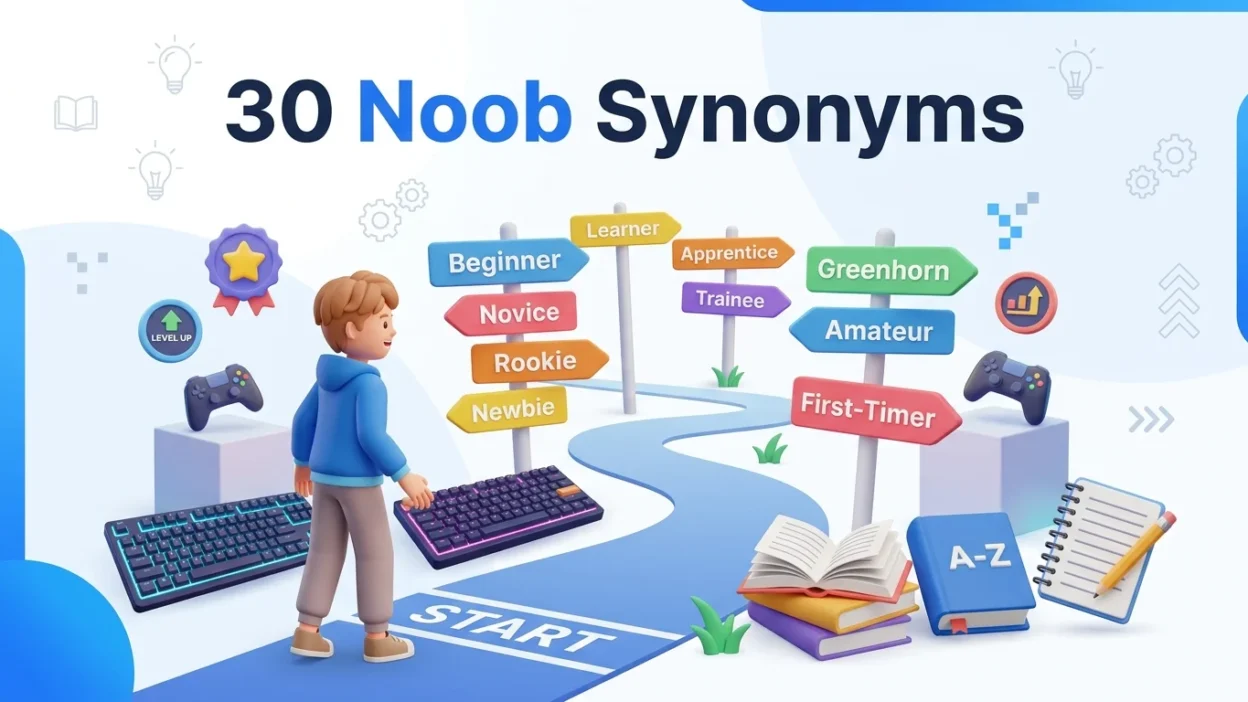
The phrase noob synonyms is commonly searched by students, gamers, writers, and English learners who want better alternatives to the word noob.
While “noob” is popular in online games and internet culture, it is not always the best word to use. Depending on the situation, you may want a more polite, professional, humorous, or descriptive alternative.
Learning different synonyms helps you communicate more clearly and respectfully.
Whether you’re writing a story, chatting online, creating content, or improving your vocabulary, understanding the right replacement for noob can make your English sound more natural and accurate.
What Does “Noob” Mean?
Meaning
A noob is someone who is new to an activity, game, job, or skill and has little experience. The word is often used in online gaming, but it can also describe beginners in many other situations.
Tone
- Usually informal
- Sometimes humorous
- Can sound insulting if used negatively
- Friendly when used jokingly among friends
Usage Context
Use noob mainly in casual conversations, gaming communities, forums, and social media. In professional or educational writing, words like beginner or novice are usually better choices.
30 Noob Synonyms with Meanings, Examples, and Usage
1. Beginner
Meaning: Someone who has just started learning.
Example: She is a beginner at chess.
Best Usage Context: Education, hobbies, sports, general conversation.
2. Novice
Meaning: A person with little knowledge or experience.
Example: Every expert was once a novice.
Best Usage Context: Professional and formal writing.
3. Rookie
Meaning: Someone in their first year or first experience.
Example: The rookie made a few simple mistakes.
Best Usage Context: Sports, gaming, workplace.
4. Learner
Meaning: A person who is still learning.
Example: Every learner improves with practice.
Best Usage Context: Schools, education, training.
5. Newcomer
Meaning: Someone who recently joined a group or activity.
Example: The newcomer quickly made friends.
Best Usage Context: Communities, workplaces, clubs.
6. Freshman
Meaning: A first-year student or beginner.
Example: The freshman attended orientation.
Best Usage Context: Schools and colleges.
7. Apprentice
Meaning: Someone learning a trade under supervision.
Example: The apprentice watched the carpenter carefully.
Best Usage Context: Skilled professions.
8. Trainee
Meaning: A person receiving training.
Example: Every trainee completed the workshop.
Best Usage Context: Business and employment.
9. Amateur
Meaning: Someone without professional experience.
Example: He is an amateur photographer.
Best Usage Context: Sports, arts, hobbies.
10. Greenhorn
Meaning: An inexperienced person.
Example: The greenhorn needed extra guidance.
Best Usage Context: Informal writing.
11. Greenie
Meaning: A newcomer with little experience.
Example: The team welcomed the greenie warmly.
Best Usage Context: Casual conversations.
12. Fresh Face
Meaning: Someone new to a place or activity.
Example: The office hired several fresh faces.
Best Usage Context: Friendly conversation.
13. Starter
Meaning: Someone just beginning.
Example: This guide is perfect for starters.
Best Usage Context: Learning resources.
14. First-Timer
Meaning: Someone doing something for the first time.
Example: Every first-timer feels nervous.
Best Usage Context: Everyday English.
15. Probationer
Meaning: Someone being tested during an initial period.
Example: The probationer completed all tasks.
Best Usage Context: Workplaces.
16. Recruit
Meaning: A newly joined member.
Example: The recruits received training.
Best Usage Context: Military, organizations.
17. Initiate
Meaning: A person newly admitted into a group.
Example: Every initiate attended the ceremony.
Best Usage Context: Formal organizations.
18. Tyro
Meaning: A beginner in a field.
Example: The tyro asked many questions.
Best Usage Context: Formal writing.
19. Neophyte
Meaning: Someone new to a subject or activity.
Example: The neophyte learned quickly.
Best Usage Context: Academic writing.
20. Greenhand
Meaning: An inexperienced worker.
Example: The greenhand followed instructions carefully.
Best UsageContext: Work and trade.
21. Newbie
Meaning: A friendly term for a beginner.
Example: The gaming community welcomed every newbie.
Best Usage Context: Gaming, internet culture.
22. Cub
Meaning: A young or inexperienced person.
Example: The cub reporter covered local events.
Best Usage Context: Journalism and informal writing.
23. Tenderfoot
Meaning: Someone inexperienced.
Example: Every tenderfoot needs patience.
Best Usage Context: Outdoor activities and scouting.
24. Cadet
Meaning: A trainee preparing for a profession.
Example: The cadets practiced every morning.
Best Usage Context: Military and police training.
25. Intern
Meaning: A learner gaining work experience.
Example: The intern assisted the manager.
Best Usage Context: Business and education.
26. Entry-Level Worker
Meaning: Someone beginning a career.
Example: Entry-level workers receive basic training.
Best Usage Context: Career discussions.
27. Amateur Player
Meaning: A non-professional player.
Example: The amateur player improved quickly.
Best Usage Context: Sports and gaming.
28. Junior
Meaning: A less experienced member.
Best Usage Context: Workplace.
29. Student
Meaning: Someone learning a subject.
Example: Every student starts with the basics.
Best Usage Context: Education.
30. Inexperienced Person
Meaning: Someone lacking experience.
Example: The inexperienced person asked for help.
Best Usage Context: Neutral, general English.
Comparison Guide: When to Use Different Noob Synonyms
Quick Comparison Table
| Synonym | Tone | Best Used For |
|---|---|---|
| Beginner | Neutral | General learning |
| Novice | Formal | Professional writing |
| Rookie | Casual | Sports and work |
| Newbie | Friendly | Gaming and online communities |
| Amateur | Neutral | Hobbies and sports |
| Learner | Positive | Education |
| Apprentice | Professional | Skilled trades |
| Trainee | Professional | Workplace |
| Greenhorn | Informal | Casual conversations |
| Neophyte | Formal | Academic writing |
How to Choose the Right Synonym
For Friendly Conversations
- Beginner
- Newbie
- Learner
- First-Timer
- Starter
These words sound welcoming and respectful.
For Professional Writing
- Novice
- Apprentice
- Trainee
- Intern
- Entry-Level Worker
These are suitable for workplaces, reports, and formal communication.
For Gaming
- Newbie
- Rookie
- Beginner
- First-Timer
- Learner
These are common in gaming communities without being overly offensive.
For Academic Writing
- Novice
- Neophyte
- Learner
- Student
- Apprentice
These sound more polished and appropriate.
For Humorous or Informal Use
- Greenhorn
- Greenie
- Cub
- Tenderfoot
- Rookie
Use these only in casual settings where the tone is lighthearted.
Tips for Using Noob Synonyms Correctly
Be Respectful
Not everyone likes being called a noob. If you want to encourage someone, choose words like beginner, learner, or newcomer.
Match the Situation
Formal writing requires professional vocabulary, while gaming chats allow casual expressions like newbie or rookie.
Consider the Tone
Some words are neutral, while others may sound humorous or slightly critical. Always think about your audience.
Common Mistakes
Using “Noob” in Formal Writing
Instead, use novice, beginner, or trainee.
Assuming Every Beginner Is Unskilled
A beginner may simply be new, not untalented.
Choosing Overly Negative Words
Words like greenhorn or noob may offend some readers if used carelessly.
Final Thoughts
Learning noob synonyms helps you express ideas with greater accuracy and confidence. While noob is popular in gaming and internet culture, there are many better alternatives depending on your audience and purpose. Words like beginner, novice, rookie, newbie, and learner are excellent choices that fit different situations.
Expanding your vocabulary makes your writing more engaging, professional, and easier to understand. By selecting the right synonym, you can communicate respectfully while matching the tone of any conversation or piece of writing.

Lucas Smith is a skilled language writer at Synomity.com, passionate about synonyms, vocabulary enrichment, and word meanings. He develops engaging content that helps readers strengthen communication skills and expand their understanding of language.