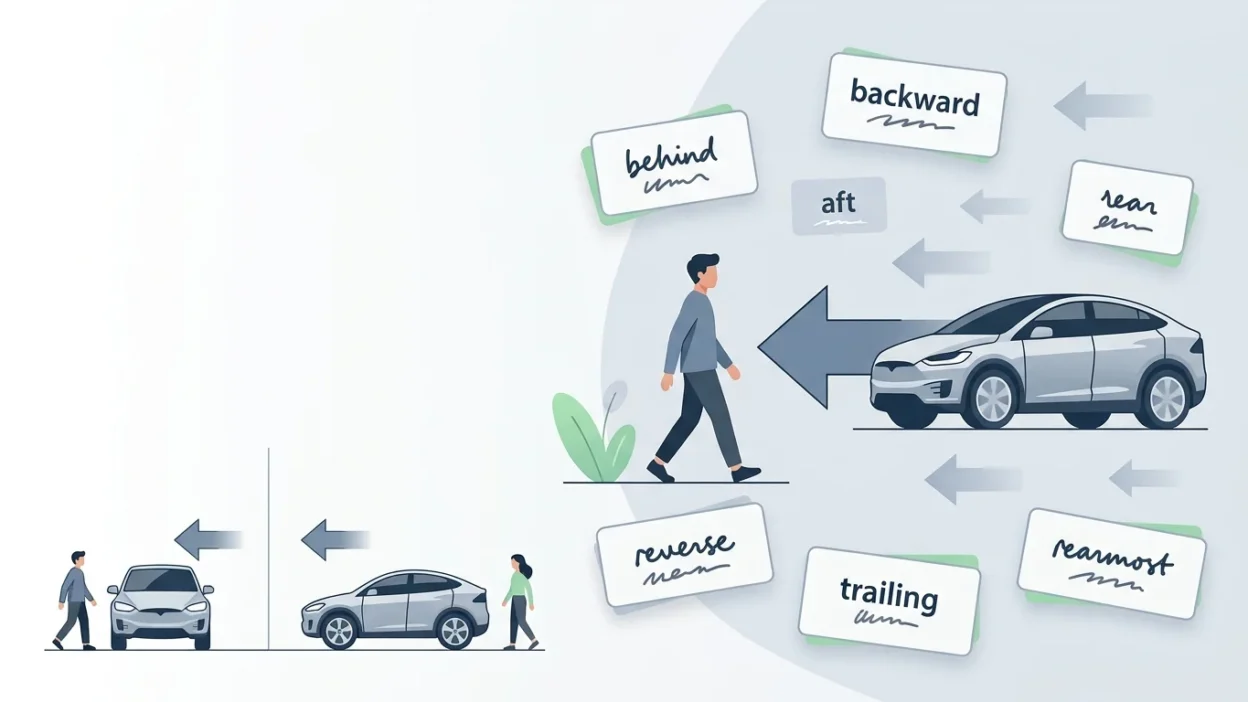
The word rearward is commonly used to describe something that is located, moving, or directed toward the back.
Although it appears frequently in military, technical, and formal writing, there are many rearward synonyms that work better in everyday English depending on the context.
Whether you’re a student, ESL learner, writer, or content creator, learning different ways to say rearward can make your writing more natural and varied.
Some synonyms describe physical position, while others refer to movement or direction. Understanding these differences helps you choose the most accurate word.
What Does “Rearward” Mean?
Simple Meaning
Rearward means toward the back, at the back, or moving backward.
It can describe the position of an object, the direction of movement, or the location of something behind another object.
Common Usage
The word rearward is commonly used in:
- Military writing
- Vehicle descriptions
- Aviation
- Engineering
- Technical manuals
- Formal English
Example:
The soldiers moved in a rearward direction after receiving new orders.
30 Rearward Synonyms
1. Backward
Meaning: Moving or facing toward the back.
Example: He took a backward step.
Best Usage Context: Everyday English.
2. Behind
Meaning: At the back of someone or something.
Example: The school is behind the library.
Best Usage Context: General conversations.
3. Back
Meaning: Located at the rear.
Example: Please sit in the back seat.
Best Usage Context: Casual speaking and writing.
4. Aft
Meaning: Toward the back of a ship or aircraft.
Example: The passengers moved aft.
Best Usage Context: Maritime and aviation.
5. Posterior
Meaning: Located at the back.
Example: The posterior section requires inspection.
Best Usage Context: Medical and scientific writing.
6. Hind
Meaning: Situated at the back.
Example: The horse injured its hind leg.
Best Usage Context: Animals and biology.
7. Following
Meaning: Coming after or behind.
Example: The following vehicle slowed down.
Best Usage Context: General descriptions.
8. After
Meaning: Toward the rear.
Example: The after cabin was quiet.
Best Usage Context: Nautical language.
9. Reverse
Meaning: Moving in the opposite direction.
Example: The car shifted into reverse.
Best Usage Context: Vehicles.
10. Retreating
Meaning: Moving backward.
Example: The army was retreating.
Best Usage Context: Military writing.
11. Receding
Meaning: Moving farther away or backward.
Example: The shoreline appeared to be receding.
Best Usage Context: Descriptive writing.
12. Rear
Meaning: The back part of something.
Example: The rear entrance was closed.
Best Usage Context: Buildings and vehicles.
13. Hindmost
Meaning: Farthest toward the back.
Example: The hindmost wagon carried supplies.
Best Usage Context: Formal descriptions.
14. Tail-End
Meaning: The very back part.
Example: We sat at the tail-end of the bus.
Best Usage Context: Informal English.
15. Last
Meaning: Coming at the end.
Example: She stood in the last row.
Best Usage Context: Everyday use.
16. Trailing
Meaning: Following behind.
Example: A dog came trailing behind him.
Best Usage Context: Descriptive writing.
17. Lagging
Meaning: Falling behind others.
Example: The slow runner was lagging behind.
Best Usage Context: Sports and education.
18. Rearmost
Meaning: Farthest back in a group.
Example: The rearmost truck carried equipment.
Best Usage Context: Formal writing.
19. Back-End
Meaning: The rear portion of something.
Example: The back-end of the vehicle was damaged.
Best Usage Context: Technical discussions.
20. Sternward
Meaning: Toward the stern of a ship.
Example: Sailors walked sternward.
Best Usage Context: Maritime writing.
21. Backside
Meaning: The rear side of an object.
Example: The backside of the building faces the park.
Best Usage Context: Everyday conversations.
22. Rear-Facing
Meaning: Directed toward the back.
Example: The child sat in a rear-facing seat.
Best Usage Context: Safety and transportation.
23. Backward-Moving
Meaning: Moving toward the back.
Example: The machine has a backward-moving belt.
Best Usage Context: Technical writing.
24. Reverse Direction
Meaning: Turning toward the opposite way.
Example: The vehicle changed to reverse direction.
Best Usage Context: Driving instructions.
25. Withdrawn
Meaning: Pulled back from a position.
Example: The troops were withdrawn safely.
Best Usage Context: Military and formal writing.
26. Falling Back
Meaning: Moving backward gradually.
Example: The team kept falling back.
Best Usage Context: Sports and military.
27. Retiring
Meaning: Moving away or backward.
Example: The soldiers were retiring from the battlefield.
Best Usage Context: Historical writing.
28. Backward-Oriented
Meaning: Facing toward the back.
Example: The camera was backward-oriented.
Best Usage Context: Technical descriptions.
29. In Reverse
Meaning: Moving backward.
Example: The truck moved in reverse.
Best Usage Context: Driving and vehicles.
30. To the Rear
Meaning: Positioned at the back.
Example: The supplies were stored to the rear.
Best Usage Context: Formal and military writing.
Comparison Guide: When to Use Different Rearward Synonyms
| Synonym | Best For | Tone |
|---|---|---|
| Rearward | Formal writing | Formal |
| Backward | Everyday movement | Neutral |
| Behind | General location | Casual |
| Rear | Vehicles and buildings | Neutral |
| Aft | Ships and aircraft | Technical |
| Posterior | Medical writing | Formal |
| Hind | Animals | Neutral |
| Reverse | Driving | Practical |
| Retreating | Military | Formal |
| Rearmost | Position in a group | Formal |
| Backside | Everyday speech | Informal |
| To the Rear | Military instructions | Formal |
How to Choose the Right Synonym
When Talking About Everyday Position
Choose:
- Behind
- Back
- Backward
- Rear
- Backside
These are easy to understand and commonly used in daily conversations.
When Writing Formally
Choose:
- Rearward
- Posterior
- Rearmost
- To the Rear
- Hindmost
These fit reports, academic writing, and technical documents.
When Talking About Vehicles
Choose:
- Reverse
- Rear-Facing
- Back-End
- In Reverse
- Rear
These are commonly used in transportation and driving contexts.
When Talking About Ships or Aircraft
Choose:
- Aft
- Sternward
- After
These are the preferred nautical and aviation terms.
When Describing Movement
Choose:
- Retreating
- Receding
- Falling Back
- Trailing
- Lagging
These describe moving toward the back or away from something.
Common Examples Using Rearward Synonyms
- The passengers moved aft during the safety drill.
- He looked behind before crossing the street.
- The truck slowly drove in reverse.
- The rear door remained locked.
- The soldiers made a retreating movement.
- The backward step prevented an accident.
Tips for Using Rearward Synonyms Correctly
Understand the Context
Some synonyms describe position, while others describe movement. Make sure your choice matches the situation.
Consider Formality
Use rearward or posterior in formal or technical writing, and choose behind or back for everyday communication.
Avoid Repeating the Same Word
Using different rearward synonyms keeps your writing more interesting and natural.
Match the Subject
Words like aft belong to ships and aircraft, while hind is mainly used for animals.
Conclusion
Learning rearward synonyms helps you describe direction, movement, and position with greater precision. While rearward is useful in formal and technical writing, alternatives such as behind, backward, rear, aft, and reverse are often better choices in everyday English.
By understanding the meaning, tone, and best usage of each synonym, you’ll improve your vocabulary, write more naturally, and communicate more clearly in both casual and professional settings.

Evelyn Mia is a passionate language writer and vocabulary enthusiast at Synomity.com, specializing in synonyms, word meanings, and language learning. She creates informative content that helps readers expand vocabulary and communicate more effectively.