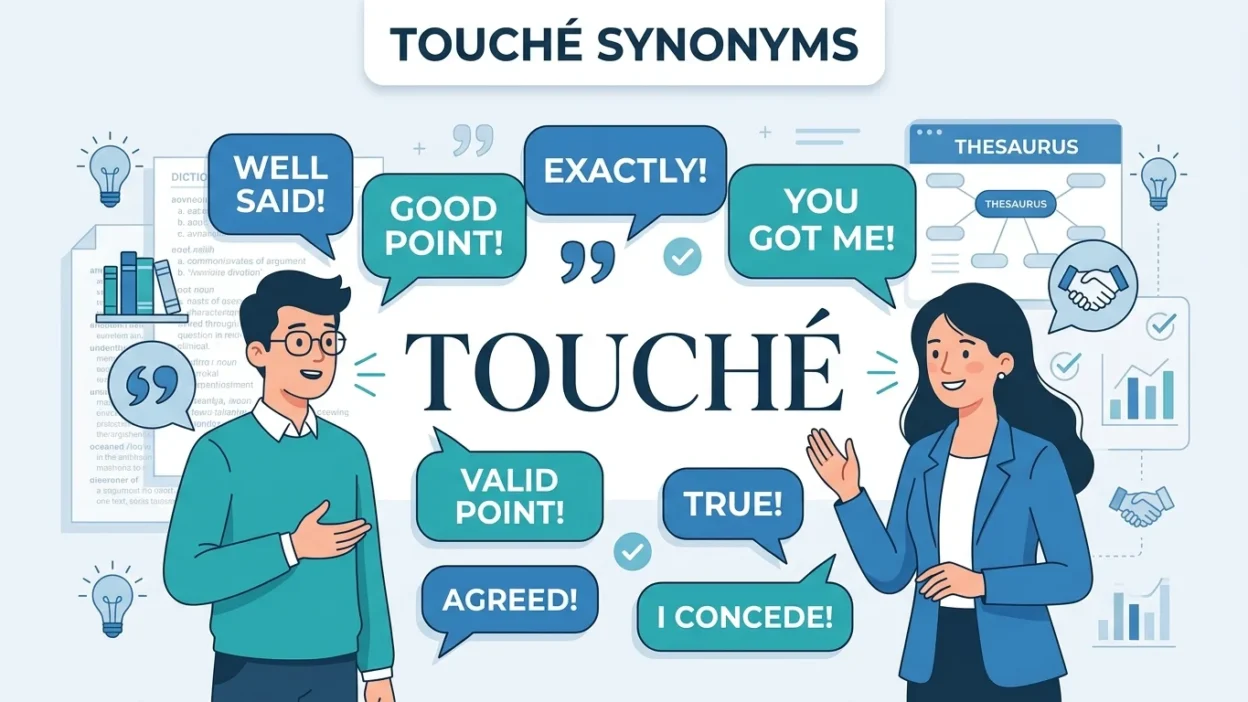
The phrase touche synonyms is popular among students, writers, ESL learners, and anyone who wants to improve their vocabulary.
While touché is a short word, it carries a powerful meaning in conversations. It is often used when someone makes a clever point that you cannot argue against.
Learning different ways to say touché helps you sound more natural in both casual and professional conversations. Some alternatives are formal, while others are humorous or friendly. Understanding these subtle differences allows you to choose the best expression for every situation.
### What Does “Touché” Mean?
Touché (pronounced too-SHAY) comes from the French language and originally belonged to the sport of fencing. It literally means “touched.”
In everyday English, touché is used when someone makes a clever argument, points out your mistake, or wins a debate with a smart comment. Saying touché shows that you recognize their good point.
Example:
Person A: You always tell me not to be late, but you arrived ten minutes late today.
Person B: Touché.
Tone: Friendly, respectful, and often humorous.
### 30 Best Touché Synonyms
1. Good Point
Meaning: You agree that someone has made a valid argument.
Example: Good point. I hadn’t thought about it that way.
Best Usage Context: Everyday conversations and discussions.
2. Fair Enough
Meaning: You accept someone’s opinion or argument.
Example: Fair enough. I understand your reasoning.
Best Usage Context: Casual conversations.
3. You Got Me
Meaning: Someone has successfully pointed out your mistake.
Example: You got me. I forgot about that.
Best Usage Context: Friendly debates.
4. I Stand Corrected
Meaning: You admit you were wrong.
Example: I stand corrected. Thanks for explaining.
Best Usage Context: Formal discussions.
5. Well Played
Meaning: Someone made a clever move or comment.
Example: Well played. That was a smart comeback.
Best Usage Context: Humor and friendly competition.
6. You’re Right
Meaning: You agree with the other person’s statement.
Example: You’re right. I should have checked first.
Best Usage Context: General conversations.
7. I Can’t Argue with That
Meaning: The point is difficult to disagree with.
Example: I can’t argue with that. It makes sense.
Best Usage Context: Discussions and debates.
8. That’s True
Meaning: You agree that something is correct.
Example: That’s true. I never noticed that before.
Best Usage Context: Everyday speech.
9. Point Taken
Meaning: You understand and accept the point.
Example: Point taken. I’ll be more careful next time.
Best Usage Context: Professional settings.
10. I See Your Point
Meaning: You understand someone’s opinion.
Example: I see your point now.
Best Usage Context: Respectful discussions.
11. Agreed
Meaning: You completely agree.
Example: Agreed. That’s the best solution.
Best Usage Context: Meetings and conversations.
12. Absolutely
Meaning: Strong agreement.
Example: Absolutely! That’s exactly what I meant.
Best Usage Context: Casual and professional.
13. Exactly
Meaning: Complete agreement.
Example: Exactly! That’s what I’ve been saying.
Best Usage Context: Daily conversation.
14. You’re Absolutely Right
Meaning: Strong acknowledgment.
Example: You’re absolutely right about that.
Best Usage Context: Formal discussions.
15. I Admit It
Meaning: You admit your mistake.
Example: I admit it. I was wrong.
Best Usage Context: Honest conversations.
16. You Win
Meaning: The other person wins the argument.
Example: You win. I’ll stop arguing.
Best Usage Context: Friendly debates.
17. Nicely Said
Meaning: Someone expressed something well.
Example: Nicely said. I couldn’t explain it better.
Best Usage Context: Compliments.
18. Well Said
Meaning: A thoughtful statement deserves praise.
Example: Well said. That’s inspiring.
Best UsageContext: Speeches and writing.
19. That’s Fair
Meaning: The opinion is reasonable.
Example: That’s fair. Let’s do it your way.
Best Usage Context: Negotiations.
20. I Concede
Meaning: You accept defeat in an argument.
Example: I concede. You’ve convinced me.
Best Usage Context: Formal debates.
21. You Make a Good Case
Meaning: Someone argued effectively.
Example: You make a good case for changing the plan.
Best Usage Context: Professional discussions.
22. You Have a Point
Meaning: Their opinion has value.
Example: You have a point. Let’s think about it.
Best Usage Context: Conversations.
23. No Argument There
Meaning: Complete agreement.
Example: No argument there. I agree.
Best Usage Context: Informal speech.
24. That’s Hard to Deny
Meaning: The statement is obviously true.
Example: That’s hard to deny after seeing the evidence.
Best Usage Context: Logical discussions.
25. You’re Not Wrong
Meaning: The person is mostly correct.
Example: You’re not wrong about that.
Best Usage Context: Casual conversations.
26. I’ll Give You That
Meaning: You admit one specific point.
Example: I’ll give you that. Your idea is creative.
Best Usage Context: Friendly debates.
27. Good Observation
Meaning: Someone noticed something important.
Example: Good observation. I missed that detail.
Best Usage Context: Learning and teamwork.
28. That’s a Valid Point
Meaning: The argument is reasonable.
Example: That’s a valid point worth considering.
Best Usage Context: Meetings and essays.
29. You Have Me There
Meaning: Someone caught you with a strong argument.
Example: You have me there. I don’t have an answer.
Best Usage Context: Informal conversations.
30. I Accept That
Meaning: You accept the argument or fact.
Example: I accept that your explanation is correct.
Best Usage Context: Formal or respectful conversations.
### Touché Synonyms Comparison Table
| Synonym | Formal | Casual | Debate | Friendly Chat |
|---|---|---|---|---|
| Good Point | ✅ | ✅ | ✅ | ✅ |
| Fair Enough | ❌ | ✅ | ✅ | ✅ |
| Point Taken | ✅ | ✅ | ✅ | ❌ |
| I Stand Corrected | ✅ | ❌ | ✅ | ❌ |
| Well Played | ❌ | ✅ | ❌ | ✅ |
| You Got Me | ❌ | ✅ | ✅ | ✅ |
| I Concede | ✅ | ❌ | ✅ | ❌ |
| You Have a Point | ✅ | ✅ | ✅ | ✅ |
| I’ll Give You That | ❌ | ✅ | ✅ | ✅ |
| You’re Right | ✅ | ✅ | ❌ | ✅ |
### How to Choose the Right Synonym
Choosing the right touché synonym depends on the situation and the tone you want to create.
For Casual Conversations
Use:
- Good Point
- Fair Enough
- You Got Me
- You’re Not Wrong
- Well Played
These sound natural among friends and family.
For Professional Settings
Choose:
- Point Taken
- I Stand Corrected
- That’s a Valid Point
- I See Your Point
- I Accept That
These are respectful and suitable for workplaces.
For Friendly Debates
Use:
- You Win
- I’ll Give You That
- I Can’t Argue with That
- You Have Me There
- I Concede
These show sportsmanship without sounding rude.
For Formal Discussions
Choose:
- You’re Absolutely Right
- I Concede
- You Make a Good Case
- That’s Hard to Deny
- I Stand Corrected
These expressions fit academic and professional conversations.
### Why Learn Touché Synonyms?
Knowing multiple alternatives helps you:
- Sound more fluent in English.
- Avoid repeating the same phrase.
- Improve your writing style.
- Express agreement naturally.
- Communicate confidently in different situations.
Using a variety of touché synonyms also makes your conversations and writing more engaging and expressive.
### Common Mistakes to Avoid
- Don’t use touché when someone simply agrees with you.
- Avoid using it in very serious or emotional situations.
- Choose formal alternatives in business or academic writing.
- Remember that touché usually acknowledges a clever or convincing point.
### Conclusion
Understanding touché synonyms gives you more ways to acknowledge a clever argument, admit a mistake, or show respectful agreement. While touché remains a popular expression, alternatives like good point, point taken, well played, you got me, and I stand corrected allow you to match different tones and situations.
Whether you’re a student, ESL learner, writer, or content creator, expanding your vocabulary with these synonyms will improve your communication skills and help your writing sound more natural, confident, and engaging.

Evelyn Mia is a passionate language writer and vocabulary enthusiast at Synomity.com, specializing in synonyms, word meanings, and language learning. She creates informative content that helps readers expand vocabulary and communicate more effectively.