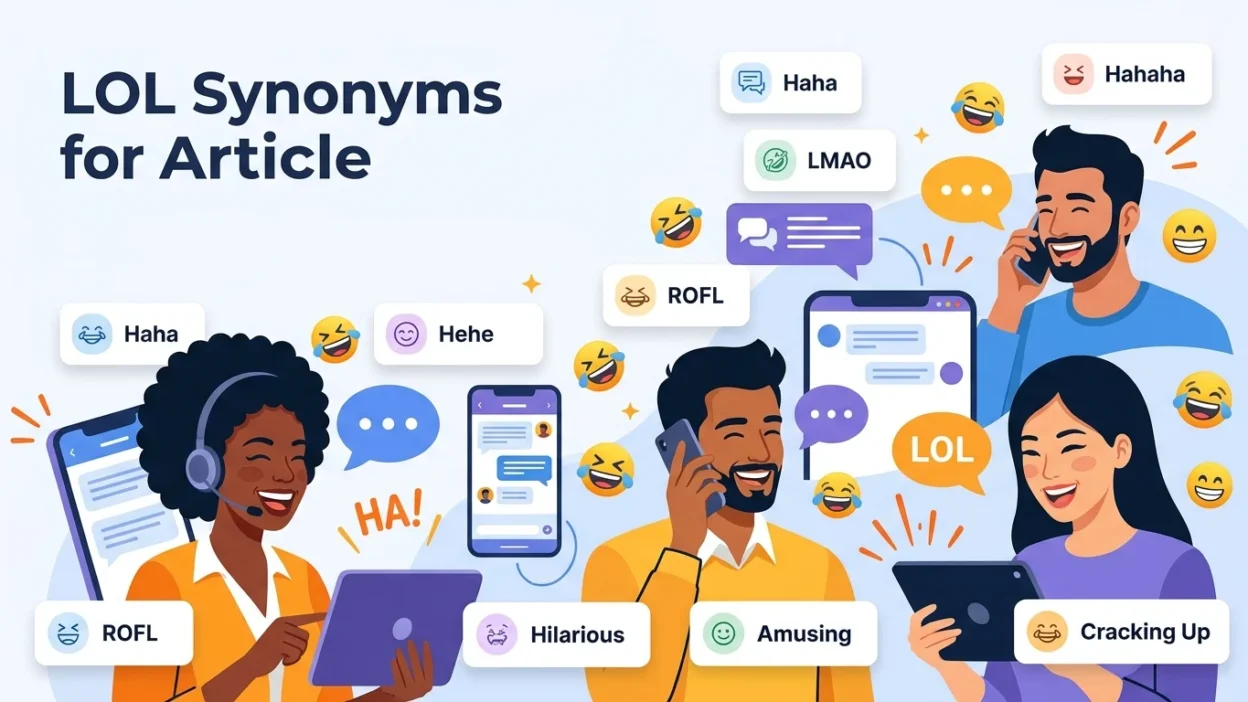
The abbreviation LOL is one of the most popular ways to show laughter in digital communication. It usually means “laughing out loud” and is commonly used in text messages, social media posts, online chats, comments, and casual conversations. Learning LOL synonyms can help you express amusement in different ways and make your online communication more natural and varied.
Although LOL is simple and widely understood, it does not always express the exact level of laughter or emotion you feel. Sometimes you may want to say that something is funny, hilarious, or amusing. In other situations, expressions such as LMAO, ROFL, haha, or I’m dying may better communicate strong laughter in informal online conversations.
This guide explores 30 useful alternatives to LOL. Each word or expression includes a simple meaning, an example sentence, and the best usage context. Whether you are a student, ESL learner, writer, content creator, or social media user, these alternatives can help you choose the right expression for every funny moment.
What Does “LOL” Mean?
LOL is an abbreviation for “laughing out loud.” It is used in digital communication to show that something is funny or amusing.
For example:
That video was so funny, LOL!
The expression can also be used to make a message sound more relaxed or friendly, even when the person is not literally laughing out loud.
For example:
I forgot my keys again, lol.
In this sentence, lol may simply show amusement or make the message sound less serious.
The tone of LOL is usually:
- Informal
- Friendly
- Casual
- Common in online communication
- Suitable for texts and social media
30 LOL Synonyms and Alternatives
1. Haha
Meaning: A simple written expression of laughter.
Example: Haha, I can’t believe you actually did that!
Best usage context: Casual texts, chats, and social media.
2. Hahaha
Meaning: A stronger written expression of laughter than “haha.”
Example: Hahaha, that was the funniest thing I have seen all day!
Best usage context: Stronger amusement in informal conversations.
3. Hehe
Meaning: A light, playful, or slightly mischievous laugh.
Example: Hehe, I knew you would notice the surprise.
Best usage context: Playful, friendly, or teasing conversations.
4. LMAO
Meaning: An abbreviation for “laughing my ass off,” used to show strong laughter.
Example: LMAO, that unexpected ending was incredible!
Best usage context: Very informal online conversations.
5. ROFL
Meaning: An abbreviation for “rolling on the floor laughing.”
Example: ROFL, I cannot stop laughing at that joke!
Best usage context: Extremely funny online content and casual chats.
6. LMFAO
Meaning: A stronger and more emphatic version of LMAO.
Example: LMFAO, that video was absolutely ridiculous!
Best usage context: Very informal digital communication.
7. I’m Dying
Meaning: An exaggerated way to say something is extremely funny.
Example: I’m dying at the way he reacted to that situation.
Best usage context: Casual social media and messaging.
8. I Can’t
Meaning: A humorous expression showing that something is so funny you do not know how to react.
Example: I can’t. That cat’s expression is too funny.
Best usage context: Informal online conversations.
9. That’s Hilarious
Meaning: That is extremely funny.
Example: That story is hilarious!
Best usage context: Everyday speech, texts, and social media.
10. That’s Funny
Meaning: That makes me laugh or feel amused.
Example: That’s funny—I never thought about it that way.
Best usage context: General conversation and casual writing.
11. Too Funny
Meaning: Extremely amusing or entertaining.
Example: Your description of the situation is too funny.
Best usage context: Informal conversations and social media.
12. Hilarious
Meaning: Extremely funny.
Example: The comedian’s performance was hilarious.
Best usage context: Everyday speech and writing.
13. Amusing
Meaning: Pleasantly funny or entertaining.
Example: The article included an amusing story about the author’s childhood.
Best usage context: Polite, neutral, and slightly formal writing.
14. Entertaining
Meaning: Enjoyable and interesting in a way that keeps you engaged.
Example: The movie was entertaining from beginning to end.
Best usage context: Reviews, conversations, and general writing.
15. Comical
Meaning: Funny in an amusing or silly way.
Example: His attempt to dance was completely comical.
Best usage context: Descriptions, storytelling, and informal writing.
16. Humorous
Meaning: Funny or showing a sense of humor.
Example: She wrote a humorous article about everyday office problems.
Best usage context: Formal and semi-formal writing.
Meaning: Extremely funny.
Best usage context: Informal conversations and enthusiastic reactions.
18. Cracking Up
Meaning: Laughing a lot or beginning to laugh uncontrollably.
Example: I was cracking up while watching that video.
Best usage context: Informal speech, texts, and social media.
19. Laughing
Meaning: Showing amusement through laughter.
Example: I’m still laughing about what happened yesterday.
Best usage context: Everyday conversations and messages.
20. Laugh Out Loud
Meaning: The full phrase represented by the abbreviation LOL.
Example: That joke made me laugh out loud.
Best usage context: Clear writing and situations where abbreviations are not appropriate.
21. Grinning
Meaning: Smiling broadly because something is funny or pleasing.
Example: I was grinning while reading your message.
Best usage context: Mild amusement and friendly communication.
22. Smiling
Meaning: Showing happiness or amusement with a smile.
Example: Your story had me smiling the entire time.
Best usage context: Gentle amusement and warm reactions.
23. Chuckling
Meaning: Laughing quietly or softly.
Example: He was chuckling as he read the funny comment.
Best usage context: Calm, mild, or understated amusement.
24. Giggling
Meaning: Laughing lightly and repeatedly.
Example: The children were giggling at the silly joke.
Best usage context: Light, playful, or youthful laughter.
25. Snickering
Meaning: Laughing quietly, sometimes in a secretive or slightly disrespectful way.
Example: The students were snickering at the funny mistake.
Best usage context: Mischievous or hidden laughter.
26. Cracking Me Up
Meaning: Making me laugh a lot.
Example: Your comments are cracking me up today.
Best usage context: Casual texts and online conversations.
27. I’m Laughing So Hard
Meaning: An exaggerated expression showing intense amusement.
Example: I’m laughing so hard at this unexpected plot twist.
Best usage context: Informal digital communication.
28. Dead
Meaning: Internet slang meaning that something is extremely funny.
Example: That reaction image is so funny. I’m dead.
Best usage context: Very informal social media and messaging.
29. Weak
Meaning: Internet slang suggesting that laughter has made someone feel weak.
Example: That joke was so unexpected. I’m weak.
Best usage context: Casual online communication.
30. I’m Losing It
Meaning: An exaggerated way to say you are laughing uncontrollably.
Example: I’m losing it at the way the dog reacted.
Best usage context: Informal conversations, memes, and social media.
Quick Comparison of LOL Synonyms
| Expression | Main Meaning | Tone | Best Usage Context |
|---|---|---|---|
| Haha | Simple laughter | Casual | Texts and chats |
| Hahaha | Stronger laughter | Casual | Very funny moments |
| Hehe | Playful laughter | Light | Teasing and friendly chats |
| LMAO | Strong laughter | Very informal | Online conversations |
| ROFL | Extreme laughter | Very informal | Extremely funny content |
| I’m dying | Very strong amusement | Informal | Social media and texts |
| That’s hilarious | Extremely funny | Casual | Everyday conversations |
| Amusing | Pleasantly funny | Neutral | Polite and formal writing |
| Humorous | Funny or witty | Formal | Articles and essays |
| Cracking up | Laughing a lot | Informal | Speech and messages |
| Chuckling | Quiet laughter | Neutral | Mild amusement |
| Giggling | Light repeated laughter | Playful | Children and playful situations |
LOL Synonyms for Different Levels of Laughter
The best alternative depends on how strongly you want to express amusement.
For mild amusement, use:
- Hehe
- Smiling
- Grinning
- Amusing
- Chuckling
For normal laughter, use
- Haha
- Hahaha
- That’s funny
- Laughing
- Humorous
- LMAO
- ROFL
- LMFAO
- Cracking up
- I’m dying
- I can’t
- I’m dead
- I’m weak
- I’m losing it
- Cracking me up
How to Choose the Right LOL Synonym
Use “Haha” for Simple, Natural Laughter
Haha is one of the easiest alternatives to LOL. It works in almost any casual online conversation.
Haha, that was a good one.
It sounds friendly and natural without exaggerating your reaction.
Use “Hahaha” for Stronger Amusement
Choose hahaha when something is funnier than a simple joke.
Hahaha, I can’t believe that actually happened!
The repeated “ha” creates a stronger sense of laughter.
Use “Hehe” for Playful or Mischievous Moments
Hehe often sounds softer and more playful than haha.
Hehe, I may have eaten the last cookie.
It can suggest teasing, shyness, or harmless mischief.
Use “LMAO” or “ROFL” for Extreme Online Laughter
Choose LMAO or ROFL when something is extremely funny and you want a dramatic reaction.
ROFL, that ending was completely unexpected.
These expressions are highly informal and are best used in casual digital communication.
Use “Hilarious” for Clear and Direct Meaning
If you want to express strong amusement without using internet slang, hilarious is an excellent choice.
That story was hilarious.
It works in both spoken and written English.
Use “Amusing” for a More Polite Tone
Amusing is a softer and more polished alternative to funny.
The writer included an amusing example.
It is especially useful in essays, reviews, and professional writing.
Use “Humorous” in Formal Writing
Choose humorous when describing writing, speech, content, or a person with a sense of humor.
The article uses a humorous tone to discuss a serious topic.
This word sounds more formal than LOL or haha.
Use “Cracking Up” for Active Laughter
Cracking up shows that you are actually laughing a lot.
I was cracking up while watching that video.
It is natural in casual spoken English and online conversations.
Use “I’m Dying” for Dramatic Internet Humor
I’m dying does not usually mean actual physical danger in this context. It is an exaggerated way to say something is incredibly funny.
I’m dying at that comment.
Use it only in informal contexts where internet slang is appropriate.
Formal and Informal LOL Synonyms
Different alternatives are appropriate for different situations.
Very Informal Choices
- LOL
- LMAO
- ROFL
- LMFAO
- I’m dead
- I’m weak
- I’m dying
- I can’t
Casual Choices
- Haha
- Hahaha
- Hehe
- That’s funny
- Too funny
- Cracking me up
- I’m losing it
Neutral or Formal Choices
- Amusing
- Humorous
- Entertaining
- Comical
- Hilarious
Understanding the level of formality helps you communicate more naturally.
LOL Synonyms for Students and ESL Learners
For simple everyday English, the easiest alternatives are:
- Haha
- That’s funny
- Hilarious
- Amusing
- Funny
- Laughing
- Cracking up
For example:
LOL, that joke was great.
You could also say:
Haha, that joke was great.
That was hilarious.
I was laughing so much.
That really made me laugh.
These alternatives help learners communicate naturally without relying only on internet abbreviations.
LOL in Texting and Social Media
LOL is especially common in texting, online chats, comments, and social media. However, different online communities may use different expressions.
For example:
- Haha sounds natural and friendly.
- LMAO suggests stronger laughter.
- ROFL is exaggerated and humorous.
- I’m dead is modern internet slang.
- I can’t can show that something is too funny to handle.
- I’m weak is a casual slang expression for intense amusement.
The best choice depends on your audience and the platform you are using.
Common Mistakes When Using LOL Synonyms
One common mistake is using extremely informal expressions in formal writing. Abbreviations such as LMAO, ROFL, and LMFAO are usually inappropriate in academic essays, professional reports, and formal emails.
Another mistake is assuming that all laughter expressions have the same emotional tone. Hehe can sound playful, haha is generally neutral, and I’m dying is much more dramatic.
It is also important to remember that internet slang changes over time. Expressions such as I’m dead and I’m weak may be popular in casual online communication but may not be suitable for every audience.
Frequently Asked Questions About LOL Synonyms
What is the best synonym for LOL?
The best general alternative is haha. For stronger laughter, you can use LMAO, ROFL, or that’s hilarious.
What does LOL mean?
LOL means “laughing out loud.” It is used to show amusement in digital communication.
What is a formal synonym for LOL?
Formal alternatives include amusing, humorous, entertaining, and comical, depending on the sentence.
What is a stronger version of LOL?
LMAO, ROFL, and LMFAO are commonly used to express stronger laughter in informal online communication.
Is “haha” the same as “LOL”?
They are similar, but haha directly represents laughter, while LOL is an abbreviation that can express amusement even when someone is not literally laughing.
What is a funny internet synonym for LOL?
Popular informal choices include I’m dead, I’m weak, I can’t, I’m dying, and I’m losing it.
Conclusion
The abbreviation LOL is a simple and popular way to show laughter in digital communication. However, learning different alternatives can help you express the exact level and type of amusement you feel.
Use haha for simple laughter, hahaha for stronger amusement, hehe for playful reactions, and LMAO or ROFL for intense online laughter. In more formal writing, words such as amusing, humorous, entertaining, and comical are better choices.
Understanding these differences helps students, ESL learners, writers, and content creators communicate with more variety and confidence. Whether you are writing a text message, creating social media content, or describing something funny in an article, the right LOL synonym can make your message sound more natural and expressive.

Evelyn Mia is a passionate language writer and vocabulary enthusiast at Synomity.com, specializing in synonyms, word meanings, and language learning. She creates informative content that helps readers expand vocabulary and communicate more effectively.