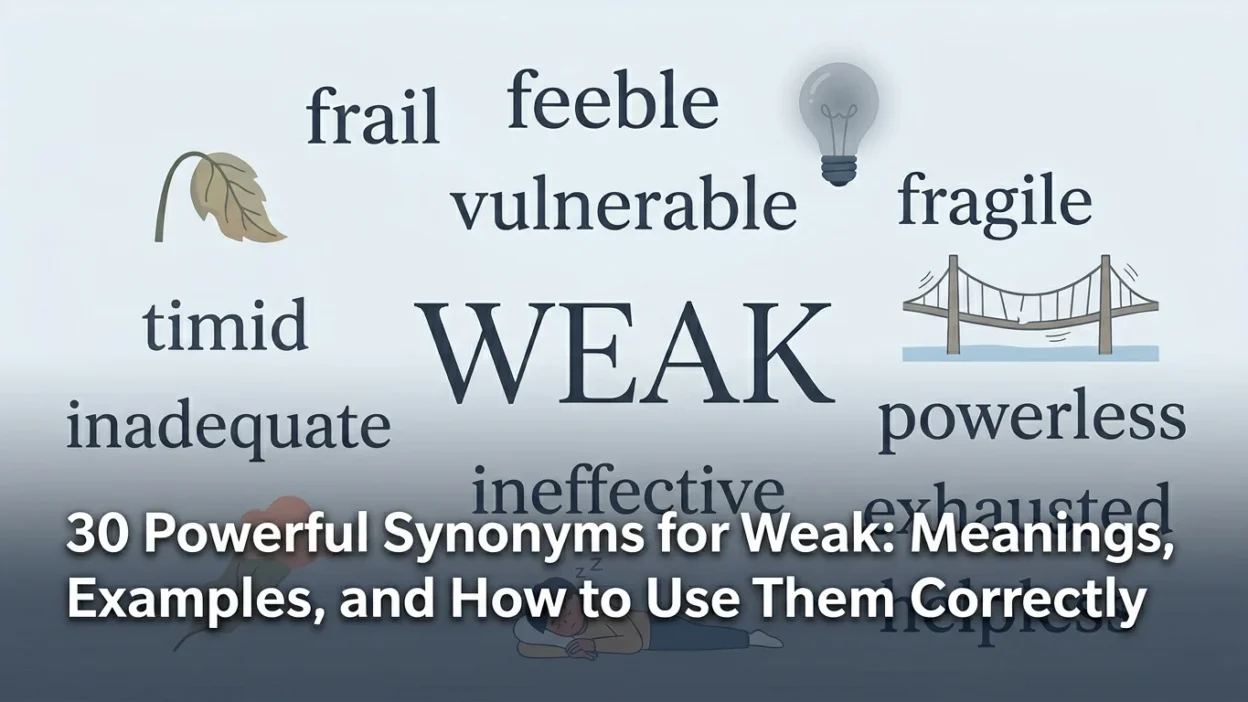
People often search for synonyms for weak because they want to express ideas more accurately and avoid repeating the same word. Whether you’re writing an essay, improving your English vocabulary, creating content, or simply trying to communicate more clearly, knowing alternative words for weak can make your language richer and more effective.
The word weak can describe physical strength, emotional resilience, arguments, performances, flavors, sounds, and even personalities. Because it has many meanings, choosing the right synonym depends on the context. A person recovering from illness may be weak physically, while an argument can be weak because it lacks evidence.
This guide will help students, ESL learners, writers, and content creators understand the different shades of meaning behind words related to weak. You’ll learn simple definitions, practical examples, and when each synonym works best.
Understanding the Meaning of “Demure”
Although this article focuses on synonyms for weak, the term demure is included for vocabulary learning purposes.
Demure means being quiet, modest, reserved, and polite in behavior or appearance. It often describes someone who avoids drawing attention to themselves.
Tone and Usage Context
- Tone: Gentle, respectful, modest.
- Common Usage: Literature, personality descriptions, fashion writing, and social observations.
Example:
She gave a demure smile before quietly introducing herself to the audience.
Demure usually has a positive tone, suggesting elegance and modesty rather than shyness.
30 Synonyms for Weak
1. Frail
Meaning: Physically delicate or easily broken.
Example:
The frail old man walked carefully with a cane.
Best Usage Context: Physical health and aging.
2. Feeble
Meaning: Lacking strength or energy.
Example:
After the illness, she felt feeble for several weeks.
Best Usage Context: Health, effort, or weak attempts.
3. Fragile
Meaning: Easily damaged or broken.
Example:
The fragile vase needed careful handling.
Best Usage Context: Objects, emotions, relationships.
4. Delicate
Meaning: Easily harmed or sensitive.
Example:
The baby had delicate skin.
Best Usage Context: Health, situations, materials.
5. Powerless
Meaning: Unable to influence events.
Example:
He felt powerless during the crisis.
Best Usage Context: Emotional or social situations.
6. Vulnerable
Meaning: Open to harm or attack.
Example:
Young children are vulnerable to infections.
Best Usage Context: Safety, emotions, health.
7. Helpless
Meaning: Unable to defend or help oneself.
Example:
The stranded travelers felt helpless.
Best Usage Context: Difficult circumstances.
8. Inadequate
Meaning: Not good enough for a purpose.
Example:
The equipment was inadequate for the task.
Best Usage Context: Performance and capability.
9. Inferior
Meaning: Lower in quality or ability.
Example:
The cheaper product proved inferior.
Best Usage Context: Comparisons.
10. Ineffective
Meaning: Failing to produce results.
Example:
The campaign was ineffective.
Best Usage Context: Plans and methods.
11. Unconvincing
Meaning: Not persuasive.
Example:
His explanation sounded unconvincing.
Best Usage Context: Arguments and speeches.
12. Flimsy
Meaning: Weak and poorly made.
Example:
The flimsy chair collapsed.
Best Usage Context: Objects and excuses.
13. Slack
Meaning: Lacking energy or effort.
Example:
The team became slack after winning.
Best Usage Context: Work performance.
14. Lax
Meaning: Not strict or careful.
Example:
Security measures were lax.
Best Usage Context: Rules and discipline.
15. Timid
Meaning: Lacking courage or confidence.
Example:
The timid student avoided speaking.
Best Usage Context: Personality traits.
16. Cowardly
Meaning: Showing a lack of bravery.
Example:
Running away was a cowardly act.
Best Usage Context: Behavior and actions.
17. Hesitant
Meaning: Slow because of uncertainty.
Example:
She was hesitant to answer.
Best Usage Context: Decision-making.
18. Shaky
Meaning: Unstable or uncertain.
Example:
His voice sounded shaky.
Best Usage Context: Emotions and structures.
19. Wobbly
Meaning: Not steady.
Example:
The table was wobbly.
Best Usage Context: Physical stability.
20. Pale
Meaning: Lacking strength or intensity.
Example:
The soup tasted pale and bland.
Best Usage Context: Colors and comparisons.
21. Mild
Meaning: Not strong or intense.
Example:
The medicine caused mild side effects.
Best Usage Context: Flavors, weather, effects.
22. Bland
Meaning: Lacking flavor or excitement.
Example:
The speech was bland.
Best Usage Context: Food and creativity.
23. Soft
Meaning: Gentle rather than forceful.
Example:
He spoke in a soft voice.
Best Usage Context: Sounds and personalities.
24. Faint
Meaning: Barely noticeable.
Example:
A faint sound came from outside.
Best Usage Context: Smells, sounds, signs.
25. Exhausted
Meaning: Extremely tired.
Example:
The runners were exhausted.
Best Usage Context: Physical energy.
26. Drained
Meaning: Emotionally or physically depleted.
Example:
She felt drained after work.
Best Usage Context: Emotional fatigue.
27. Tired
Meaning: Needing rest.
Example:
I am too tired to study.
Best Usage Context: Everyday conversations.
28. Defenseless
Meaning: Unable to protect oneself.
Example:
The villagers were defenseless.
Best Usage Context: Conflict and danger.
29. Substandard
Meaning: Below acceptable quality.
Example:
The materials were substandard.
Best Usage Context: Products and services.
30. Spineless
Meaning: Lacking courage or determination.
Example:
People criticized his spineless response.
Best Usage Context: Informal personality descriptions.
Comparison Guide: When to Use Different Synonyms for Weak
| Situation | Best Synonyms |
|---|---|
| Physical weakness | Frail, Feeble, Exhausted, Tired |
| Emotional weakness | Vulnerable, Helpless, Drained |
| Weak arguments | Ineffective, Unconvincing, Flimsy |
| Lack of bravery | Timid, Cowardly, Spineless |
| Poor quality | Inferior, Substandard, Inadequate |
| Low intensity | Mild, Faint, Pale |
| Lack of effort | Slack, Lax |
| Unstable conditions | Shaky, Wobbly |
How to Choose the Right Synonym
Choosing the best synonym depends on what kind of weakness you want to describe.
For Physical Strength
Use:
- Frail
- Feeble
- Exhausted
- Tired
These words describe bodies, health, and energy levels.
For Emotional Sensitivity
Use:
- Vulnerable
- Helpless
- Drained
These express emotional exposure or fatigue.
For Weak Ideas or Arguments
Use:
- Ineffective
- Unconvincing
- Flimsy
These work well in essays, debates, and professional writing.
For Lack of Courage
Use:
- Timid
- Cowardly
- Spineless
Choose carefully because some have stronger negative meanings.
For Poor Quality or Ability
Use:
- Inferior
- Inadequate
- Substandard
These are useful for reviews and comparisons.
For Gentle or Low Intensity
Use:
- Mild
- Faint
- Soft
- Pale
These fit descriptions involving flavor, sound, color, and mood.
Why Learning Synonyms for Weak Matters
Expanding your vocabulary helps you:
- Avoid repetitive writing.
- Express ideas more accurately.
- Improve essays and assignments.
- Write engaging blog posts and stories.
- Speak English with greater confidence.
- Understand subtle differences in meaning.
A richer vocabulary allows readers and listeners to understand exactly what you mean.
Conclusion
Learning synonyms for weak is about much more than replacing one word with another. Different situations require different shades of meaning. A frail person, an ineffective strategy, a timid personality, and a mild flavor all represent different forms of weakness.
By understanding definitions, examples, and usage contexts, students, ESL learners, writers, and content creators can communicate with greater precision and confidence. Keep this guide handy whenever you want to choose a more accurate and engaging alternative to the word weak.

John Morrison is a dedicated content writer at Synomity.com, focused on synonyms, vocabulary development, and word meanings. He creates clear, educational resources that help readers improve language skills and communicate with confidence.