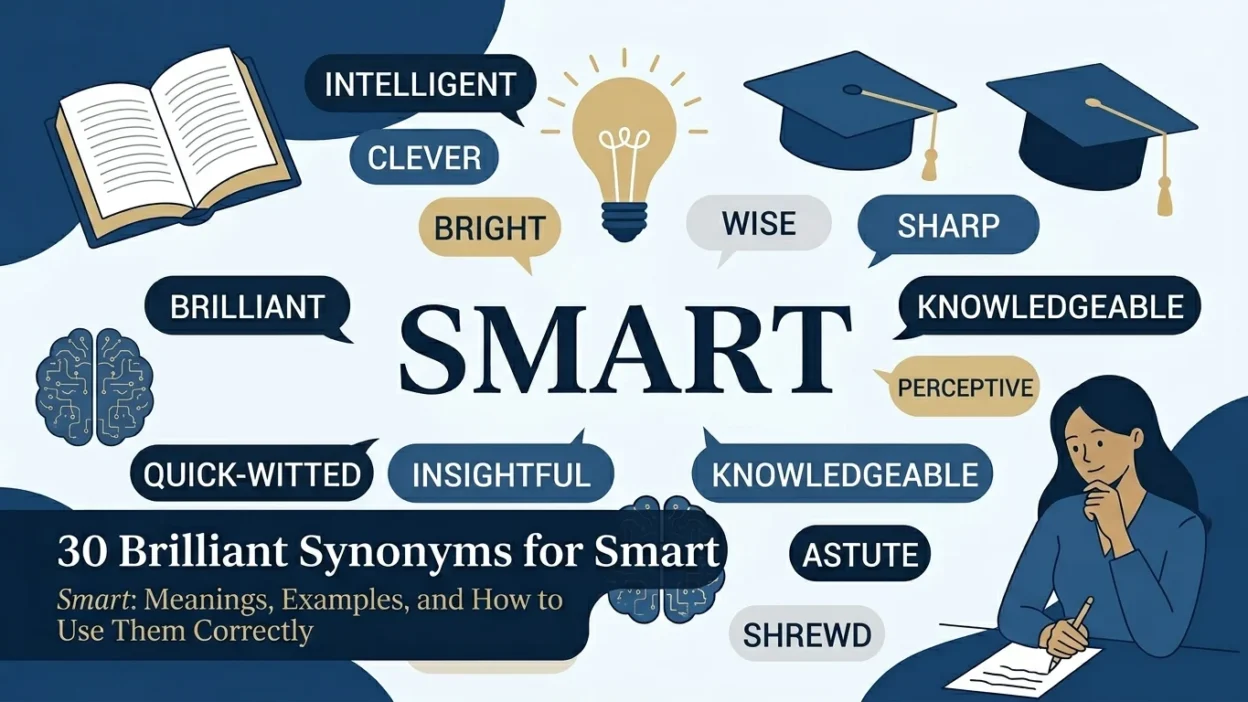
The word smart is one of the most common words in English. We use it to describe intelligent students, clever ideas, quick thinkers, and people who solve problems effectively. However, using the same word repeatedly can make your writing sound repetitive. That’s why learning synonyms for smart is valuable for students, ESL learners, writers, and content creators.
Different synonyms for smart carry slightly different meanings. Some describe academic intelligence, while others focus on practical wisdom, creativity, quick thinking, or sound judgment. Choosing the right word helps you communicate your ideas more accurately and naturally.
In this guide, you’ll discover beginner-friendly explanations, practical examples, and usage notes for common alternatives to smart. By the end, you’ll have a richer vocabulary and greater confidence in both speaking and writing English.
Understanding the Meaning of “Demure”
Although this article focuses on synonyms for smart, the term demure is included to expand your vocabulary knowledge.
Demure means quiet, modest, reserved, and polite in behavior or appearance. A demure person usually avoids attracting too much attention and behaves in a graceful manner.
Tone and Usage Context
- Tone: Gentle, elegant, and respectful.
- Usage Context: Personality descriptions, literature, fashion, and social settings.
Example:
She gave a demure smile and thanked everyone for their support.
Demure often has a positive meaning, suggesting modesty and refinement rather than shyness.
30 Synonyms for Demure
1. Modest
Meaning: Not showing off abilities or appearance.
Example:
She remained modest despite her success.
Best Usage Context: Personality and achievements.
2. Reserved
Meaning: Quiet and not openly expressive.
Example:
He was reserved during the meeting.
Best Usage Context: Social behavior.
3. Shy
Meaning: Nervous or uncomfortable around others.
Example:
The shy student avoided eye contact.
Best Usage Context: Everyday conversations.
4. Bashful
Meaning: Easily embarrassed and shy.
Example:
He gave a bashful smile.
Best Usage Context: Friendly descriptions.
5. Coy
Meaning: Pretending to be shy in a playful way.
Example:
She offered a coy response.
Best Usage Context: Romantic or literary settings.
6. Unassuming
Meaning: Humble and not seeking attention.
Example:
Despite fame, he remained unassuming.
Best Usage Context: Positive personality traits.
7. Humble
Meaning: Not arrogant or proud.
Example:
She stayed humble after winning.
Best Usage Context: Character descriptions.
8. Meek
Meaning: Quiet and gentle.
Example:
The meek child spoke softly.
Best Usage Context: Personality discussions.
9. Retiring
Meaning: Avoiding attention and social spotlight.
Example:
He had a retiring nature.
Best Usage Context: Formal writing.
10. Quiet
Meaning: Not loud or attention-seeking.
Example:
She was quiet throughout dinner.
Best Usage Context: General descriptions.
11. Soft-spoken
Meaning: Speaking gently and calmly.
Example:
The teacher was soft-spoken.
Best Usage Context: Communication style.
12. Prim
Meaning: Proper and careful about behavior.
Example:
Her prim manners impressed guests.
Best Usage Context: Formal character descriptions.
13. Proper
Meaning: Following accepted social standards.
Example:
He maintained proper behavior.
Best Usage Context: Etiquette discussions.
14. Ladylike
Meaning: Polite and graceful in manner.
Example:
She behaved in a ladylike way.
Best Usage Context: Traditional contexts.
15. Well-mannered
Meaning: Showing good manners.
Example:
The children were well-mannered.
Best Usage Context: Social behavior.
16. Polite
Meaning: Respectful toward others.
Example:
Always be polite to guests.
Best Usage Context: Everyday situations.
17. Courteous
Meaning: Very respectful and considerate.
Example:
The staff remained courteous.
Best Usage Context: Professional settings.
18. Respectful
Meaning: Showing regard for others.
Example:
The audience stayed respectful.
Best Usage Context: Social interactions.
19. Graceful
Meaning: Elegant in movement and behavior.
Example:
She handled criticism gracefully.
Best Usage Context: Appearance and conduct.
20. Elegant
Meaning: Stylish and refined.
Example:
Her elegant appearance stood out.
Best Usage Context: Fashion and style.
21. Refined
Meaning: Polished and sophisticated.
Example:
He had refined manners.
Best Usage Context: Formal descriptions.
22. Dignified
Meaning: Calm and worthy of respect.
Example:
She remained dignified under pressure.
Best Usage Context: Serious situations.
23. Discreet
Meaning: Careful and private.
Example:
The assistant was discreet.
Best Usage Context: Confidential matters.
24. Restrained
Meaning: Controlled and not excessive.
Example:
He gave a restrained response.
Best Usage Context: Emotions and reactions.
25. Introverted
Meaning: Preferring quieter environments.
Example:
Many introverted people enjoy solitude.
Best Usage Context: Personality discussions.
26. Composed
Meaning: Calm and self-controlled.
Example:
She remained composed during the interview.
Best Usage Context: Stressful situations.
27. Sedate
Meaning: Calm and serious.
Example:
The gathering had a sedate atmosphere.
Best Usage Context: Formal writing.
28. Decorous
Meaning: Proper and socially acceptable.
Example:
His decorous conduct earned praise.
Best Usage Context: Academic or formal contexts.
29. Chaste
Meaning: Simple and modest.
Example:
The design featured chaste elegance.
Best Usage Context: Literature and style.
30. Self-effacing
Meaning: Avoiding attention or praise.
Example:
The self-effacing leader credited the team.
Best Usage Context: Professional and literary writing.
Comparison Guide: When to Use Different Synonyms
| Situation | Best Synonyms |
|---|---|
| Everyday modesty | Modest, Humble, Polite |
| Quiet personality | Reserved, Quiet, Introverted |
| Shyness | Shy, Bashful, Coy |
| Formal elegance | Refined, Elegant, Graceful |
| Good manners | Courteous, Respectful, Well-mannered |
| Emotional control | Composed, Restrained, Dignified |
| Avoiding attention | Unassuming, Retiring, Self-effacing |
| Formal behavior | Proper, Decorous, Prim |
How to Choose the Right Synonym
Choosing the right synonym depends on tone and intent.
For Positive Modesty
Use:
- Modest
- Humble
- Unassuming
These words highlight admirable humility.
For Quiet Personalities
Use:
- Reserved
- Quiet
- Introverted
These describe people who are naturally private.
For Traditional Elegance
Use:
- Demure
- Graceful
- Elegant
- Refined
These suggest sophistication and poise.
For Good Manners
Use:
- Polite
- Courteous
- Respectful
- Well-mannered
These work well in social and professional contexts.
For Emotional Control
Use:
- Composed
- Restrained
- Dignified
These emphasize calmness under pressure.
Why Expanding Your Vocabulary Matters
Learning synonyms improves communication in many ways.
- It helps you avoid repetition.
- It makes writing more engaging.
- It improves essay quality.
- It builds confidence in speaking English.
- It helps you understand subtle differences in meaning.
- It allows you to express ideas more precisely.
A strong vocabulary is useful in school, work, and everyday life.
Conclusion
While many people search for synonyms for smart to strengthen their vocabulary, understanding related words and nuanced meanings also expands your command of English. Learning words associated with demure teaches you how tone, personality, and context influence word choice.
The key is not simply memorizing lists but understanding when and why each word fits a particular situation. With practice, you’ll choose vocabulary more naturally, communicate more clearly, and become a more confident English speaker and writer.

John Morrison is a dedicated content writer at Synomity.com, focused on synonyms, vocabulary development, and word meanings. He creates clear, educational resources that help readers improve language skills and communicate with confidence.