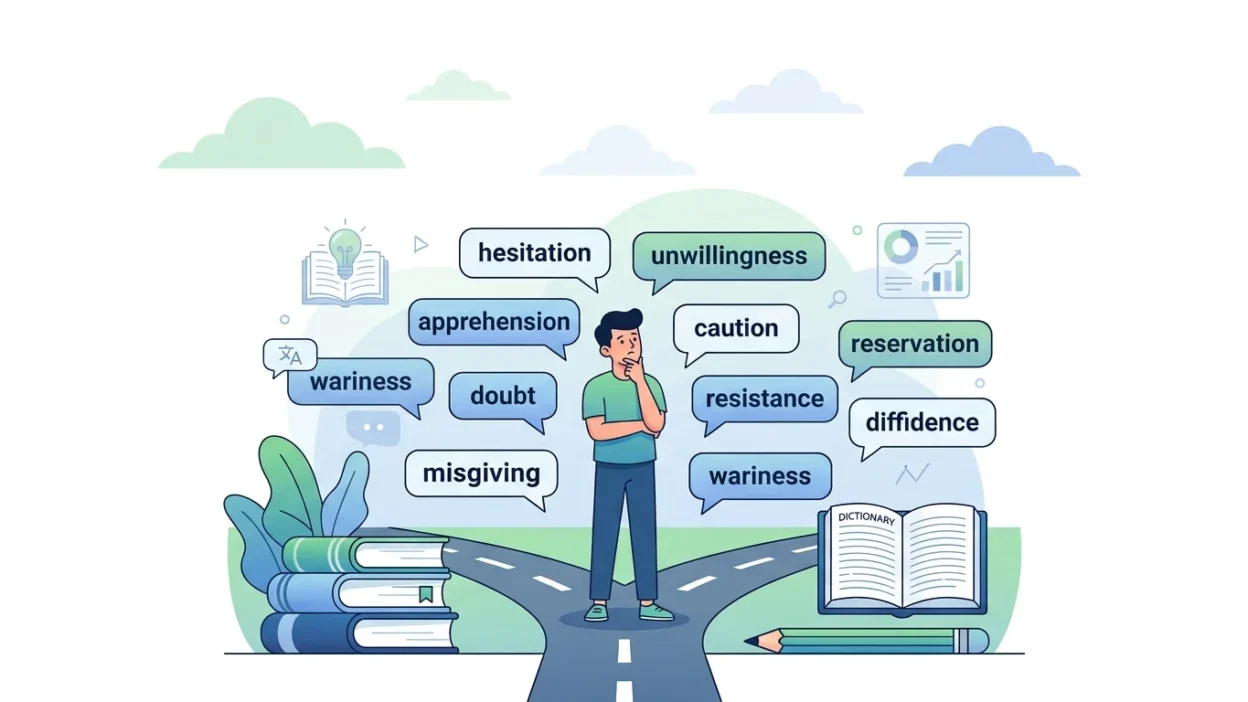
Finding the right reluctance synonyms can make your writing more natural, precise, and engaging.
Instead of repeating the word reluctance, you can choose from many alternatives that better express hesitation, unwillingness, doubt, or resistance depending on the situation.
Whether you’re a student, ESL learner, writer, or content creator, understanding the subtle differences between these words helps you communicate more effectively.
Some synonyms sound formal, while others fit casual conversations or creative writing. Learning when to use each one will improve both your vocabulary and your confidence.
What Does “Reluctance” Mean?
Simple Meaning
Reluctance means not wanting to do something because of hesitation, doubt, fear, or unwillingness. A reluctant person may eventually agree to do something but feels uncertain or uncomfortable about it.
Tone and Usage Context
The word reluctance usually has a neutral tone. It suggests hesitation rather than complete refusal. It is commonly used in everyday conversations, academic writing, business communication, and storytelling.
Example:
She accepted the new job with some reluctance because she would have to move to another city.
30 Best Reluctance Synonyms
1. Hesitation
Meaning: A pause caused by uncertainty.
Example: He showed hesitation before signing the contract.
Best Usage Context: Everyday conversations and formal writing.
2. Unwillingness
Meaning: Not wanting to do something.
Example: Her unwillingness to cooperate delayed the project.
Best Usage Context: Formal and professional writing.
3. Resistance
Meaning: Opposition to an idea or action.
Example: The team faced resistance when introducing new policies.
Best Usage Context: Business and academic writing.
4. Doubt
Meaning: A feeling of uncertainty.
Example: She had doubts about changing careers.
Best Usage Context: General writing and discussions.
5. Apprehension
Meaning: Anxiety about something that may happen.
Example: He felt apprehension before the interview.
Best Usage Context: Formal writing and storytelling.
6. Misgiving
Meaning: A feeling that something may be wrong.
Example: Despite her misgivings, she accepted the invitation.
Best Usage Context: Literature and formal writing.
7. Reservation
Meaning: A concern or doubt.
Example: I have some reservations about the proposal.
Best Usage Context: Professional communication.
8. Caution
Meaning: Carefulness before acting.
Example: She approached the investment with caution.
Best Usage Context: Business and everyday English.
9. Doubtfulness
Meaning: A state of being uncertain.
Example: His doubtfulness was obvious during the discussion.
Best Usage Context: Formal writing.
10. Diffidence
Meaning: Lack of confidence causing hesitation.
Example: Her diffidence prevented her from speaking first.
Best Usage Context: Academic and literary writing.
11. Timidity
Meaning: Shyness or fearfulness.
Example: Timidity stopped him from asking questions.
Best Usage Context: Personal descriptions.
12. Fear
Meaning: Feeling afraid.
Example: Fear made her reluctant to travel alone.
Best Usage Context: General writing.
13. Anxiety
Meaning: Worry about future events.
Example: Anxiety kept him from making a decision.
Best Usage Context: Everyday and formal writing.
14. Uneasiness
Meaning: Feeling uncomfortable or worried.
Example: She felt uneasiness before the presentation.
Best Usage Context: Narrative writing.
15. Concern
Meaning: A feeling of worry.
Example: Parents expressed concern about safety.
Best Usage Context: News and business writing.
16. Wariness
Meaning: Being careful because of possible danger.
Example: Travelers showed wariness around strangers.
Best Usage Context: Storytelling and journalism.
17. Skepticism
Meaning: Doubting whether something is true.
Example: Many people expressed skepticism about the claim.
Best Usage Context: Academic and news writing.
18. Suspicion
Meaning: Feeling that something may be wrong.
Example: His suspicion prevented him from trusting the offer.
Best Usage Context: Crime stories and discussions.
19. Reluctancy
Meaning: Another form of reluctance.
Example: Her reluctancy was easy to notice.
Best Usage Context: General English.
20. Disinclination
Meaning: A preference not to do something.
Example: His disinclination to travel surprised everyone.
Best Usage Context: Formal writing.
21. Aversion
Meaning: Strong dislike.
Example: She has an aversion to public speaking.
Best Usage Context: Formal and academic writing.
22. Antipathy
Meaning: Deep dislike.
Example: His antipathy toward dishonesty was well known.
Best Usage Context: Literary writing.
23. Reticence
Meaning: Being quiet or unwilling to speak.
Example: Her reticence made the interview difficult.
Best Usage Context: Professional and literary writing.
24. Reserve
Meaning: Emotional restraint or caution.
Example: He spoke with noticeable reserve.
Best Usage Context: Formal communication.
25. Inhibition
Meaning: Something that prevents free action.
Example: Fear created an inhibition against speaking publicly.
Best Usage Context: Psychology and education.
26. Indecision
Meaning: Difficulty making a choice.
Example: His indecision delayed the purchase.
Best Usage Context: Everyday English.
27. Vacillation
Meaning: Constantly changing between choices.
Example: Her vacillation confused the team.
Best Usage Context: Formal writing.
28. Shyness
Meaning: Being nervous around others.
Example: Shyness stopped him from introducing himself.
Best Usage Context: Daily conversations.
29. Tentativeness
Meaning: Acting with uncertainty.
Example: She answered with tentativeness.
Best Usage Context: Academic writing.
30. Reluctant Attitude
Meaning: A hesitant way of thinking or behaving.
Example: His reluctant attitude changed after hearing the benefits.
Best Usage Context: General descriptions.
Comparison Guide: When to Use Different Reluctance Synonyms
Quick Comparison Table
| Synonym | Best Used For | Tone |
|---|---|---|
| Hesitation | Short pause before acting | Neutral |
| Unwillingness | Not wanting to act | Formal |
| Resistance | Opposition | Professional |
| Doubt | Uncertainty | Neutral |
| Apprehension | Fear of future events | Formal |
| Misgiving | Inner concern | Literary |
| Reservation | Minor concerns | Professional |
| Caution | Careful behavior | Neutral |
| Diffidence | Lack of confidence | Formal |
| Timidity | Shyness | Neutral |
| Anxiety | Worry | Neutral |
| Wariness | Carefulness | Neutral |
| Skepticism | Doubting facts | Academic |
| Disinclination | Preference not to act | Formal |
| Aversion | Strong dislike | Formal |
| Reticence | Quiet hesitation | Literary |
| Indecision | Difficulty choosing | Everyday |
| Vacillation | Changing decisions repeatedly | Formal |
| Shyness | Social nervousness | Everyday |
| Tentativeness | Uncertain actions | Academic |
How to Choose the Right Reluctance Synonym
For Everyday Conversations
Choose:
- Hesitation
- Doubt
- Concern
- Shyness
- Indecision
These words are easy to understand and commonly used.
For Academic Writing
Choose:
- Diffidence
- Apprehension
- Skepticism
- Inhibition
- Vacillation
These sound more formal and precise.
For Business Communication
Choose:
- Reservation
- Resistance
- Caution
- Unwillingness
- Concern
These fit reports, emails, and workplace discussions.
For Creative Writing
Choose:
- Misgiving
- Wariness
- Reticence
- Aversion
- Uneasiness
These create stronger emotions and richer descriptions.
For Strong Negative Feelings
Choose:
- Aversion
- Antipathy
- Resistance
- Fear
These suggest stronger emotions than simple reluctance.
For Mild Hesitation
Choose:
- Hesitation
- Reservation
- Doubt
- Tentativeness
These express uncertainty without sounding too negative.
Common Mistakes When Using Reluctance Synonyms
Confusing Hesitation with Refusal
Hesitation means someone may still agree later.
Correct: She hesitated before answering.
Using Aversion Instead of Reluctance
Aversion means strong dislike, while reluctance simply means hesitation.
Correct: He felt reluctance about speaking.
Not Always Correct: He had an aversion to speaking.
Mixing Doubt with Fear
Doubt refers to uncertainty.
Fear refers to being afraid.
Choose the word that best matches the emotion.
Why Learning Reluctance Synonyms Matters
Expanding your vocabulary helps you avoid repetition and express ideas more accurately. Different situations require different levels of emotion and formality. Knowing several reluctance synonyms allows you to write naturally in essays, emails, stories, articles, and conversations.
For ESL learners, these words also improve reading comprehension because you’ll recognize them in books, news articles, and exams.
Conclusion
Learning reluctance synonyms is an excellent way to improve your English vocabulary and writing skills. While reluctance expresses hesitation or unwillingness, its alternatives each carry slightly different meanings and tones. Words like hesitation, reservation, misgiving, apprehension, and disinclination work better in different situations.
Practice using these synonyms in your own sentences, and you’ll quickly become more confident in choosing the perfect word for every context.

John Morrison is a dedicated content writer at Synomity.com, focused on synonyms, vocabulary development, and word meanings. He creates clear, educational resources that help readers improve language skills and communicate with confidence.