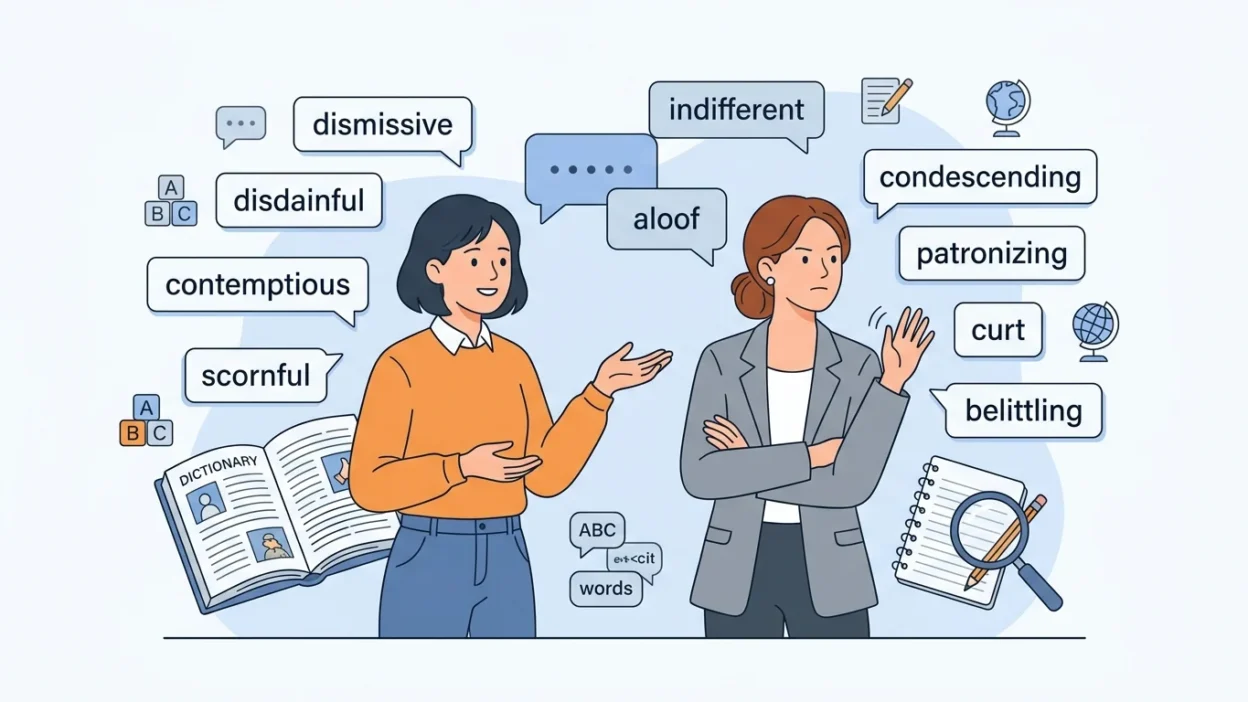
Using the right dismissive synonyms can make your writing more expressive and accurate.
Instead of repeating the word dismissive, you can choose from many alternatives that better describe someone’s attitude, behavior, or response.
Each synonym carries a slightly different meaning, helping you match the right tone to the situation.
Whether you’re a student, ESL learner, writer, or content creator, expanding your vocabulary with dismissive synonyms will improve your writing and speaking skills.
Some words express mild indifference, while others suggest disrespect, rejection, or lack of interest. Understanding these differences allows you to communicate more naturally and effectively.
What Does “Dismissive” Mean?
Simple Meaning
The word dismissive describes someone who shows that they do not think something or someone is important, worthy of attention, or deserving of respect. A dismissive person may ignore ideas, reject opinions quickly, or behave as though something does not matter.
Tone and Usage Context
Dismissive usually has a negative tone. It is commonly used when describing attitudes, conversations, workplace behavior, relationships, and opinions.
Examples:
- The manager gave a dismissive response to the suggestion.
- She sounded dismissive when answering his question.
- His dismissive attitude discouraged the team.
30 Best Dismissive Synonyms
1. Disdainful
Meaning: Showing strong dislike or lack of respect.
Example: She gave him a disdainful look.
Best Usage Context: Formal writing and literature.
2. Contemptuous
Meaning: Showing deep disrespect.
Example: His contemptuous remarks upset everyone.
Best Usage Context: Academic and professional writing.
3. Scornful
Meaning: Expressing strong dislike or ridicule.
Example: She made a scornful comment about the idea.
Best Usage Context: Storytelling and journalism.
4. Indifferent
Meaning: Not caring or showing interest.
Example: He seemed indifferent to the results.
Best Usage Context: Everyday English.
5. Unconcerned
Meaning: Not worried or interested.
Example: She remained unconcerned during the discussion.
Best Usage Context: General writing.
6. Aloof
Meaning: Emotionally distant or unfriendly.
Example: The new employee appeared aloof.
Best Usage Context: Character descriptions.
7. Condescending
Meaning: Acting as though others are less intelligent.
Example: His condescending tone annoyed the audience.
Best Usage Context: Workplace and education.
8. Patronizing
Meaning: Treating someone as less capable.
Example: Her patronizing comments were unnecessary.
Best Usage Context: Professional communication.
9. Derisive
Meaning: Showing mockery or ridicule.
Example: The audience laughed with derisive humor.
Best Usage Context: Literature and criticism.
10. Mocking
Meaning: Making fun of someone.
Example: His mocking voice hurt her feelings.
Best Usage Context: Everyday conversations.
11. Belittling
Meaning: Making someone feel less important.
Example: Constant belittling damaged his confidence.
Best Usage Context: Relationships and workplace.
12. Snobbish
Meaning: Acting as though you are superior.
Example: Her snobbish attitude offended others.
Best Usage Context: Informal writing.
13. Arrogant
Meaning: Overly proud and disrespectful.
Example: His arrogant behavior frustrated the team.
Best Usage Context: General English.
14. Cold
Meaning: Emotionally distant.
Example: She gave him a cold reply.
Best Usage Context: Relationships.
15. Detached
Meaning: Not emotionally involved.
Example: He remained detached throughout the meeting.
Best Usage Context: Formal and academic writing.
16. Offhand
Meaning: Casual without much thought.
Example: She made an offhand remark.
Best Usage Context: Conversations and articles.
17. Curt
Meaning: Rudely brief.
Example: His curt answer ended the conversation.
Best Usage Context: Business and dialogue.
18. Abrupt
Meaning: Suddenly rude or direct.
Example: Her abrupt response surprised everyone.
Best Usage Context: Everyday writing.
19. Blunt
Meaning: Honest in a way that may seem rude.
Example: He gave a blunt opinion.
Best Usage Context: Professional and casual writing.
20. Unfriendly
Meaning: Not kind or welcoming.
Example: The receptionist seemed unfriendly.
Best Usage Context: Everyday English.
21. Unresponsive
Meaning: Not reacting or replying.
Example: The customer service team was unresponsive.
Best Usage Context: Business communication.
22. Neglectful
Meaning: Failing to give proper attention.
Example: His neglectful attitude affected the project.
Best Usage Context: Formal writing.
23. Rejecting
Meaning: Refusing to accept something.
Example: She gave a rejecting glance.
Best Usage Context: General writing.
24. Ignoring
Meaning: Not paying attention.
Example: He kept ignoring helpful advice.
Best Usage Context: Everyday English.
25. Skeptical
Meaning: Doubting something.
Example: She was skeptical about the proposal.
Best Usage Context: Academic and professional writing.
26. Disinterested
Meaning: Lacking interest.
Example: The students looked disinterested.
Best Usage Context: General English.
27. Insolent
Meaning: Rudely disrespectful.
Example: His insolent behavior upset the teacher.
Best Usage Context: Literature and formal writing.
28. Flippant
Meaning: Not taking something seriously.
Example: She gave a flippant response.
Best Usage Context: Conversations and articles.
29. Dismissing
Meaning: Rejecting or refusing to consider.
Example: He kept dismissing every suggestion.
Best Usage Context: Everyday and business writing.
30. Disrespectful
Meaning: Showing little respect.
Example: His disrespectful comments were inappropriate.
Best Usage Context: General communication.
Comparison Guide for Dismissive Synonyms
When to Use Different Synonyms
| Synonym | Best Used For | Tone |
|---|---|---|
| Dismissive | Ignoring ideas or opinions | Neutral to Negative |
| Disdainful | Strong disrespect | Formal |
| Contemptuous | Deep disrespect | Formal |
| Scornful | Open ridicule | Literary |
| Indifferent | Lack of interest | Neutral |
| Aloof | Emotional distance | Neutral |
| Condescending | Feeling superior | Negative |
| Patronizing | Talking down to others | Negative |
| Curt | Short, rude replies | Everyday |
| Blunt | Direct honesty | Neutral |
| Flippant | Not taking something seriously | Casual |
| Disinterested | Lack of interest | Neutral |
| Unresponsive | No reaction | Professional |
| Belittling | Making others feel small | Negative |
| Mocking | Making fun of someone | Casual |
How to Choose the Right Dismissive Synonym
For Everyday Conversations
Choose:
- Indifferent
- Unfriendly
- Ignoring
- Curt
- Blunt
These words are simple and commonly used.
For Academic Writing
Use:
- Contemptuous
- Disdainful
- Detached
- Skeptical
- Condescending
These sound formal and precise.
For Business Communication
The best choices are:
- Unresponsive
- Detached
- Curt
- Dismissive
- Skeptical
These fit workplace discussions and reports.
For Creative Writing
Choose:
- Scornful
- Derisive
- Mocking
- Aloof
- Insolent
These create vivid character descriptions.
For Describing Strong Disrespect
Use:
- Contemptuous
- Disdainful
- Scornful
- Insolent
- Belittling
These express stronger negative emotions.
For Mild Lack of Interest
Choose:
- Indifferent
- Disinterested
- Detached
- Unconcerned
- Aloof
These suggest distance without open hostility.
Common Mistakes When Using Dismissive Synonyms
Confusing “Indifferent” and “Dismissive”
Indifferent means not caring.
Dismissive means actively treating something as unimportant.
Example:
- She was indifferent to the outcome.
- He was dismissive of her opinion.
Using “Blunt” Instead of “Condescending”
Blunt means direct.
Condescending means acting superior.
A blunt person may simply be honest, while a condescending person speaks down to others.
Confusing “Disinterested” with “Uninterested”
Disinterested traditionally means impartial or unbiased, although it is often used to mean “not interested” in everyday English.
Uninterested more clearly means lacking interest.
Why Learning Dismissive Synonyms Matters
Learning different dismissive synonyms helps you describe attitudes and emotions with greater precision. Instead of repeating the same adjective, you can choose a word that best reflects indifference, disrespect, sarcasm, emotional distance, or rejection. This makes your essays, stories, emails, and conversations more engaging and natural.
For ESL learners, these synonyms also improve reading comprehension by helping you recognize subtle emotional differences in books, articles, and everyday conversations.
Conclusion
Understanding dismissive synonyms strengthens your English vocabulary and helps you express attitudes more accurately. While dismissive generally describes someone who ignores or undervalues others, words like disdainful, indifferent, condescending, patronizing, and scornful each add their own unique shade of meaning.
Practice using these synonyms in different contexts to make your writing more varied, expressive, and confident.

John Morrison is a dedicated content writer at Synomity.com, focused on synonyms, vocabulary development, and word meanings. He creates clear, educational resources that help readers improve language skills and communicate with confidence.