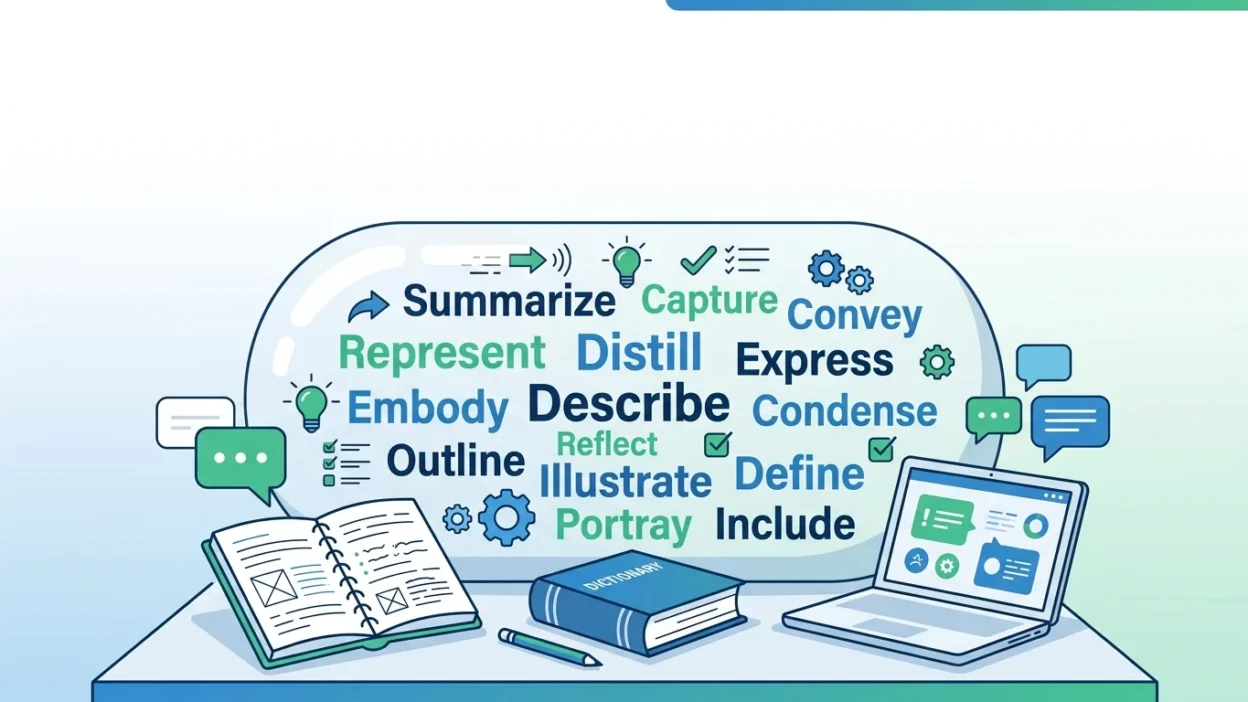
The English word encapsulate is useful when you want to express the idea of containing, summarizing, representing, or enclosing something in a clear and concise way.
Whether you’re writing an essay, creating content, preparing a report, or improving your vocabulary, knowing different encapsulate synonyms can make your writing more natural and engaging.
Many words can replace encapsulate, but each has a slightly different meaning and tone.
Some are better for academic writing, while others fit business communication, storytelling, or everyday conversation. Learning these alternatives helps you choose the most accurate word for every situation.
In this guide, you’ll discover the meaning of encapsulate, explore 30 useful encapsulate synonyms, understand their meanings through simple examples, and learn when each word works best.
What Does “Encapsulate” Mean?
Simple Meaning
Encapsulate means to express the main idea of something in a short and clear way or to contain or enclose something completely.
Tone and Usage Context
The word is commonly used in:
- Academic writing
- Business reports
- Professional presentations
- Technical writing
- Everyday conversations
- Creative writing
Example:
“The final paragraph perfectly encapsulates the author’s main argument.”
Here, encapsulates means summarizes or captures the main idea.
30 Best Encapsulate Synonyms
1. Summarize
Meaning: Explain the main points briefly.
Example: She summarized the meeting in two paragraphs.
Best Usage Context: Reports, essays, presentations.
2. Condense
Meaning: Make something shorter while keeping important details.
Example: Please condense the article into one page.
Best Usage Context: Editing and academic writing.
3. Capture
Meaning: Express or represent perfectly.
Example: The painting captures the beauty of the sunset.
Best Usage Context: Creative writing and descriptions.
4. Represent
Meaning: Stand for or show something.
Example: This logo represents our company’s values.
Best Usage Context: Business and branding.
5. Express
Meaning: Communicate thoughts or ideas.
Example: She expressed her opinion clearly.
Best Usage Context: Everyday and formal writing.
6. Reflect
Meaning: Show or demonstrate something.
Example: His actions reflect kindness.
Best Usage Context: Personal qualities and analysis.
7. Embody
Meaning: Be a perfect example of something.
Example: She embodies confidence and determination.
Best Usage Context: Descriptions and biographies.
8. Enclose
Meaning: Surround or contain completely.
Example: The package enclosed important documents.
Best Usage Context: Physical objects.
9. Include
Meaning: Contain as part of something.
Example: The report includes several recommendations.
Best Usage Context: General writing.
10. Incorporate
Meaning: Add or combine into something larger.
Example: The design incorporates modern features.
Best Usage Context: Business and technical writing.
11. Compress
Meaning: Reduce size or length.
Example: The software compresses large files.
Best Usage Context: Technology and editing.
12. Abstract
Meaning: Remove the essential ideas.
Example: The researcher abstracted the key findings.
Best Usage Context: Academic writing.
13. Outline
Meaning: Present the main points.
Example: The teacher outlined the lesson.
Best Usage Context: Education and planning.
14. Describe
Meaning: Explain in words.
Example: He described the event clearly.
Best Usage Context: Everyday writing.
15. Characterize
Meaning: Describe distinctive qualities.
Example: Patience characterizes her leadership.
Best Usage Context: Formal writing.
16. Define
Meaning: Explain the meaning precisely.
Example: The dictionary defines every word.
Best Usage Context: Education and dictionaries.
17. Explain
Meaning: Make something easy to understand.
Example: Please explain the process.
Best Usage Context: Everyday communication.
18. Illustrate
Meaning: Make something clearer with examples.
Example: The chart illustrates sales growth.
Best Usage Context: Teaching and reports.
19. Convey
Meaning: Communicate an idea or feeling.
Example: His smile conveyed gratitude.
Best Usage Context: Writing and speaking.
20. Portray
Meaning: Present or depict.
Example: The movie portrays real events.
Best Usage Context: Literature and media.
21. Depict
Meaning: Show through words or images.
Example: The novel depicts village life.
Best Usage Context: Creative writing.
22. Frame
Meaning: Present in a particular way.
Example: She framed the discussion positively.
Best Usage Context: Business and communication.
23. Encase
Meaning: Cover or surround completely.
Example: The jewel was encased in glass.
Best Usage Context: Physical enclosure.
24. Package
Meaning: Present something attractively.
Example: The company packaged the proposal professionally.
Best Usage Context: Marketing and business.
25. Distill
Meaning: Reduce to the most important ideas.
Example: The editor distilled the report into one page.
Best Usage Context: Academic and professional writing.
26. Digest
Meaning: Simplify complex information.
Example: The article digests scientific research.
Best Usage Context: Education and journalism.
27. Encircle
Meaning: Surround completely.
Example: Tall trees encircle the lake.
Best Usage Context: Physical descriptions.
28. Wrap Up
Meaning: Finish with a brief summary.
Example: Let’s wrap up today’s meeting.
Best Usage Context: Conversations and meetings.
29. Boil Down
Meaning: Reduce to the essential point.
Example: The issue boils down to trust.
Best Usage Context: Informal writing and speaking.
30. Encipher
Meaning: Encode or hide information.
Example: The message was enciphered for security.
Best Usage Context: Technical and security topics.
When to Use Different Encapsulate Synonyms
Quick Comparison Table
| Synonym | Best For | Tone |
|---|---|---|
| Summarize | Essays, reports | Neutral |
| Condense | Editing | Formal |
| Capture | Emotions, ideas | Creative |
| Represent | Business | Neutral |
| Express | Everyday writing | Neutral |
| Reflect | Analysis | Formal |
| Embody | Personal qualities | Formal |
| Enclose | Physical objects | Neutral |
| Include | General writing | Neutral |
| Incorporate | Technical writing | Formal |
| Compress | Technology | Technical |
| Outline | Planning | Neutral |
| Explain | Teaching | Friendly |
| Convey | Feelings | Professional |
| Distill | Research | Formal |
| Wrap Up | Meetings | Informal |
| Boil Down | Conversation | Informal |
| Encase | Physical enclosure | Neutral |
How to Choose the Right Synonym
For Academic Writing
Use these when writing essays or research papers:
- Summarize
- Condense
- Distill
- Abstract
- Outline
- Define
For Business Communication
These sound professional and clear:
- Represent
- Incorporate
- Frame
- Convey
- Express
- Package
For Creative Writing
These create vivid descriptions:
- Capture
- Embody
- Portray
- Depict
- Reflect
- Illustrate
For Everyday Conversation
Choose simple, natural words:
- Explain
- Describe
- Include
- Wrap Up
- Boil Down
- Express
For Physical Enclosure
Use these when something is literally enclosed:
- Enclose
- Encase
- Encircle
- Include
Common Mistakes When Using “Encapsulate”
Don’t Use “Encapsulate” for Every Summary
Sometimes summarize or outline sounds more natural, especially in everyday writing.
Consider the Context
If you’re talking about emotions, capture or convey may be better than encapsulate.
If you’re discussing physical objects, enclose or encase is often the correct choice.
Match the Tone
Formal documents usually benefit from words like distill, incorporate, or represent, while casual conversations often sound better with wrap up or boil down.
Tips for Improving Your Vocabulary
Learn Words in Context
Reading articles, books, and blogs helps you understand how different synonyms are naturally used.
Practice with Sentences
Create your own example sentence for each new synonym to remember it more easily.
Think About Purpose
Before choosing a synonym, ask yourself:
- Am I summarizing?
- Am I describing?
- Am I representing an idea?
- Am I enclosing something physically?
The answer will help you pick the most suitable word.
Conclusion
Learning encapsulate synonyms helps you write with greater accuracy, variety, and confidence. Although encapsulate is excellent for expressing the idea of summarizing or containing something, many alternatives offer more specific meanings depending on your purpose.
Words like summarize, capture, represent, distill, convey, and embody each bring their own nuance. By understanding these differences and practicing them in context, you’ll improve your vocabulary and make your writing more engaging for readers, teachers, and search engines alike.

John Morrison is a dedicated content writer at Synomity.com, focused on synonyms, vocabulary development, and word meanings. He creates clear, educational resources that help readers improve language skills and communicate with confidence.