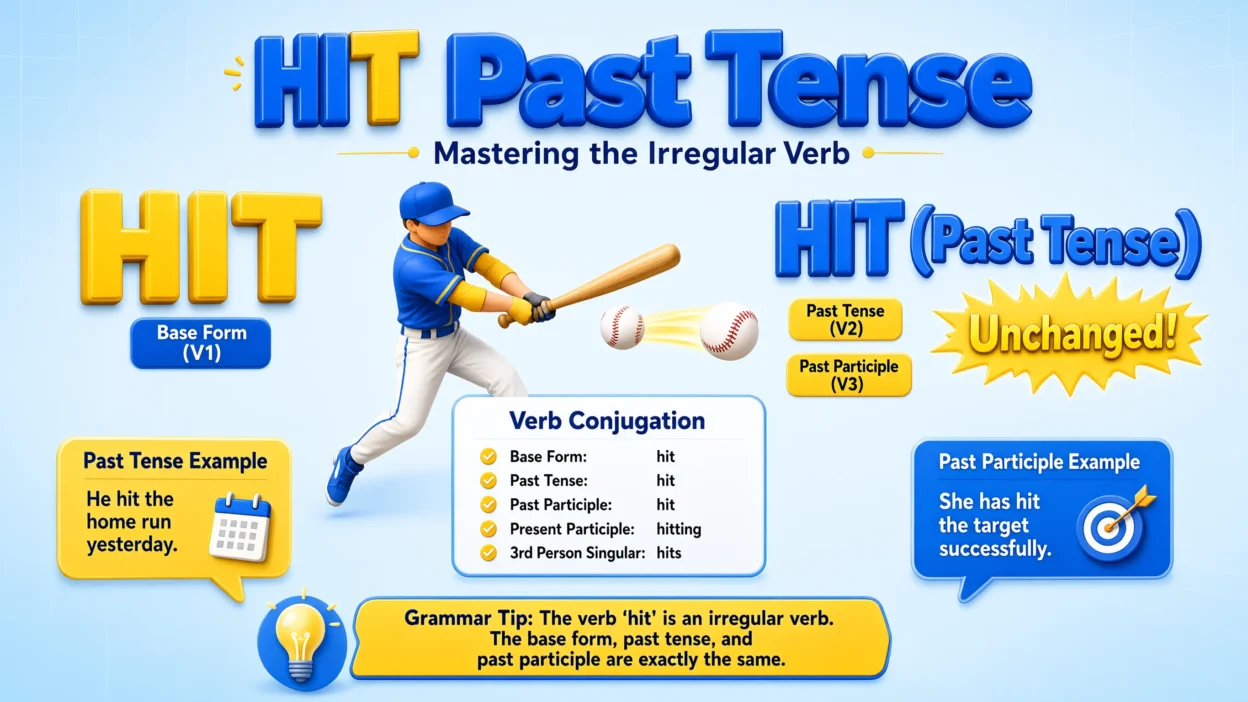
The past tense of hit is hit, not hitted. The word hit is an irregular verb, which means it does not follow the usual rule of adding -ed to form the past tense. Its three main forms are hit, hit, and hit. Whether you are talking about hitting a ball, striking an object, or reaching a particular target, the spelling stays the same in the past tense.
Many English learners find this word confusing because most regular verbs change when describing something that happened in the past. For example, walk becomes walked and play becomes played. However, some English verbs follow different patterns. Hit is one of them.
Understanding how to use it correctly will help you write clearer sentences and speak more naturally. In this guide, you will learn its meaning, verb forms, grammar rules, common mistakes, and practical examples.
Quick Answer
The past tense of hit is hit. It is an irregular verb, so you do not add -ed to make it past tense. Its three forms are hit (base form), hit (simple past), and hit (past participle). For example: She hit the ball yesterday.
Why Do People Confuse It?
People often confuse hit and hitted because English has many regular verbs that form their past tense by adding -ed.
For example:
- Walk → Walked
- Jump → Jumped
- Clean → Cleaned
- Open → Opened
- Hit → Hit
The last example does not follow the regular pattern.
Hit is an irregular verb, meaning its past-tense form does not follow the standard -ed rule.
Another reason for confusion is that hit has the same spelling in its present, past, and past participle forms. The sentence structure and time expressions help readers understand when the action happened.
First Word: Hit
Hit is the base form of the verb. It means to strike, touch forcefully, or make contact with something.
It can describe physical actions as well as reaching a particular point or achieving something.
Verb forms of hit:
- Base form: Hit
- Simple past: Hit
- Past participle: Hit
- Present participle: Hitting
- Third-person singular: Hits
Examples:
- I hit the ball every morning.
- They hit the target during practice.
- He hits the punching bag at the gym.
- We hit the road early in the morning.
- She is hitting the ball with a racket.
The word hit can also have figurative meanings, such as becoming successful or affecting someone emotionally.
Second Word: Hitted
Hitted is generally considered an incorrect form of the verb hit in standard modern English.
English learners sometimes use hitted because they apply the regular past-tense rule of adding -ed to a verb. However, hit is irregular and does not change its spelling in the simple past or past participle.
Incorrect examples:
- She hitted the ball yesterday.
- He hitted the wall accidentally.
- They hitted the target.
Correct versions:
- She hit the ball yesterday.
- He hit the wall accidentally.
- They hit the target.
Remember that hit is the correct past-tense form, not hitted.
Hit vs Hitted: Comparison Table
| Feature | Hit | Hitted |
| Word type | Irregular verb | Incorrect verb form |
| Base form | Hit | Hit |
| Simple past | Hit | Not standard |
| Past participle | Hit | Not standard |
| Correct in standard English? | Yes | No |
| Example | He hit the ball. | He hitted the ball. |
The main difference is simple: hit is grammatically correct, while hitted is not accepted as the standard past-tense form.
When to Use Each
Knowing when to use hit will help you avoid grammar mistakes.
When to Use Hit in the Present Tense
Use hit when describing something that happens regularly, generally, or right now as part of an expression with an appropriate helping verb.
Examples:
- I hit the gym every evening.
- They hit the ball during practice.
- He hits the target consistently.
- We hit the road at sunrise.
When to Use Hit in the Past Tense
Use hit when describing an action that happened and finished in the past.
Examples:
- She hit the ball yesterday.
- I hit my head on the door.
- They hit the target last weekend.
- He hit the brakes suddenly.
When to Use Hit as a Past Participle
Use hit with helping verbs such as has, have, and had.
Examples:
- She has hit three home runs this season.
- They have hit their sales target.
- He had hit the ball before the whistle blew.
- I have hit the wrong button.
15 Examples of Hit in Sentences
Here are practical examples showing how to use hit correctly in different situations.
Simple Present Tense
- I hit the gym every morning.
- They hit the ball across the field.
- We hit our daily targets regularly.
Simple Past Tense
- She hit the ball over the fence.
- He hit his head against the wall.
- The player hit the winning shot.
- I accidentally hit the wrong key.
- They hit the road early yesterday.
Present Perfect Tense
- She has hit the target twice.
- We have hit our monthly goal.
- He has hit the ball very hard.
Past Perfect Tense
- They had hit the target before sunset.
- She had hit the brakes before the accident.
- I had hit the wrong button before noticing my mistake.
These examples show that the spelling remains hit even when the tense changes.
Common Mistakes to Avoid
English learners sometimes make mistakes when using irregular verbs. Here are some common errors involving hit.
Mistake 1: Using Hitted Instead of Hit
Incorrect: He hitted the ball.
Correct: He hit the ball.
Mistake 2: Adding -Ed to the Past Participle
Incorrect: She has hitted the target.
Correct: She has hit the target.
Mistake 3: Using Hit Instead of Hits With He, She, or It
Incorrect: She hit the ball every day.
Correct: She hits the ball every day.
The second sentence describes a regular habit in the present tense.
Mistake 4: Confusing Hitting With Hit
Incorrect: He is hit the ball.
Correct: He is hitting the ball.
Use hitting after is, am, or are when forming the present continuous tense.
Mistake 5: Using the Wrong Helping Verb
Incorrect: They has hit the target.
Correct: They have hit the target.
Use have with they, we, and I, and has with he, she, and it.
Memory Trick: How to Remember the Past Tense of Hit
A simple way to remember the correct form is:
Hit stays hit in the past!
Think of it as a verb that never changes its spelling in its three main forms.
- Present: I hit the ball.
- Past: I hit the ball yesterday.
- Past participle: I have hit the ball.
You can also remember this simple pattern:
Hit – Hit – Hit
Practice saying these three forms aloud. Repeating them in sentences will make the correct spelling easier to remember.
American vs British English
There is no difference between American and British English when it comes to the past tense of hit.
Both varieties use hit as the correct simple past and past participle form.
| Grammar Form | American English | British English |
| Base form | Hit | Hit |
| Simple past | Hit | Hit |
| Past participle | Hit | Hit |
| Present participle | Hitting | Hitting |
Examples:
- American English: He hit the ball yesterday.
- British English: He hit the ball yesterday.
Both sentences are correct. The spelling and grammatical rules remain the same in both varieties.
Similar Words to Hit
Several English verbs have meanings similar to hit. However, their meanings and past-tense forms may differ.
| Word | Meaning | Past Tense |
| Strike | Hit something forcefully | Struck |
| Beat | Hit repeatedly | Beat |
| Smack | Hit sharply | Smacked |
| Punch | Hit with a fist | Punched |
| Slap | Hit with an open hand | Slapped |
| Tap | Touch lightly | Tapped |
| Bash | Hit forcefully | Bashed |
| Knock | Hit a surface | Knocked |
| Whack | Hit with force | Whacked |
| Strike against | Make forceful contact | Struck against |
These words can help you express different types of actions more accurately.
Final Verdict: Hit or Hitted?
The correct past tense of hit is hit, not hitted.
Hit is an irregular verb that keeps the same spelling in its base form, simple past, and past participle.
Remember these three forms:
- Base form: Hit
- Past tense: Hit
- Past participle: Hit
For example, She hit the ball yesterday is correct, while She hitted the ball yesterday is incorrect.
Whenever you describe an action involving hit in the past, use hit without adding -ed.
FAQs:
1. What Is the Past Tense of Hit?
The past tense of hit is hit. It is an irregular verb, so its spelling does not change when describing an action that happened in the past.
Example: He hit the ball yesterday.
2. Is Hitted a Real Word?
Hitted is sometimes used mistakenly by English learners, but it is not the standard past-tense form of hit. In standard English, use hit instead.
3. Is Hit a Regular or Irregular Verb?
Hit is an irregular verb because it does not follow the regular pattern of adding -ed to form its past tense.
Its three main forms are hit, hit, and hit.
4. What Is the Past Participle of Hit?
The past participle of hit is also hit.
Example: She has hit the target.
It is commonly used with helping verbs such as has, have, and had.
5. What Is the Difference Between Hit and Hitting?
Hit is the base form and simple past form of the verb, while hitting is its present participle.
Examples:
- I hit the ball yesterday.
- I am hitting the ball now.
6. What Is the Third Form of Hit?
The third form, also called the past participle, is hit.
The three forms are:
- First form: Hit
- Second form: Hit
- Third form: Hit
7. Can We Use Hit in the Present Perfect Tense?
Yes, hit is used in the present perfect tense with has or have.
Examples:
- I have hit the target.
- She has hit the ball.
- They have hit their goal.
Remember This
- Hit is the correct past tense of hit.
- Hitted is incorrect in standard English.
- Hit is an irregular verb.
- Its three main forms are hit, hit, and hit.
- The past participle is also hit.
- Both American and British English follow the same rule.
Conclusion
Learning irregular verbs becomes easier when you understand their patterns. The verb hit is a simple example because its base form, past tense, and past participle all have the same spelling. You do not need to add -ed or change the word when talking about something that happened in the past.
Always remember that hit is correct and hitted is not the standard form. Practice using it in everyday sentences, and you will become more confident in your English grammar and writing.