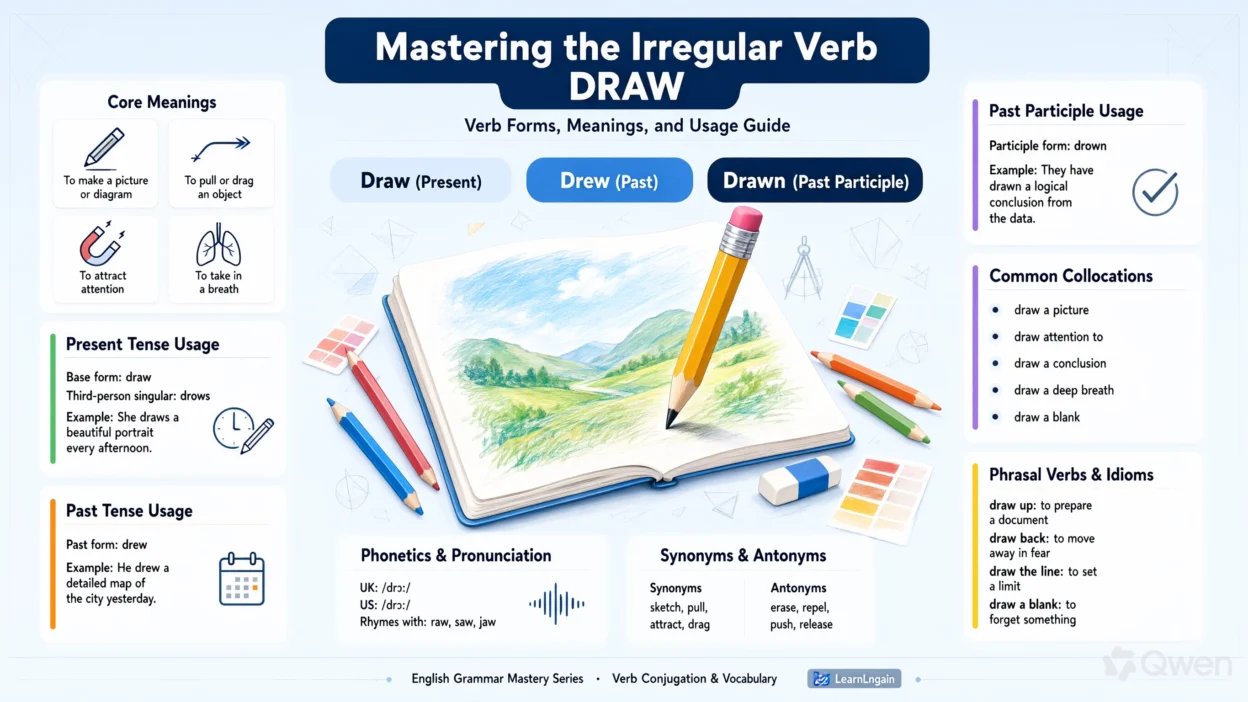
The past tense of draw is drew, not drawed. The verb draw is an irregular verb, which means it does not form its past tense by simply adding -ed. For example, you can say, “She drew a beautiful picture yesterday.” The word drawn is the past participle, used with helping verbs such as has, have, and had.
Many English learners confuse draw, drew, and drawn because all three forms describe the same basic action but are used in different grammatical situations. Understanding these forms will help you speak and write more naturally.
In this guide, you will learn the past tense of draw, the difference between drew and drawn, common mistakes, and practical examples. If you are a student, beginner, or English learner, these simple explanations will help you use the verb correctly.
Quick Answer: What Is the Past Tense of Draw?
The simple past tense of draw is drew. The past participle is drawn, while draw is the base form. Use drew for completed actions in the past and drawn with helping verbs such as has, have, and had.
- Present: Draw
- Past: Drew
- Past participle: Drawn
- -ing form: Drawing
Why Do People Confuse Draw, Drew, and Drawn?
People often confuse these three words because they are different forms of the same irregular verb. Unlike regular verbs such as walk and walked, the verb draw changes its spelling in the past tense.
Another reason for confusion is that drew and drawn both describe actions that happened in the past. However, they have different grammatical functions.
For example:
- Correct: I drew a picture yesterday.
- Correct: I have drawn a picture.
- Incorrect: I drawed a picture yesterday.
Remember that drew is the simple past form, while drawn is the past participle.
First Word: Draw (Present Tense)
Draw is the base form and present tense of the verb. It means to create a picture using a pencil, pen, or another tool. It can also mean to pull something, attract attention, or select something by chance.
Meaning of Draw
The word draw has several meanings depending on the context:
- To create a picture or illustration.
- To pull something toward yourself.
- To attract attention or interest.
- To select something randomly.
- To take money from a bank account.
Examples of Draw in Sentences
- I draw pictures in my free time.
- She likes to draw flowers.
- They draw water from the well.
- The advertisement can draw attention.
- We draw names from a box.
Second Word: Drew (Simple Past Tense)
Drew is the simple past tense of draw. It describes an action that started and finished in the past.
Use drew when talking about something someone created, pulled, attracted, or selected in the past.
Meaning of Drew
Drew means that someone performed the action of drawing at an earlier time.
Examples of Drew in Sentences
- She drew a beautiful portrait yesterday.
- I drew a map for my friend.
- He drew a circle on the board.
- The artist drew a picture of a mountain.
- They drew attention to the problem.
Comparison Table: Draw vs Drew vs Drawn
The following table explains the three main forms of the verb draw.
| Verb Form | Word | Example |
| Base form | Draw | I draw every day. |
| Simple present (he/she/it) | Draws | She draws flowers. |
| Simple past | Drew | He drew a picture. |
| Past participle | Drawn | I have drawn a picture. |
| Present participle | Drawing | She is drawing now. |
Important: Drew and drawn are not interchangeable. Their correct use depends on the tense and sentence structure.
When to Use Draw, Drew, and Drawn
Knowing when to use each form will help you avoid grammatical mistakes.
1. When to Use Draw
Use draw for present habits, general facts, instructions, and actions that happen regularly.
Examples:
- I draw cartoons every weekend.
- They draw pictures at school.
- Please draw a straight line.
2. When to Use Drew
Use drew for completed actions in the past. It often appears with time expressions such as yesterday, last week, and two days ago.
Examples:
- She drew a picture yesterday.
- I drew a diagram last night.
- He drew a beautiful landscape last Sunday.
3. When to Use Drawn
Use drawn as the past participle. It usually appears with helping verbs such as has, have, and had. It is also used in passive constructions.
Examples:
- I have drawn five pictures.
- She has drawn a beautiful sketch.
- They had drawn the curtains before leaving.
- The picture was drawn by a young artist.
15 Examples of Draw, Drew, and Drawn in Sentences
Here are practical examples to help you understand the correct use of each verb form.
Examples of Draw
- I draw pictures in my notebook.
- My sister likes to draw animals.
- Students draw diagrams during science class.
- He can draw realistic faces.
- We draw lines with a ruler.
Examples of Drew
- She drew a beautiful flower yesterday.
- I drew a picture of my family.
- The child drew a house on the wall.
- He drew a map for the visitors.
- They drew a large circle on the ground.
Examples of Drawn
- I have drawn three pictures today.
- She has drawn a portrait of her mother.
- They had drawn the curtains before bedtime.
- The artist has drawn several landscapes.
- A beautiful picture was drawn by the student.
Common Mistakes When Using the Past Tense of Draw
English learners sometimes use the wrong form of draw. Here are common mistakes and their corrections.
| Incorrect Sentence | Correct Sentence |
| I drawed a picture. | I drew a picture. |
| She has drew a flower. | She has drawn a flower. |
| He had drew a map. | He had drawn a map. |
| They have drawed pictures. | They have drawn pictures. |
| I am drew a picture. | I am drawing a picture. |
Why Is “Drawed” Incorrect?
Drawed is not the standard past tense of draw. Because draw is an irregular verb, its simple past form changes to drew.
Remember these forms:
- Draw = Present
- Drew = Past
- Drawn = Past participle
Memory Trick: How to Remember Drew and Drawn
A simple way to remember the three forms is to memorize this pattern:
Draw → Drew → Drawn
Think of these example sentences:
- Today, I draw a picture.
- Yesterday, I drew a picture.
- I have drawn a picture.
You can also remember this rule:
- If the action happened yesterday, use drew.
- If the sentence contains has, have, or had, use drawn.
Practice this pattern a few times, and you will find it easier to remember.
American vs British English: Is the Past Tense of Draw Different?
No. The past tense of draw is the same in both American and British English.
Both varieties use:
- Draw (base form)
- Drew (simple past)
- Drawn (past participle)
Examples:
- American English: She drew a picture yesterday.
- British English: She drew a picture yesterday.
There is no spelling difference between American and British English for these verb forms.
Similar Words: Other Irregular Verbs Like Draw
The verb draw belongs to a group of irregular verbs that change their spelling in the past tense or past participle.
Here are some similar verbs:
| Base Form | Simple Past | Past Participle |
| Draw | Drew | Drawn |
| Blow | Blew | Blown |
| Grow | Grew | Grown |
| Know | Knew | Known |
| Throw | Threw | Thrown |
| Fly | Flew | Flown |
| Show | Showed | Shown |
| Write | Wrote | Written |
| Break | Broke | Broken |
| Speak | Spoke | Spoken |
Learning these patterns can make it easier to remember irregular verbs and use them correctly.
Final Verdict: Is It Drew or Drawed?
The correct past tense of draw is drew, not drawed. Use drew when describing a completed action in the past.
Use drawn as the past participle with helping verbs such as has, have, and had.
Remember:
- Present: Draw
- Past: Drew
- Past participle: Drawn
For example, “I drew a picture yesterday” is correct, while “I drawed a picture yesterday” is incorrect.
FAQs:
1. What is the past tense of draw?
The past tense of draw is drew. It is used to describe an action that was completed in the past.
Example: She drew a beautiful picture yesterday.
2. Is it drawed or drew?
Drew is correct. Draw is an irregular verb, so its past tense does not follow the regular -ed spelling rule.
Example: He drew a house last night.
3. What is the past participle of draw?
The past participle of draw is drawn.
Example: I have drawn a picture of my school.
4. Is draw a regular or irregular verb?
Draw is an irregular verb because its past tense and past participle forms change to drew and drawn instead of following the regular -ed pattern.
5. Is it have drew or have drawn?
Have drawn is correct because have must be followed by the past participle in the present perfect tense.
Correct: I have drawn a picture.
Incorrect: I have drew a picture.
6. What are the three forms of draw?
The three main forms of draw are:
- Base form: Draw
- Simple past: Drew
- Past participle: Drawn
7. Can I use drew and drawn in the same sentence?
Yes. Both forms can appear in the same sentence when the grammar requires them.
Example: She drew a picture yesterday, and I have drawn one today.
Remember This
The most important thing to remember is that draw, drew, and drawn are three different forms of the same irregular verb.
- Draw = Present tense
- Drew = Simple past tense
- Drawn = Past participle
Never use drawed in standard English. Always use drew for simple past sentences and drawn after has, have, or had.
Conclusion
The past tense of draw is drew, while its past participle is drawn. Although these words describe the same basic action, they serve different grammatical purposes. Understanding their differences will help you avoid common mistakes and improve your English writing and speaking skills.
Keep practicing with simple sentences such as “I draw every day,” “I drew yesterday,” and “I have drawn a picture.” Remembering the pattern draw → drew → drawn will make it much easier to use this irregular verb correctly.

John Morrison is a dedicated content writer at Synomity.com, focused on synonyms, vocabulary development, and word meanings. He creates clear, educational resources that help readers improve language skills and communicate with confidence.