
The verb drive is commonly used when talking about controlling a car, truck, or another vehicle. However, its past tense forms can confuse English learners because it does not follow the regular pattern of adding -ed.
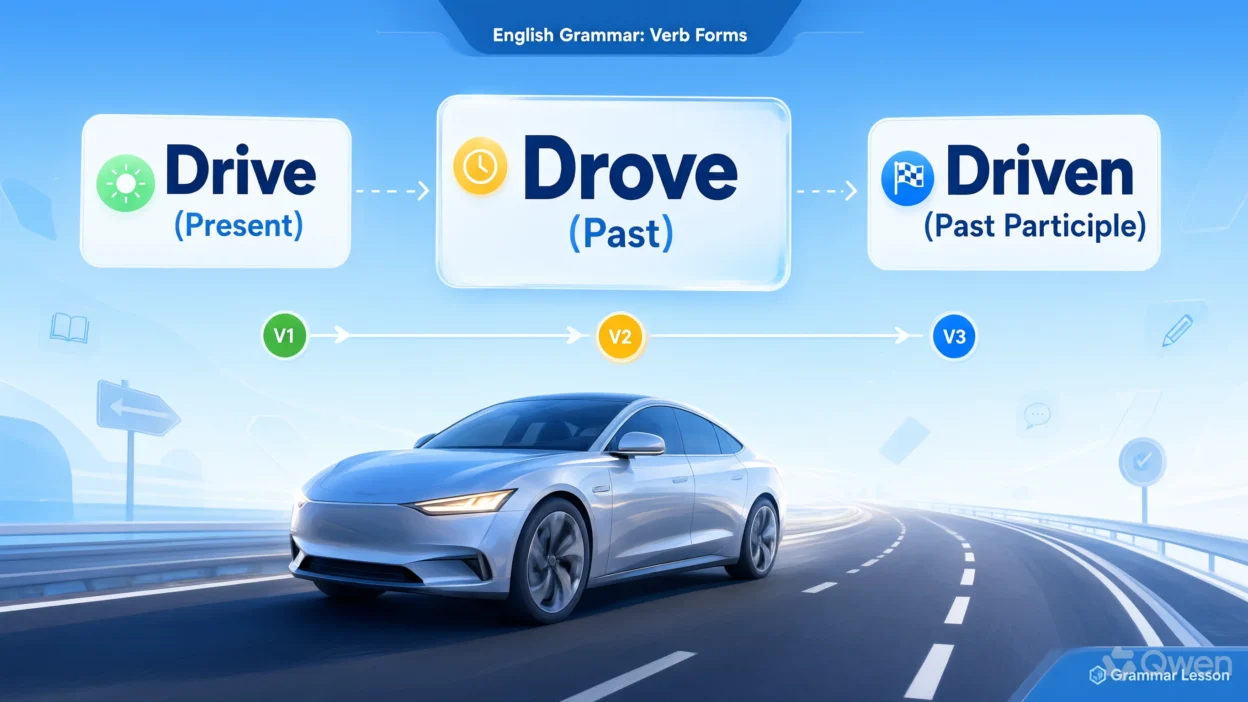
If you are wondering about the drive past tense, the correct answer is drove. The past participle is driven. Both words come from the verb drive, but they are used differently in sentences.
Understanding the difference between drive, drove, and driven will help you speak and write English more accurately. If you are a student, beginner, ESL learner, or someone improving everyday communication, learning these three forms is important. In this guide, you will discover how to use each form, understand common mistakes, and practice with simple examples.
Quick Answer: What Is the Past Tense of Drive?
The simple past tense of drive is drove, while its past participle is driven. The three main forms are drive – drove – driven. Use drove for completed past actions and driven with helping verbs such as has, have, and had.
Why Do People Confuse Drive, Drove, and Driven?
People often confuse these words because they represent different grammatical forms of the same irregular verb.
Unlike regular verbs such as walk (walked) or talk (talked), the verb drive changes its spelling in both the simple past tense and past participle.
Here are the three forms:
- Drive: Present tense
- Drove: Simple past tense
- Driven: Past participle
For example:
- I drive to work every morning.
- I drove to work yesterday.
- I have driven to work many times.
The main difference is the grammatical structure in which each form appears.
First Word: What Does Drive Mean?
Drive is the base form of an irregular verb. It means to control and operate a vehicle, such as a car, bus, or truck.
It can also mean to take someone somewhere in a vehicle or cause something to move forward.
Examples of Drive in Sentences
- I drive to school every day.
- She knows how to drive a car.
- They drive carefully on busy roads.
- My father will drive us to the airport.
- We drive to the beach every summer.
When to use Drive: Use drive with the present tense, after modal verbs such as can and will, and with the infinitive marker to.
Second Word: What Does Drove Mean?
Drove is the simple past tense of the verb drive. It describes an action that started and finished in the past.
Use drove when talking about something that happened yesterday, last week, or at another completed time in the past.
Examples of Drove in Sentences
- I drove to the office yesterday.
- She drove her children to school.
- We drove through the mountains last weekend.
- He drove his new car for the first time.
- They drove home after the party.
When to use Drove: Use drove when describing a completed past action without a helping verb such as have or had.
Third Word: What Does Driven Mean?
Driven is the past participle of the verb drive. It is not normally used alone to describe a completed action in standard English.
It usually appears with helping verbs such as has, have, and had. It can also be used in passive constructions.
Examples of Driven in Sentences
- I have driven this car before.
- She has driven across the country.
- They have driven for five hours.
- He had driven to work before the rain started.
- The car was driven by a professional.
When to use Driven: Use driven with perfect tenses and passive voice constructions.
Drive vs Drove vs Driven: Comparison Table
The following table explains the differences between the three forms of the verb drive.
| Word | Verb Form | Example |
| Drive | Base form | I drive every day. |
| Drove | Simple past | I drove yesterday. |
| Driven | Past participle | I have driven before. |
Remember that drove describes a completed past action, while driven generally needs a helping verb.
When to Use Drive, Drove, and Driven?
Choosing the correct form depends on the tense and structure of your sentence.
1. Use Drive for Present and Future Actions
Use drive for regular activities, general truths, and after modal verbs.
Examples:
- I drive to work every morning.
- They drive carefully.
- I will drive you home.
- Can you drive a truck?
2. Use Drove for Completed Past Actions
Use drove when an action happened and finished in the past.
Examples:
- She drove to the supermarket yesterday.
- We drove all night.
- My brother drove me to college last Monday.
- They drove to another city last month.
3. Use Driven with Perfect Tenses and Passive Voice
Use driven with helping verbs to form perfect tenses or passive constructions.
Examples:
- I have driven this vehicle before.
- She has driven for many years.
- We had driven for three hours.
- The bus was driven by an experienced driver.
15 Examples of Drive, Drove, and Driven in Sentences
Here are 15 easy examples to help you understand how these verb forms work in everyday English.
Examples of Drive
- I drive my car to work every morning.
- My mother can drive a bus.
- They drive slowly in the rain.
- We will drive to the city tomorrow.
- He likes to drive on empty roads.
Examples of Drove
- I drove to the market yesterday.
- She drove her brother to school.
- We drove across the bridge last night.
- My father drove us to the airport.
- They drove home after dinner.
Examples of Driven
- I have driven this car many times.
- She has driven through several countries.
- He had driven for six hours before stopping.
- The truck was driven by an experienced man.
- We have never driven on that road before.
Common Mistakes When Using Drive, Drove, and Driven
English learners sometimes use the wrong form of this irregular verb. Here are common mistakes and their corrections.
| Incorrect Sentence | Correct Sentence |
| I drive yesterday. | I drove yesterday. |
| She has drove home. | She has driven home. |
| He had drove the car. | He had driven the car. |
| I have drive before. | I have driven before. |
| They drived to school. | They drove to school. |
| She is drove to work. | She is driving to work. |
Important tip: Never use drived as the standard past tense of drive. The correct simple past form is drove.
What Is an Easy Trick to Remember Drive, Drove, and Driven?
An easy way to remember these forms is to learn them as a three-word sequence:
Drive
Present
Drove
Past
Driven
Past participle
Remember this simple sentence:
- Today, I drive.
- Yesterday, I drove.
- I have driven before.
Repeat this pattern several times to remember the correct forms.
Is Drive, Drove, or Driven Different in American and British English?
No. The verb forms drive, drove, and driven are the same in both American and British English.
Both varieties follow the same standard irregular verb pattern:
- Present: Drive
- Simple past: Drove
- Past participle: Driven
For example:
- American English: I drove to the store yesterday.
- British English: I drove to the shop yesterday.
The verb forms remain unchanged. Only the vocabulary in the rest of the sentence may differ.
Similar Words to Drive and Their Past Tense Forms
Learning other irregular verbs can help you understand how English verbs change in the past tense.
| Present | Past Tense | Past Participle |
| Ride | Rode | Ridden |
| Write | Wrote | Written |
| Rise | Rose | Risen |
| Give | Gave | Given |
| Take | Took | Taken |
| Speak | Spoke | Spoken |
| Break | Broke | Broken |
| Choose | Chose | Chosen |
| Eat | Ate | Eaten |
| Fall | Fell | Fallen |
These verbs follow different irregular patterns, so learning all three forms is helpful.
Final Verdict: Is It Drive, Drove, or Driven?
The correct past tense of drive is drove. However, driven is the past participle, which is used with helping verbs or in passive constructions.
Here is the easiest way to remember:
- Drive: Present tense – I drive to work.
- Drove: Simple past tense – I drove to work yesterday.
- Driven: Past participle – I have driven to work.
Never write drived when you mean the standard past tense of drive.
FAQs:
1. What is the past tense of drive?
The past tense of drive is drove. It describes an action that happened and finished in the past.
Example: I drove to the office yesterday.
2. Is it drived or drove?
Drove is correct. Drive is an irregular verb, so it does not form its past tense by adding -ed. The word drived is incorrect in standard English.
3. Is driven the past tense of drive?
No. Driven is the past participle of drive. The simple past tense is drove.
Example: She has driven this car before.
4. What are the three forms of drive?
The three main forms are:
- Base form: Drive
- Past tense: Drove
- Past participle: Driven
5. Is it have drove or have driven?
Have driven is correct because present perfect tense requires the past participle.
Correct: I have driven this car before.
Incorrect: I have drove this car before.
6. What is the past perfect tense of drive?
The past perfect form is had driven.
Example: He had driven home before the storm began.
7. What is the present perfect tense of drive?
The present perfect form uses has driven or have driven.
Examples:
- She has driven to work.
- They have driven across the country.
Remember This
- Drive = Present tense.
- Drove = Simple past tense.
- Driven = Past participle.
- Drived = Incorrect in standard English.
- Have/has/had + driven = Correct grammatical structure.
The easiest pattern to remember is: Drive – Drove – Driven.
Conclusion
Understanding the drive past tense is easy once you learn the difference between drive, drove, and driven. The word drive is the base form, drove is the simple past tense, and driven is the past participle. Each form has a different grammatical purpose, so choosing the correct one depends on how your sentence is structured.
For better English communication, practice these forms with everyday examples and remember the pattern: “I drive today, I drove yesterday, and I have driven before.” With regular practice, you will confidently use all three forms in speaking, writing, and everyday conversations.