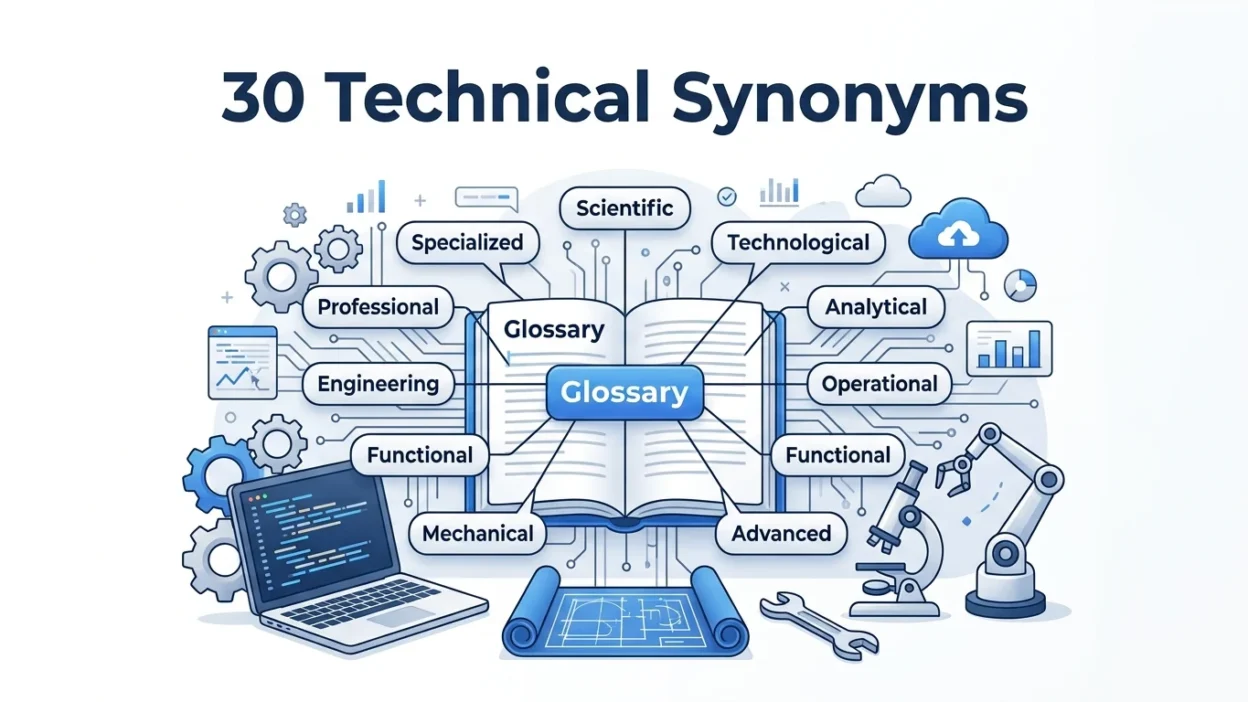
The term technical is widely used in education, engineering, science, technology, business, and everyday communication.
Whether you’re writing an academic paper, preparing professional content, or simply expanding your vocabulary, knowing different technical synonyms can help you express ideas more accurately and naturally.
Learning synonyms for technical is especially useful for students, ESL learners, writers, and content creators. While many alternatives have similar meanings, each carries its own nuance and works best in specific situations. Understanding these differences will improve both your writing and speaking skills.
What Does “Technical” Mean?
Meaning
The word technical describes something that relates to specialized knowledge, science, technology, engineering, mechanics, or a particular skill or profession. It can also refer to language or details that require expert understanding.
Tone
- Neutral
- Professional
- Academic
- Informative
Usage Context
Use technical when discussing specialized subjects, professional skills, scientific concepts, engineering, computer science, medicine, or detailed procedures.
30 Technical Synonyms with Meanings, Examples, and Usage
1. Specialized
Meaning: Designed for a specific purpose or field.
Example: She has specialized knowledge in cybersecurity.
Best Usage Context: Professional and academic writing.
2. Scientific
Meaning: Related to science or scientific methods.
Example: The report includes scientific evidence.
Best Usage Context: Science and research.
3. Professional
Meaning: Connected to a particular profession or career.
Example: He uses professional software every day.
Best Usage Context: Workplace communication.
4. Expert
Meaning: Showing advanced knowledge or skill.
Example: The expert analysis solved the problem.
Best Usage Context: Skill-based discussions.
5. Mechanical
Meaning: Related to machines or machinery.
Example: The mechanical system requires maintenance.
Best Usage Context: Engineering.
6. Industrial
Meaning: Connected with industry or manufacturing.
Example: Industrial equipment must meet safety standards.
Best Usage Context: Manufacturing.
7. Engineering
Meaning: Related to engineering principles.
Example: Engineering drawings require precision.
Best Usage Context: Engineering projects.
8. Technological
Meaning: Related to technology.
Example: Technological advances improve communication.
Best Usage Context: Technology articles.
9. Operational
Meaning: Connected with the way something works.
Example: The operational manual explains every step.
Best Usage Context: Business and engineering.
10. Functional
Meaning: Designed to work effectively.
Example: The device is fully functional.
Best Usage Context: Product descriptions.
11. Practical
Meaning: Focused on real-world application.
Example: The course offers practical experience.
Best Usage Context: Education and training.
12. Skilled
Meaning: Requiring or showing expertise.
Example: Skilled technicians repaired the machine.
Best Usage Context: Jobs and professions.
13. Precise
Meaning: Exact and accurate.
Example: Technical drawings must be precise.
Best Usage Context: Engineering and science.
14. Detailed
Meaning: Including many important facts.
Example: The guide provides detailed instructions.
Best Usage Context: Manuals and documentation.
15. Analytical
Meaning: Based on careful examination.
Example: Analytical thinking improves decision-making.
Best Usage Context: Research and business.
16. Methodical
Meaning: Done in an organized way.
Example: Her methodical approach reduced errors.
Best Usage Context: Professional writing.
17. Systematic
Meaning: Following an organized system.
Example: The investigation was systematic.
Best Usage Context: Research and education.
18. Complex
Meaning: Difficult because of many parts.
Example: The software has complex features.
Best Usage Context: Technology and engineering.
19. Advanced
Meaning: Highly developed or sophisticated.
Example: The lab uses advanced equipment.
Best Usage Context: Technology and science.
20. Sophisticated
Meaning: Highly developed and refined.
Example: Sophisticated software detects errors.
Best Usage Context: Technology.
21. Expert-Level
Meaning: Suitable for experienced users.
Example: The guide targets expert-level programmers.
Best Usage Context: Learning materials.
22. Professional-Grade
Meaning: High quality for professional use.
Example: Professional-grade cameras produce excellent images.
Best Usage Context: Product reviews.
23. Computerized
Meaning: Controlled by computers.
Example: The factory uses computerized systems.
Best Usage Context: Technology.
24. Digital
Meaning: Related to electronic technology.
Example: Digital tools improve productivity.
Best Usage Context: Modern technology.
25. Programmed
Meaning: Controlled by software.
Example: The robot is programmed to sort packages.
Best Usage Context: Computing and robotics.
26. Scientific-Based
Meaning: Supported by scientific research.
Example: The treatment follows scientific-based methods.
Best Usage Context: Healthcare and research.
27. Vocational
Meaning: Related to job skills or training.
Example: Vocational education prepares students for careers.
Best Usage Context: Education.
28. Trade-Specific
Meaning: Connected with a particular trade.
Example: Trade-specific knowledge is valuable.
Best Usage Context: Skilled professions.
29. Instructional
Meaning: Designed for teaching.
Example: The instructional manual is easy to follow.
Best Usage Context: Education and training.
30. Discipline-Specific
Meaning: Related to one academic or professional field.
Example: Discipline-specific vocabulary helps students succeed.
Best Usage Context: Academic writing.
Comparison Guide: When to Use Different Technical Synonyms
Quick Comparison Table
| Synonym | Tone | Best Used For |
|---|---|---|
| Specialized | Neutral | Professional writing |
| Scientific | Academic | Research |
| Technological | Modern | Technology |
| Mechanical | Technical | Engineering |
| Professional | Formal | Workplace |
| Practical | Friendly | Education |
| Analytical | Professional | Business and research |
| Detailed | Neutral | Manuals |
| Advanced | Formal | Technology |
| Functional | Neutral | Products and systems |
How to Choose the Right Synonym
For Academic Writing
- Scientific
- Analytical
- Systematic
- Discipline-Specific
- Specialized
These words are ideal for essays, research papers, and educational content.
For Technology Topics
- Technological
- Digital
- Computerized
- Programmed
- Advanced
These fit discussions about computers, software, and innovation.
For Engineering
- Mechanical
- Engineering
- Operational
- Functional
- Precise
These emphasize machinery, systems, and technical accuracy.
For Professional Communication
- Professional
- Skilled
- Specialized
- Methodical
- Practical
These work well in workplaces, resumes, and business reports.
For Training and Education
- Instructional
- Vocational
- Practical
- Learner-Focused
- Trade-Specific
These are suitable for educational materials and career training.
Tips for Using Technical Synonyms Correctly
Match Your Audience
If your readers are beginners, use simple words like practical or professional. For experts, terms like analytical or discipline-specific may be more appropriate.
Keep Language Clear
Avoid replacing technical with a complicated synonym unless it improves understanding.
Consider the Subject
A synonym that fits engineering may not work well in education or medicine.
Common Mistakes
Using Technical Words Incorrectly
Some synonyms have very specific meanings. For example, mechanical relates to machines, while scientific relates to science.
Making Writing Too Complex
Using difficult vocabulary unnecessarily can confuse readers.
Ignoring Context
Choose a synonym that fits the topic, audience, and tone rather than selecting one simply because it sounds formal.
Final Thoughts
Knowing different technical synonyms helps you communicate with greater precision and confidence. Whether you’re writing about science, engineering, technology, education, or professional skills, choosing the right synonym makes your content clearer and more engaging.
Words like specialized, scientific, technological, professional, and analytical each serve different purposes. By understanding their meanings and usage, you’ll improve your vocabulary, write more effectively, and communicate with the right tone in every situation.

Lucas Smith is a skilled language writer at Synomity.com, passionate about synonyms, vocabulary enrichment, and word meanings. He develops engaging content that helps readers strengthen communication skills and expand their understanding of language.