
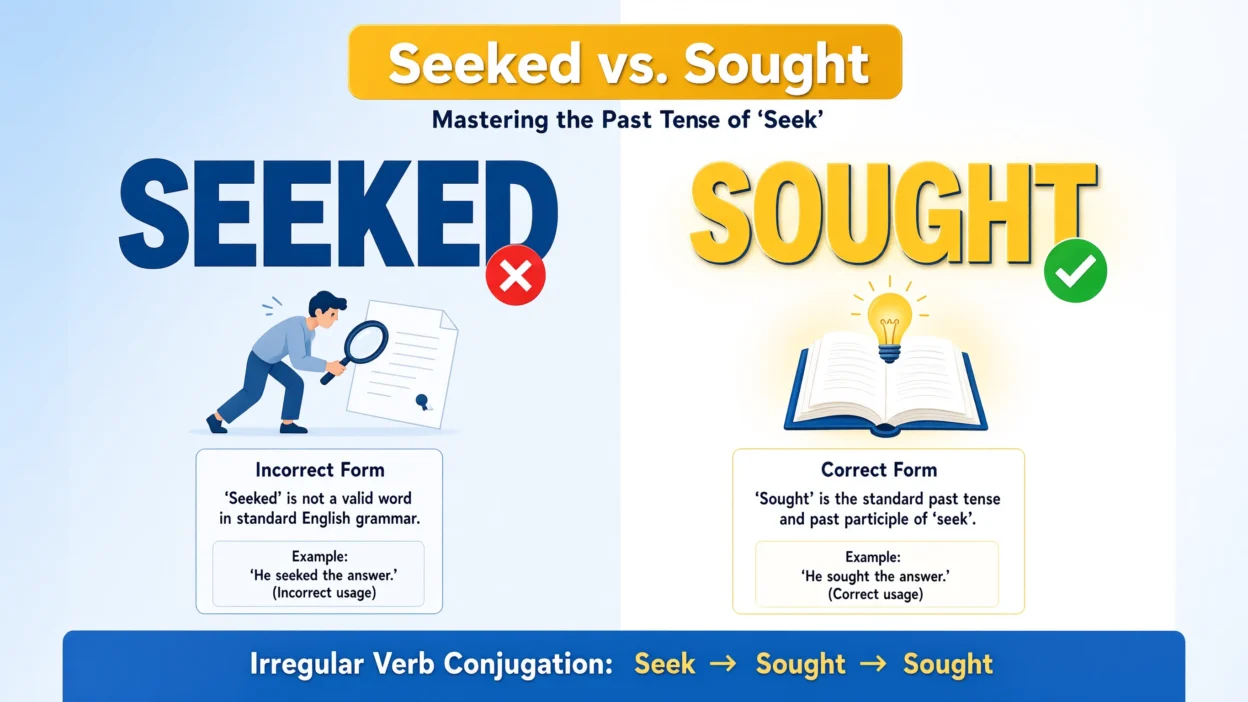
Have you ever wondered if “seeked” or “sought” is the correct past tense of seek? If so, you are not alone. Many English learners find this word confusing because most regular verbs form their past tense by adding -ed, but seek follows an irregular pattern.
Sought is the correct standard past tense and past participle of seek. “Seeked” is generally considered nonstandard in modern English, so you should use sought in school assignments, professional writing, formal conversations, and everyday English. For example, “She sought advice from her teacher” is correct, while “She seeked advice from her teacher” is not standard usage.
Understanding this difference will help you speak and write more confidently. If you are learning English as a second language, preparing for an exam, or improving your grammar, this guide explains the meanings of both words, their grammatical forms, common mistakes, and practical examples. By the end, you will know exactly when to use sought and why seeked is usually best avoided.
Quick Answer: Seeked or Sought?
Sought is the correct standard past tense of seek. It is also the past participle used with helping verbs such as have, has, and had. For example, “He sought help yesterday” and “They have sought advice.” Avoid seeked in standard English because it is generally considered nonstandard.
Why Do People Confuse Seeked and Sought?
People confuse these words because English has two common patterns for forming the past tense.
- Regular verbs usually add -ed: walk → walked, ask → asked.
- Irregular verbs change form in different ways: speak → spoke, teach → taught, seek → sought.
Because seek ends in the same sound as many verbs that take -ed, learners may naturally assume its past tense is seeked. However, seek is an irregular verb, and its standard past-tense form is sought.
The confusion is understandable, but remembering the correct irregular form will help you avoid mistakes.
What Does Seek Mean?
Seek is a verb that means to try to find, obtain, discover, or achieve something. It often suggests making an effort to get something that is needed or wanted.
Examples:
- I seek answers to difficult questions.
- They seek a better life.
- She seeks advice before making important decisions.
- The company seeks talented employees.
The word is commonly used in expressions such as seek help, seek advice, seek employment, seek permission, and seek the truth.
What Does Sought Mean?
Sought is the standard past tense and past participle of seek. It describes an attempt to find, obtain, or achieve something in the past, or it appears in perfect-tense and passive constructions.
Examples:
- She sought help after the accident.
- We sought information about the course.
- He has sought professional advice.
- The position was sought by many qualified candidates.
In each example, sought connects to the idea of searching for, requesting, or pursuing something.
Seeked vs. Sought: Comparison Table
| Feature | Seeked | Sought |
| Status | Generally nonstandard | Standard English |
| Base verb | Seek | Seek |
| Simple past | Not recommended | Sought |
| Past participle | Not standard in ordinary usage | Sought |
| Formal writing | Avoid | Correct |
| Example | She seeked help. | She sought help. |
Remember: When you need the past tense of seek, choose sought, not seeked.
When Should You Use Seeked or Sought?
When to Use Sought
Use sought whenever you need the standard past tense or past participle of seek.
Use it for a completed action in the past:
- He sought a new job last month.
- They sought shelter during the storm.
Use it with have, has, or had:
- I have sought help before.
- She has sought several solutions.
- We had sought permission before entering.
Use it in passive constructions:
- Legal advice was sought.
- A peaceful solution was sought by both sides.
When to Use Seeked
In standard modern English, you should generally avoid seeked. Although someone might use it by analogy with regular verbs, it is not the accepted form for ordinary formal or informal writing.
Instead of writing “I seeked an answer,” write “I sought an answer.”
This is especially important in exams, essays, business communication, and other situations where standard grammar matters.
12 Examples of Seek, Sought, and Incorrect Seeked
The following examples show how to use the correct forms in different situations.
- Present tense: I seek guidance from experienced teachers.
- Simple past: I sought guidance from my teacher yesterday.
- Present perfect: I have sought guidance several times.
- Past perfect: She had sought medical advice before the appointment.
- Future tense: They will seek permission tomorrow.
- Question: Did you seek help when you needed it?
- Negative sentence: He did not seek assistance.
- Professional context: The manager sought feedback from the team.
- Education: The student sought clarification about the assignment.
- Personal growth: She sought ways to improve her confidence.
- Passive voice: Expert advice was sought before the decision was made.
- Incorrect vs. correct: “We seeked the truth” is nonstandard; “We sought the truth” is correct.
Notice that seek remains in its base form after did and did not. You should say “Did she seek help?” rather than “Did she sought help?”
Common Mistakes to Avoid
Even when you know that sought is correct, a few related grammar mistakes can still cause confusion.
1. Using Seeked Instead of Sought
Incorrect: He seeked a solution.
Correct: He sought a solution.
2. Using Sought After Did
Incorrect: Did she sought advice?
Correct: Did she seek advice?
The auxiliary verb did already marks the past tense, so the main verb stays in its base form.
3. Using Seek Instead of Sought in the Simple Past
Incorrect: They seek help last week.
Correct: They sought help last week.
4. Confusing the Past Tense With the Past Participle
Incorrect: I have seek advice.
Correct: I have sought advice.
The present perfect tense requires have or has followed by the past participle.
5. Forgetting the Correct Form in Passive Voice
Incorrect: Assistance was seeked.
Correct: Assistance was sought.
Using the correct form makes your sentences sound natural and grammatically standard.
Memory Trick: How to Remember Sought
A simple way to remember the correct form is to learn seek, sought, sought as one group.
Think of these three forms together:
- Seek — present
- Sought — simple past
- Sought — past participle
You can also connect seek with speak:
- Seek → sought
- Speak → spoke
Although these verbs do not follow exactly the same pattern, remembering them as irregular verbs can help you avoid adding -ed automatically.
Try repeating this sentence: “Today I seek help, yesterday I sought help, and I have sought help before.”
American vs. British English: Is There a Difference?
There is no meaningful difference between standard American and British English in this case. Both use sought as the standard past tense and past participle of seek.
| English variety | Correct form | Example |
| American English | Sought | She sought a new opportunity. |
| British English | Sought | She sought a new opportunity. |
| Formal writing in both | Sought | They have sought permission. |
Unlike spelling differences such as color and colour, the choice between seeked and sought is not a regional spelling preference.
Whether you are writing for an American, British, Australian, or other English-speaking audience, sought is the appropriate standard form.
Similar Words: Other Irregular Verbs Like Seek
Learning related irregular verbs can help you understand why sought is correct.
| Base verb | Simple past | Past participle |
| Seek | Sought | Sought |
| Speak | Spoke | Spoken |
| Teach | Taught | Taught |
| Catch | Caught | Caught |
| Buy | Bought | Bought |
| Bring | Brought | Brought |
| Think | Thought | Thought |
| Fight | Fought | Fought |
| Find | Found | Found |
| Keep | Kept | Kept |
These verbs do not all follow one identical rule. However, learning their three principal forms together is a useful way to improve your grammar and vocabulary.
Final Verdict: Seeked or Sought?
Sought is the correct choice in standard English. It serves as both the simple past tense and the past participle of seek.
Use sought when describing an earlier attempt to find, obtain, request, or pursue something. For example, “She sought employment after graduation” and “They have sought advice from an expert” are both correct.
Avoid seeked in ordinary writing and speech when you mean the past tense of seek. Learning the irregular pattern seek – sought – sought will help you use the verb accurately in almost any context.
FAQs:
1. Is seeked a real word?
Seeked does occur in some nonstandard usage, usually because speakers apply the regular -ed pattern. However, it is not the accepted standard past tense of seek. Use sought in conventional English.
2. Is sought the past tense of seek?
Yes. Sought is the simple past tense of seek. For example, “He sought help yesterday” describes an action that happened in the past.
3. Is sought also a past participle?
Yes. Sought is both the simple past tense and the past participle of seek. You can use it with helping verbs, as in “She has sought advice” and “They had sought permission.”
4. Should I write “I seeked help” or “I sought help”?
Write “I sought help.” This is the standard grammatical form. “I seeked help” is generally considered nonstandard.
5. What are the three forms of seek?
The three principal forms are seek – sought – sought. The first is the base form, the second is the simple past, and the third is the past participle.
6. Is sought correct in both American and British English?
Yes. Both American and British English use sought as the standard past tense and past participle. There is no regional distinction between the two forms.
7. How do I use sought in a sentence?
Use sought when someone tried to find, obtain, or achieve something. For example, “The student sought help from her teacher” means that the student tried to get assistance.
Remember This
- Present tense: seek
- Simple past: sought
- Past participle: sought
- Nonstandard form to avoid: seeked
Example: “I seek advice today, I sought advice yesterday, and I have sought advice before.”
Conclusion
The difference between seeked and sought is simple once you understand irregular verbs. Although many English verbs form their past tense by adding -ed, seek follows a different pattern. Its standard past tense and past participle are both sought. Using the correct form will make your sentences clearer and more natural.
Whenever you write about looking for help, pursuing an opportunity, requesting information, or trying to discover something, remember to use sought for the past. Practise the pattern seek – sought – sought with a few example sentences, and you will find it easier to remember. If you are a student, an English learner, or a professional writer, choosing sought will help you communicate accurately and confidently.


