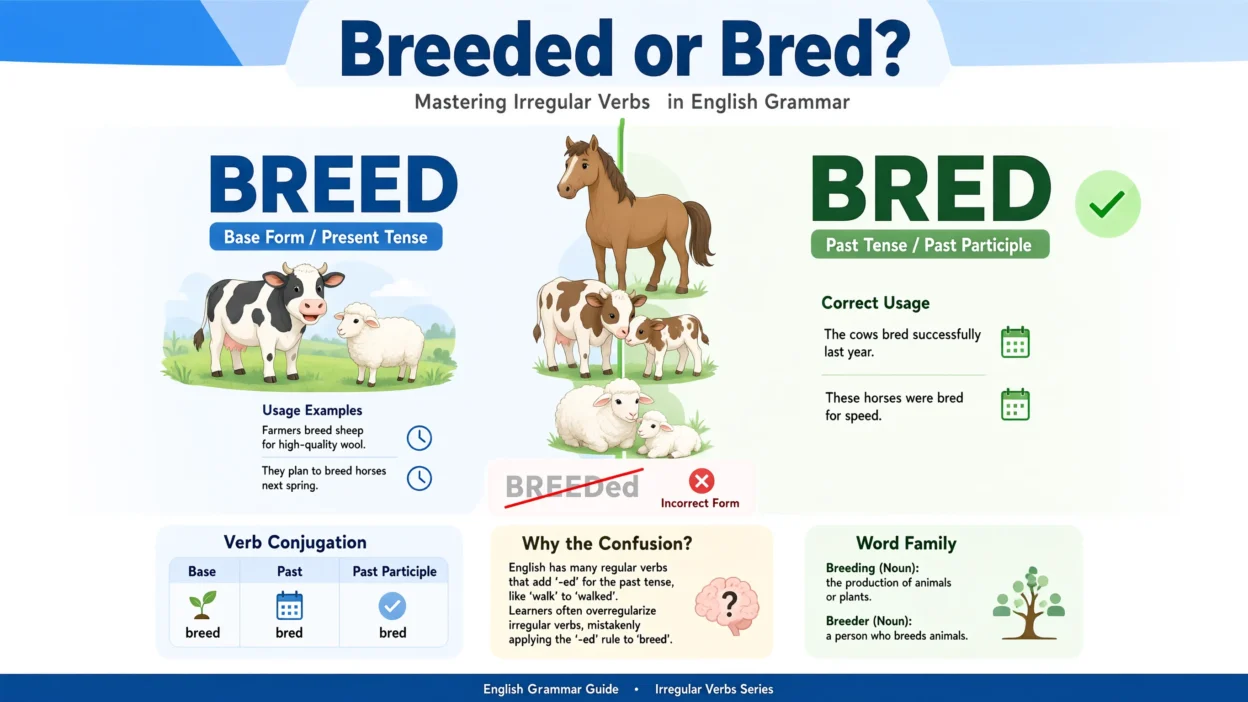
Have you ever wondered if to write “breeded” or “bred” when talking about animals, plants, or the process of producing offspring? These words may look similar, but only one is the standard past-tense form of the verb breed. If you want to use correct English in writing, conversation, or schoolwork, understanding this difference is important.
The correct word is bred, not breeded. The verb breed is an irregular verb, which means it does not form its past tense by simply adding -ed. Instead, its three main forms are breed, bred, and bred. For example, you should write, “The farmer bred healthy cows,” rather than “The farmer breeded healthy cows.”
The same rule applies when discussing animal reproduction, raising livestock, or developing particular characteristics in plants and animals. In this guide, you will learn the meanings of both words, see practical examples, explore common mistakes, and discover an easy way to remember the correct form.
Quick Answer: Breeded or Bred?
Bred is the correct standard English word. It is the past tense and past participle of breed. The word breeded is generally considered incorrect in standard English. For example, say “They bred horses on the farm,” not “They breeded horses on the farm.” Remember the forms: breed, bred, bred.
Why Do People Confuse Breeded and Bred?
People often confuse these words because many English verbs form their past tense by adding -ed. For example, walk becomes walked, and play becomes played.
However, English also contains irregular verbs that follow different patterns. The verb breed belongs to this group.
Its forms are:
- Present tense: breed
- Past tense: bred
- Past participle: bred
- Present participle: breeding
Because breeded sounds as though it follows a familiar spelling pattern, some learners use it by mistake. Understanding that breed is irregular will help you avoid this error.
1. What Does Breed Mean?
Breed is a verb that means to produce offspring, reproduce, or raise animals for particular purposes or characteristics. It can also refer to the reproduction or cultivation of plants and, in some contexts, to causing something to develop.
Examples:
- Farmers breed cattle for milk and meat.
- Some people breed dogs for specific characteristics.
- Certain birds breed during the spring.
- Poor living conditions can breed discontent.
The word can also be a noun. As a noun, breed refers to a particular type or variety of animal, such as a German Shepherd breed of dog.
Example Sentences With Breed
- The farmer plans to breed stronger sheep.
- These birds breed in warmer climates.
- Responsible breeders carefully select animals.
- Neglect can breed resentment.
- They breed horses for racing.
In each example, breed refers to reproduction or the development of something.
2. What Does Bred Mean?
Bred is the simple past tense and past participle of breed. It describes an action that happened in the past or is used with an auxiliary verb to form a perfect tense or passive construction.
Examples:
- The farmer bred several horses last year.
- She has bred dogs for many years.
- These animals were bred for their strength.
- The plants were bred to resist disease.
The word bred is correct in all these sentences. You do not need to add -ed to it again.
Example Sentences With Bred
- My uncle bred sheep on his farm.
- The breeder bred two healthy dogs.
- These cattle were bred for milk production.
- Scientists have bred plants that tolerate drought.
- The horses were bred for competitive racing.
Notice that bred works with different subjects and helping verbs without changing its spelling.
Breeded vs. Bred: Comparison Table
| Feature | Breeded | Bred |
| Standard English usage | Generally incorrect | Correct |
| Base verb | Breed | Breed |
| Past tense | Incorrect form | Bred |
| Past participle | Incorrect form | Bred |
| Suitable for formal writing | No | Yes |
| Example | They breeded horses. | They bred horses. |
The main difference is simple: use bred whenever you need the past tense or past participle of breed.
When Should You Use Breed or Bred?
Choosing between breed and bred depends on the tense and structure of your sentence.
Use Breed for the Present Tense
Use breed when describing a current activity, a habit, a general fact, or a future plan.
Examples:
- They breed horses for racing.
- Some insects breed rapidly.
- We plan to breed chickens next year.
Use Bred for the Past Tense
Use bred when the action happened in the past.
Examples:
- They bred horses last year.
- The farmer bred several chickens.
- My grandparents bred cattle for decades.
Use Bred With Has, Have, or Had
Use bred after has, have, or had to form perfect tenses.
Examples:
- She has bred dogs for ten years.
- They have bred several varieties of roses.
- The farmer had bred horses before moving away.
Use Bred in Passive Sentences
Use bred after a form of be when the subject receives the action.
Examples:
- The dogs were bred for companionship.
- These plants are bred for their resistance to disease.
- The horses have been bred for speed.
12 Examples of Bred in Sentences
Here are practical examples to help you understand how to use bred correctly.
- The farmer bred healthy cows on his farm.
- My neighbor bred two German Shepherds last year.
- These horses were bred for long-distance racing.
- The scientist has bred plants that need less water.
- The birds bred successfully during the spring.
- The breeder had bred several generations of dogs.
- These chickens were bred to produce more eggs.
- The family bred sheep for wool production.
- The plants were carefully bred to improve their quality.
- The animals have been bred under controlled conditions.
- His interest in gardening bred a love of nature.
- The organization promotes responsible practices for animals bred as pets.
Each sentence uses bred as the past tense or past participle, except where bred appears in a passive construction or the figurative expression in sentence 11.
Common Mistakes With Breeded and Bred
Even experienced English learners can make mistakes with irregular verbs. Here are some errors to watch for.
Mistake 1: Using Breeded as the Past Tense
Incorrect: The farmer breeded several horses.
Correct: The farmer bred several horses.
Why? Breed is irregular, so its past tense is bred.
Mistake 2: Writing Has Breeded
Incorrect: She has breeded dogs for years.
Correct: She has bred dogs for years.
Why? The past participle of breed is also bred.
Mistake 3: Using Breed Instead of Bred for a Completed Past Action
Incorrect: They breed horses last year.
Correct: They bred horses last year.
Why? The phrase last year indicates a completed action in the past.
Mistake 4: Confusing Breed With Breeding
Incorrect: The animals are breed in the spring.
Correct: The animals are breeding in the spring.
Also correct: The animals are bred for their strength.
Why? Breeding is the -ing form, while bred is the past participle used in the passive construction.
Mistake 5: Adding -Ed to an Irregular Verb
Incorrect: The dogs were breeded for hunting.
Correct: The dogs were bred for hunting.
Why? Once you know the irregular form, you do not add another -ed ending.
Easy Memory Trick: How to Remember Bred
Use this simple pattern:
Breed → Bred → Bred
Think of it as the same pattern used by some other irregular verbs, such as feed → fed → fed.
Try remembering this sentence:
“We breed today, bred yesterday, and have bred before.”
You can also memorize these three examples:
- Today: We breed horses.
- Yesterday: We bred horses.
- Over time: We have bred horses.
If you remember these forms, you will be much less likely to write breeded by mistake.
Is Breeded Ever Correct in American or British English?
No. In standard American and British English, bred is the accepted past tense and past participle of breed.
| English variety | Correct form | Example |
| American English | Bred | The farmer bred cattle. |
| British English | Bred | The farmer bred cattle. |
| Australian English | Bred | The farmer bred cattle. |
There is no standard regional spelling difference between bred and breeded. Although you might encounter breeded in informal writing or learner-generated text, it is not the recommended form for formal writing, academic work, or professional communication.
Similar Irregular Verbs You Should Know
Learning related irregular verbs can help you recognize patterns in English.
| Base form | Past tense | Past participle |
| Breed | Bred | Bred |
| Feed | Fed | Fed |
| Lead | Led | Led |
| Read | Read | Read |
| Meet | Met | Met |
| Speed | Sped | Sped |
| Bleed | Bled | Bled |
| Flee | Fled | Fled |
| Keep | Kept | Kept |
| Sleep | Slept | Slept |
These verbs do not all follow exactly the same spelling pattern, but they demonstrate why you cannot always form the past tense by adding -ed.
Final Verdict: Breeded or Bred?
The correct choice is bred.
Use breed for the present tense and bred for the simple past tense and past participle. Avoid breeded in standard English because it is not the accepted form of this irregular verb.
Correct: “They bred horses last year.”
Incorrect: “They breeded horses last year.”
Whether you are writing an essay, completing an English exercise, describing animal reproduction, or communicating professionally, choosing bred will keep your grammar accurate and natural.
FAQs:
1. Is breeded a real word?
Breeded sometimes appears in informal writing or as a learner’s error, but it is not accepted as the standard past tense or past participle of breed. Use bred instead.
2. What is the past tense of breed?
The simple past tense of breed is bred.
Example: “The farmer bred sheep last year.”
3. Is it bred or breeded dogs?
The correct expression is bred dogs.
Example: “The family bred dogs for many years.”
4. What is the past participle of breed?
The past participle is bred. It is used with helping verbs such as has, have, and had, as well as in passive constructions.
Examples: “She has bred dogs.” “The animals were bred for strength.”
5. What are the three forms of breed?
The three principal forms are:
- Base form: breed
- Past tense: bred
- Past participle: bred
The -ing form is breeding.
6. Is bred correct in both American and British English?
Yes. Both American and British English use bred as the standard past tense and past participle of breed. There is no difference between these varieties on this point.
7. Why is breeded incorrect?
Breed is an irregular verb. Its past tense does not follow the usual rule of adding -ed. The correct form is bred, just as feed becomes fed rather than feeded.
Remember This
- Breed = present or base form.
- Bred = past tense.
- Bred = past participle.
- Breeding = -ing form.
- Breeded = not the standard form.
The easiest rule to remember is: Breed, bred, bred — never breeded in standard English.
Conclusion
Choosing between breeded and bred becomes easy once you understand irregular verbs. Although adding -ed works for many English verbs, breed follows a different pattern. Its correct forms are breed, bred, and bred. Using these forms will help you write clearer sentences and avoid common grammar mistakes.
Whenever you describe animals reproducing, farmers raising livestock, or plants developed for particular characteristics, remember to use bred for past actions and perfect-tense constructions. With a little practice and the examples in this guide, you can confidently use the correct form in everyday conversations, school assignments, and professional writing.