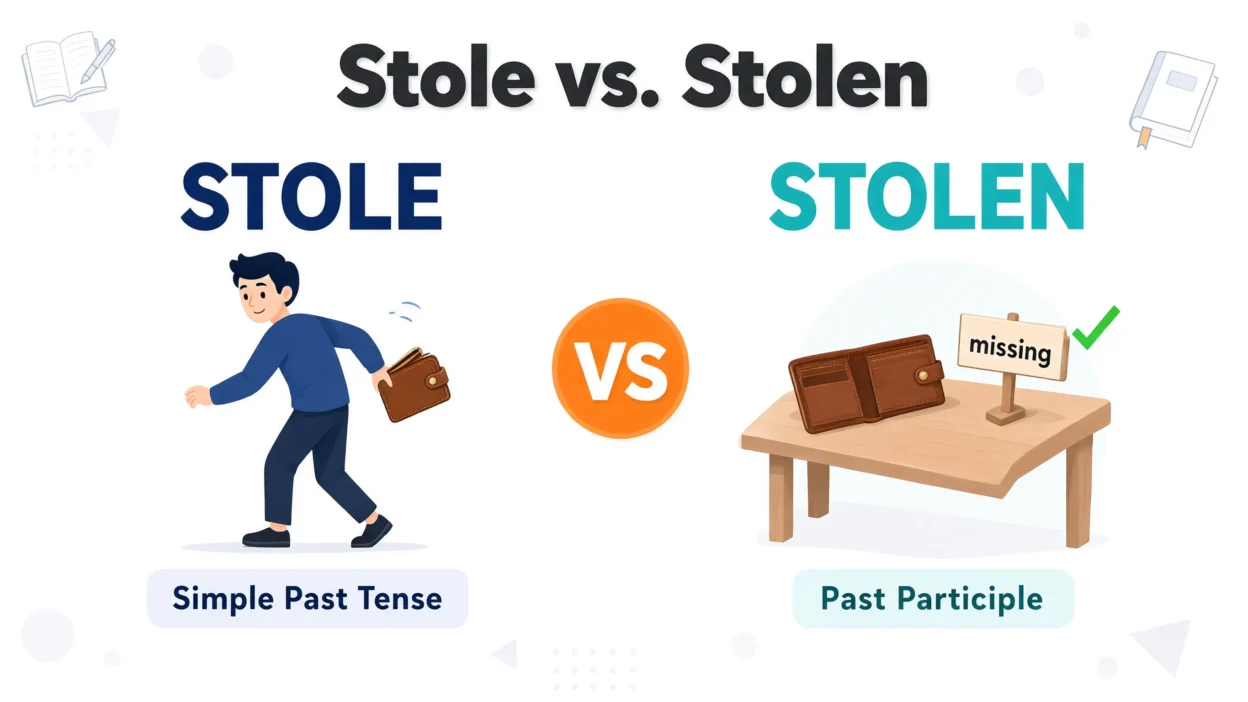
Have you ever wondered if to use stole or stolen when talking about something taken without permission? Both words come from the verb steal, but they are used in different grammatical situations. Understanding the difference between stole vs. stolen will help you write correct sentences, speak more naturally, and avoid common English grammar mistakes.
The main difference is simple: stole is the simple past tense of steal, while stolen is the past participle. Use stole to describe an action that happened in the past, such as “Someone stole my wallet.” Use stolen with helping verbs such as has, have, had, or was in the appropriate grammatical construction, as in “Someone has stolen my wallet” or “My wallet was stolen.”
Both words describe taking something without permission, but they do not work interchangeably in every sentence. In this guide, you will learn their meanings, grammatical rules, differences, and practical examples so you can choose the correct word confidently.
Quick Answer: Stole vs. Stolen
Stole is the simple past tense of steal, while stolen is its past participle. Use stole for a completed past action: “He stole my phone.” Use stolen with helping verbs or in passive constructions: “He has stolen my phone” or “My phone was stolen.” The correct choice depends on the sentence structure.
Why Do People Confuse Stole and Stolen?
People often confuse these words because both describe the same action and refer to something that was taken without permission. The difference is not their basic meaning but their grammatical function.
English has many irregular verbs that change form instead of adding -ed. For example, steal becomes stole in the simple past and stolen as the past participle.
Consider these examples:
- Correct: She stole my bag yesterday.
- Correct: She has stolen my bag.
- Incorrect: She has stole my bag.
- Incorrect: She stolen my bag yesterday.
The key is to recognize whether the sentence needs a simple past verb or a past participle.
What Does Stole Mean?
Stole is the simple past tense of the verb steal. It describes an action that happened and was completed in the past.
The verb steal means to take something that belongs to another person without permission, usually dishonestly or unlawfully.
Examples of Stole in Sentences
- Someone stole my bicycle last night.
- The child stole a cookie from the kitchen.
- He stole money from the company.
- A stranger stole her phone on the bus.
- The player stole the ball from his opponent.
In each sentence, stole describes an action that happened in the past.
When Should You Use Stole?
Use stole when you are describing a past event without using an auxiliary verb such as has, have, or had to form a perfect tense.
Examples:
- I stole a glance at the clock.
- They stole the documents last week.
- Someone stole my identity.
- The thief stole several valuable paintings.
Remember: The basic pattern is subject + stole + object.
Example: “The man stole the wallet.”
What Does Stolen Mean?
Stolen is the past participle of steal. It is used with helping verbs to form perfect tenses and passive constructions. It can also function as an adjective.
Unlike stole, stolen generally does not function as the main verb by itself in a standard past-tense sentence.
Examples of Stolen in Sentences
- Someone has stolen my laptop.
- They had stolen the money before the police arrived.
- My bicycle was stolen yesterday.
- The police recovered the stolen jewelry.
- Her identity has been stolen.
Notice how stolen appears with a helping verb or describes a noun.
When Should You Use Stolen?
Use stolen in these common grammatical patterns:
1. With has, have, or had
These helping verbs form perfect tenses.
- She has stolen my notebook.
- They have stolen several cars.
- The thief had stolen the money before sunrise.
2. In passive sentences
Use a form of be with stolen when the focus is on the thing taken rather than the person who took it.
- My phone was stolen.
- The paintings were stolen from the gallery.
- The documents have been stolen.
3. As an adjective
Use stolen to describe something that was taken without permission.
- The police found the stolen car.
- He was carrying stolen goods.
- The stolen wallet was returned to its owner.
Stole vs. Stolen: Comparison Table
| Feature | Stole | Stolen |
| Base verb | Steal | Steal |
| Grammatical form | Simple past tense | Past participle |
| Main use | Describes a past action | Forms perfect tenses, passive constructions, or adjectives |
| Common pattern | Subject + stole | Has/have/had + stolen |
| Passive example | Not used alone in this pattern | The bag was stolen |
| Adjective use | Not normally used | Stolen property |
| Example | He stole my watch. | He has stolen my watch. |
The easiest way to remember the difference is that stole reports a past action, while stolen usually appears with a helping verb or describes something that was taken.
When Should You Use Stole or Stolen?
Choosing between these words becomes easier when you look at the structure of the sentence.
Use Stole for a Simple Past Action
Use stole when you are telling someone what happened in the past.
Examples:
- The thief stole my wallet.
- She stole a book from the library.
- Someone stole our luggage at the airport.
- He stole the money two days ago.
Use Stolen with Has, Have, or Had
Use stolen when forming a perfect tense.
Examples:
- I have stolen nothing.
- She has stolen the documents.
- They had stolen the car before it was reported missing.
The helping verb indicates the tense, while stolen supplies the past participle.
Use Stolen in Passive Sentences
Use stolen when you want to emphasize the object or the event rather than identify the person responsible.
Examples:
- My wallet was stolen.
- Several computers were stolen from the office.
- The artwork has been stolen.
Use Stolen as an Adjective
Use stolen before a noun when describing property taken without permission.
Examples:
- The stolen phone was found.
- Police recovered the stolen vehicle.
- The shop owner reported the stolen merchandise.
12 Examples of Stole vs. Stolen in Sentences
Here are practical examples showing how each word works in everyday English.
| No. | Sentence | Correct word and reason |
| 1 | Someone ___ my phone yesterday. | Stole — simple past |
| 2 | Someone has ___ my phone. | Stolen — present perfect |
| 3 | The thief ___ the jewelry last night. | Stole — past action |
| 4 | The jewelry was ___. | Stolen — passive construction |
| 5 | They had ___ the money before noon. | Stolen — past perfect |
| 6 | The police found the ___ bicycle. | Stolen — adjective |
| 7 | He ___ my idea during the meeting. | Stole — simple past |
| 8 | She has ___ my heart. | Stolen — present perfect |
| 9 | The documents were ___ from the office. | Stolen — passive construction |
| 10 | The employee ___ confidential files. | Stole — simple past |
| 11 | Someone had ___ my luggage. | Stolen — past perfect |
| 12 | The ___ painting was returned to the museum. | Stolen — adjective |
More Examples in Everyday Conversations
Conversation 1
A: What happened to your bicycle?
B: Someone stole it last night.
Conversation 2
A: Why is your laptop missing?
B: I think it has been stolen.
Conversation 3
A: Did the police recover the vehicle?
B: Yes, they found the stolen car this morning.
These examples demonstrate how the grammatical form changes according to the sentence.
Common Mistakes When Using Stole and Stolen
Even experienced English learners sometimes mix up irregular verb forms. Here are common errors and their corrections.
Mistake 1: Using Stole After Has or Have
Incorrect: She has stole my bag.
Correct: She has stolen my bag.
Why? The present perfect tense requires has or have followed by the past participle.
Mistake 2: Using Stolen as a Simple Past Verb
Incorrect: He stolen my phone yesterday.
Correct: He stole my phone yesterday.
Why? The simple past tense of steal is stole.
Mistake 3: Forgetting the Helping Verb
Incorrect: They stolen the documents.
Correct: They stole the documents.
Also correct: They have stolen the documents.
Why? In standard English, stolen needs an appropriate grammatical structure.
Mistake 4: Confusing Active and Passive Sentences
Incorrect: My wallet stolen yesterday.
Correct: My wallet was stolen yesterday.
Why? A standard passive sentence needs a form of be before the past participle.
Mistake 5: Using Stole in the Past Perfect
Incorrect: The thief had stole the money.
Correct: The thief had stolen the money.
Why? The past perfect uses had + past participle.
What Is an Easy Memory Trick for Stole vs. Stolen?
Use this simple memory trick:
Stole = Past action.
Stolen = Helping verb or description.
Remember these two examples:
- He stole the money.
- He has stolen the money.
You can also memorize the three principal forms of the verb:
Steal → Stole → Stolen
- Steal: present or base form
- Stole: simple past
- Stolen: past participle
If you see has, have, or had before the blank, stolen is normally the form you need. If you are describing a completed action in the simple past, use stole.
Is There a Difference Between American and British English?
No significant difference exists between American and British English when it comes to the standard forms stole and stolen. Both varieties use steal → stole → stolen.
- Someone stole my phone.
- My phone has been stolen.
Examples in British English:
- Someone stole my phone.
- My phone has been stolen.
The spelling and grammatical rules are the same in both varieties. Differences in pronunciation or regional vocabulary do not change the correct use of these verb forms.
Similar Words to Stole and Stolen
Learning related irregular verbs can help you understand how English past-tense and past-participle forms work.
| Base form | Simple past | Past participle |
| Steal | Stole | Stolen |
| Take | Took | Taken |
| Break | Broke | Broken |
| Speak | Spoke | Spoken |
| Write | Wrote | Written |
| Choose | Chose | Chosen |
| Freeze | Froze | Frozen |
| Wake | Woke | Woken |
| Give | Gave | Given |
| Drive | Drove | Driven |
These verbs follow a similar pattern: their simple past and past participle forms are different.
For example:
- She took my book.
- She has taken my book.
- He broke the window.
- He has broken the window.
Just as you would not normally say “She has took my book,” you should not say “She has stole my book.”
Final Verdict: Stole or Stolen?
Both stole and stolen are correct English words, but they serve different grammatical purposes.
Use stole when describing a completed action in the simple past.
Example: “Someone stole my bag.”
Use stolen after helping verbs in perfect tenses, in passive constructions, or as an adjective.
Examples: “Someone has stolen my bag.” “My bag was stolen.” “The stolen bag was recovered.”
The main rule is straightforward: stole is the simple past tense, and stolen is the past participle. Remember this distinction, and you will be able to choose the correct form in everyday conversations, school assignments, emails, and professional writing.
FAQs:
1. Is stole or stolen correct?
Both are correct, but they are used differently. Stole is the simple past tense of steal, while stolen is the past participle. The correct choice depends on the sentence.
Examples: “He stole my phone” and “He has stolen my phone.”
2. Is stolen the past tense of steal?
No. Stolen is the past participle of steal. The simple past tense is stole.
The three forms are steal, stole, stolen.
3. Can I say “I have stole”?
No. In standard English, the correct expression is “I have stolen.” The present perfect tense follows the pattern have/has + past participle.
Correct: “I have stolen nothing.”
4. Is it “my phone was stole” or “my phone was stolen”?
The correct sentence is “My phone was stolen.” Passive constructions use a form of be followed by the past participle.
Incorrect: My phone was stole.
Correct: My phone was stolen.
5. What is the difference between stole and stolen in a sentence?
Stole describes a past action, while stolen is used with helping verbs or as an adjective.
- The man stole the wallet.
- The man has stolen the wallet.
- The stolen wallet was recovered.
6. What are the three forms of steal?
The three principal forms are:
- Base form: steal
- Simple past: stole
- Past participle: stolen
Example: “I steal,” “I stole,” and “I have stolen.”
7. Is “stolen” an adjective?
Yes. Stolen can function as an adjective when it describes property that was taken without permission.
Example: “The police recovered the stolen car.”
It can also function as a past participle in verb constructions, such as “The car has been stolen.”
Remember This
- Steal = present or base form.
- Stole = simple past tense.
- Stolen = past participle.
- Say “He stole my wallet,” not “He stolen my wallet.”
- Say “He has stolen my wallet,” not “He has stole my wallet.”
- Say “My wallet was stolen,” not “My wallet was stole.”
The easiest formula to memorize is steal → stole → stolen.
Conclusion
Understanding the difference between stole and stolen is an important step toward using English grammar correctly. Although both words come from the same verb and describe the same basic action, their grammatical roles are different.
Stole is used for a completed action in the simple past, while stolen is used as a past participle with helping verbs or in passive constructions. Learning this distinction will help you avoid common mistakes and write clearer, more natural sentences.
To remember the rule, practice using both words in short sentences. Say, “Someone stole my bag yesterday,” and then, “Someone has stolen my bag.” Once you become familiar with the pattern steal, stole, stolen, choosing the right word will feel much easier. Keep practicing with other irregular verbs, and your English grammar skills will continue to improve.

Lucas Smith is a skilled language writer at Synomity.com, passionate about synonyms, vocabulary enrichment, and word meanings. He develops engaging content that helps readers strengthen communication skills and expand their understanding of language.