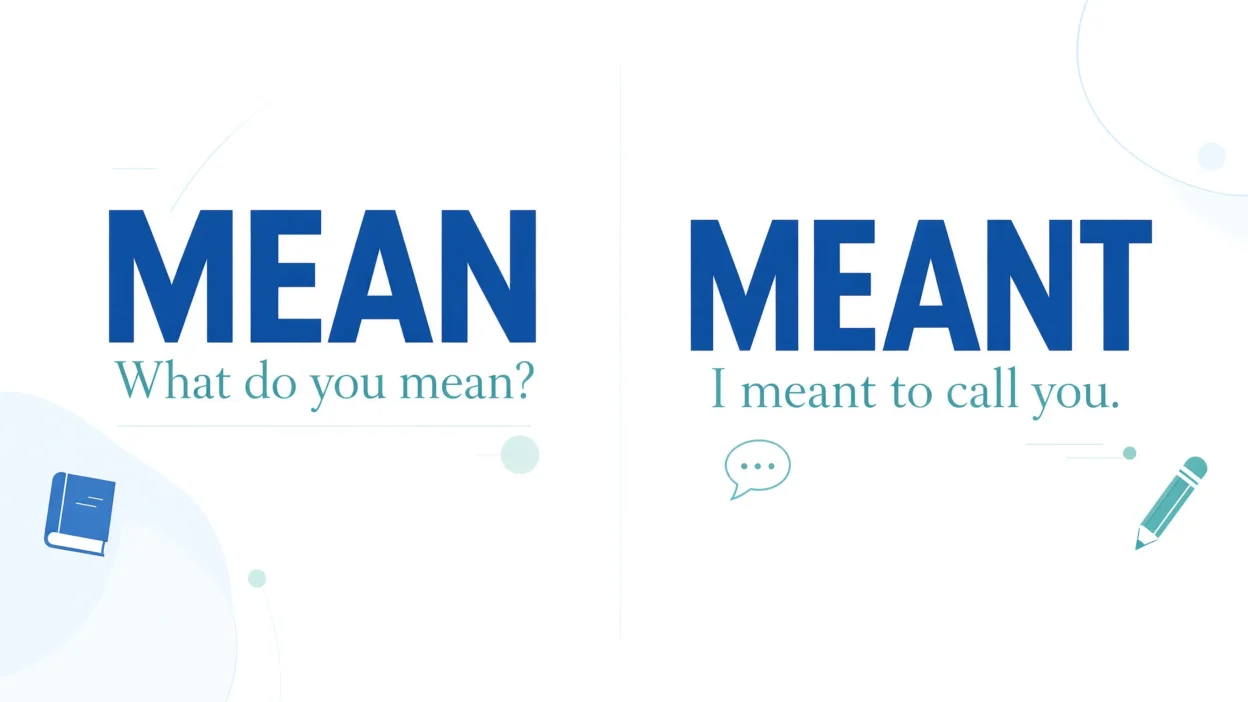
The words mean and meant are both correct, but they are used in different situations. Mean is the present-tense form of a verb that can express intention, meaning, or significance. Meant is the past tense and past participle of mean. For example, “What do you mean?” is correct when asking about someone’s current meaning, while “What did you mean?” refers to something they said earlier.
Understanding the difference between mean and meant can help you avoid common grammar and spelling mistakes. Although the two words look similar and have related meanings, their verb forms determine when you should use each one. The same rule applies if you are writing a school assignment, sending a text message, or speaking English in everyday conversations.
In this guide, you will learn the meaning of each word, when to use mean or meant, how they work in different sentences, and which mistakes to avoid. You will also find practical examples, a comparison table, and simple memory tricks to help you remember the correct form.
Quick Answer: Mean or Meant?
Mean is the present-tense form of the verb, while meant is its past tense and past participle. Use mean to talk about what something signifies or what someone intends now. Use meant to describe what someone intended or what something signified in the past. For example, “I mean it” and “I meant it.”
Why Do People Confuse Mean and Meant?
People often confuse these words because they share the same basic meaning and differ by only a few letters. Both can describe an intention, definition, or significance.
The main difference is grammatical tense:
- Mean: Present tense — “I mean what I say.”
- Meant: Past tense — “I meant what I said.”
Another source of confusion is the pronunciation. Mean rhymes with “clean,” while meant rhymes with “went.” Remembering their sounds and verb forms makes choosing the correct word easier.
What Does Mean Mean?
Mean is the base form of a verb used to express what someone intends, what a word signifies, or what something represents.
Common meanings of mean
1. To intend: To have a particular purpose or plan.
- Example: “I mean to finish my homework today.”
2. To signify: To express or represent a particular idea.
- Example: “What does this symbol mean?”
3. To communicate an intention: To express something sincerely.
- Example: “I mean every word I say.”
4. To indicate importance or value: To matter to someone.
- Example: “Your friendship means a lot to me.”
The word mean can also function as an adjective meaning unkind or unfair, as in “That was a mean comment.” It can have other meanings in mathematics, including the average of a set of numbers.
Examples of mean in sentences
- What do you mean by that?
- I mean no harm.
- These words mean something special to me.
- Does this sign mean we should stop?
- I mean to call her this evening.
What Does Meant Mean?
Meant is the simple past tense and past participle of mean. It describes an intention, definition, or significance connected to the past.
Common meanings of meant
1. Intended: Someone had a particular purpose.
- Example: “I meant to call you yesterday.”
2. Signified: Something had a particular meaning.
- Example: “What meant the most to her was his kindness.”
3. Was intended for someone or something: Something was designed or planned for a particular purpose.
- Example: “This gift was meant for you.”
4. Was supposed or expected to happen: Something was intended as part of a plan.
- Example: “We were meant to meet.”
Examples of meant in sentences
- I meant what I said.
- She meant to help you.
- What did he mean by that?
- This message was meant for you.
- I never meant to hurt your feelings.
Notice that meant can also appear in questions about the past. For example, “What did you mean?” asks about a previous statement.
Mean vs. Meant: Comparison Table
| Feature | Mean | Meant |
| Verb form | Present tense or base form | Simple past and past participle |
| Main use | Current meaning or intention | Past meaning or intention |
| Example | I mean what I say. | I meant what I said. |
| With do/does | Do you mean it? | Not normally used with do/does for past meaning |
| With did | Not used as the main verb after did | Did you mean it? |
| With have/has | Not used as the past participle | I have meant to call you. |
| Pronunciation | Rhymes with “clean” | Rhymes with “went” |
Important grammar rule: After did, use mean, not meant, because did already marks the past tense.
- Correct: “What did you mean?”
- Incorrect: “What did you meant?”
When Should You Use Mean or Meant?
Choose the word based on the tense and structure of your sentence.
Use mean for the present
Use mean when talking about what something signifies now or what you intend.
Examples:
- What do you mean?
- I mean every word.
- This word means happiness.
- I mean to speak with him today.
For he, she, and it in the simple present, use means.
Example: “This expression means the same thing.”
Use meant for the past
Use meant when referring to an intention or meaning in the past.
Examples:
- I meant to tell you yesterday.
- She meant no disrespect.
- His message meant a lot to me.
- We meant to arrive earlier.
Use meant with have, has, and had
Because meant is also a past participle, it appears in perfect-tense constructions.
Examples:
- I have meant to ask you something.
- She has always meant well.
- They had meant to leave before sunset.
Use mean after did
In questions and negative sentences with did, the main verb returns to its base form.
- Correct: “Did you mean that?”
- Correct: “I did not mean to upset you.”
- Incorrect: “Did you meant that?”
- Incorrect: “I did not meant to upset you.”
12 Examples of Mean and Meant in Sentences
Here are practical examples showing how to use both words correctly.
- Mean: What do you mean by this statement?
- Meant: What did you mean by that statement?
- Mean: I mean no harm to anyone.
- Meant: I meant no harm when I said it.
- Mean: These instructions mean you should wait.
- Meant: Those instructions meant we had to wait.
- Mean: I mean to finish the project today.
- Meant: I meant to finish the project yesterday.
- Mean: Your support means everything to me.
- Meant: Your support meant everything to me during that difficult time.
- Mean: Do you mean what you are saying?
- Meant: I have always meant what I said.
These examples show that the correct choice depends on the time being discussed and the sentence structure.
Common Mistakes When Using Mean and Meant
Even experienced English speakers can make mistakes when choosing between these forms. Here are some common errors and how to correct them.
Mistake 1: Using meant after did
Incorrect: “What did you meant?”
Correct: “What did you mean?”
Why? The auxiliary verb did already shows the past tense, so the main verb must be in its base form.
Mistake 2: Using mean for a past event
Incorrect: “I mean to call you yesterday.”
Correct: “I meant to call you yesterday.”
Why? The word yesterday places the intended action in the past.
Mistake 3: Confusing mean with means
Incorrect: “This word mean happiness.”
Correct: “This word means happiness.”
Why? In the simple present, use means with singular third-person subjects such as he, she, it, and singular nouns.
Mistake 4: Using meant after do or does
Incorrect: “Do you meant what you said?”
Correct: “Do you mean what you say?”
Why? Use the base form mean after do and does.
Mistake 5: Assuming meant always refers to a completed action
Although meant is a past-tense form, it also appears in perfect constructions and passive sentences.
Examples:
- “I have meant to ask you for weeks.”
- “This letter was meant for you.”
The surrounding words help determine the exact meaning and time reference.
Memory Trick: How to Remember Mean vs. Meant
Use this simple rule:
Mean = now; meant = before.
Think of these two sentences:
- “I mean it now.”
- “I meant it yesterday.”
You can also remember that meant rhymes with went, a word often associated with the past.
One more helpful trick is to check whether your sentence contains did:
- If it does, use mean: “Did you mean it?”
- If it does not and you are describing a past intention, meant may be correct: “I meant it.”
These quick checks can help you choose the correct form when writing or speaking.
Mean or Meant in American vs. British English
There is no spelling difference between mean and meant in American and British English. Both varieties use mean for the present form and meant for the past tense and past participle.
| Variety | Present form | Past form | Example |
| American English | Mean | Meant | I meant to call you. |
| British English | Mean | Meant | I meant to ring you. |
The main differences you might notice are in surrounding vocabulary, pronunciation, or conversational style. The grammar rule remains the same in both varieties.
Similar Words Related to Mean and Meant
Understanding related words can help you express intentions and meanings more precisely.
- Means: The third-person singular present form of mean. Example: “This word means peace.”
- Meaning: The idea or message expressed by a word, action, or statement. Example: “What is the meaning of this phrase?”
- Meantime: The period between two events. Example: “In the meantime, please wait here.”
- Intend: To have a plan or purpose. Example: “I intend to study tonight.”
- Signify: To represent or indicate something. Example: “A red light signifies danger.”
- Imply: To suggest something without stating it directly. Example: “His words implied that he was unhappy.”
- Misunderstand: To interpret something incorrectly. Example: “I misunderstood what you meant.”
Remember that mean and meant are forms of the same verb, while the other words have their own grammatical roles and uses.
Final Verdict: Mean or Meant?
Both mean and meant are correct English words, but they serve different grammatical purposes.
- Use mean for present meanings and intentions: “I mean what I say.”
- Use meant for past meanings and intentions: “I meant what I said.”
- Use mean after did: “Did you mean it?”
- Use means with singular third-person subjects in the simple present: “It means a lot.”
If you are talking about what someone intends now, choose mean. If you are describing what someone intended or what something signified in the past, choose meant, unless a helping verb such as did requires the base form.
FAQs:
1. Is it mean or meant?
Both are correct, depending on the context. Mean is the present form, while meant is the past tense and past participle. For example, “I mean it” refers to the present, while “I meant it” refers to the past.
2. Is it “What do you mean” or “What do you meant”?
The correct phrase is “What do you mean?” The auxiliary verb do takes the base form of the main verb, so meant would be incorrect in this sentence.
3. Is it “What did you mean” or “What did you meant”?
The correct phrase is “What did you mean?” Because did already marks the past tense, you must use mean rather than meant.
4. What is the past tense of mean?
The simple past tense of mean is meant. For example, “I mean to help” becomes “I meant to help” when referring to the past.
5. Is meant a real word?
Yes. Meant is the standard past tense and past participle of mean. It is used in sentences such as “I meant to call you” and “The gift was meant for her.”
6. What is the difference between mean and means?
Mean is used with subjects such as I, you, we, and they in the simple present. Means is used with singular third-person subjects such as he, she, it, or a singular noun.
Examples:
- “They mean well.”
- “She means well.”
7. Is it “I mean to say” or “I meant to say”?
Both phrases are correct. Use “I mean to say” when expressing your current intention or clarifying something now. Use “I meant to say” when referring to something you intended to say earlier.
Remember This
- Mean = present tense or base form.
- Meant = past tense and past participle.
- Means = present tense with singular third-person subjects.
- After did, always use mean, not meant.
- After have, has, or had, use meant when forming the perfect tense.
The easiest rule to remember is that mean usually refers to the present, while meant refers to a past intention or meaning. Always check the helping verb and the time reference before choosing your word.
Conclusion
Choosing between mean and meant becomes easy once you understand their verb forms. Use mean to describe a current meaning, intention, or significance. Use meant to talk about a past intention or meaning, or as the past participle in perfect-tense constructions. Both words are standard in American and British English, so the difference is grammatical rather than regional.
To avoid mistakes, remember the simple rule: mean for the present, meant for the past, and mean after did. With a little practice and the examples in this guide, you can use both words confidently in conversations, messages, schoolwork, and professional writing.

Evelyn Mia is a passionate language writer and vocabulary enthusiast at Synomity.com, specializing in synonyms, word meanings, and language learning. She creates informative content that helps readers expand vocabulary and communicate more effectively.