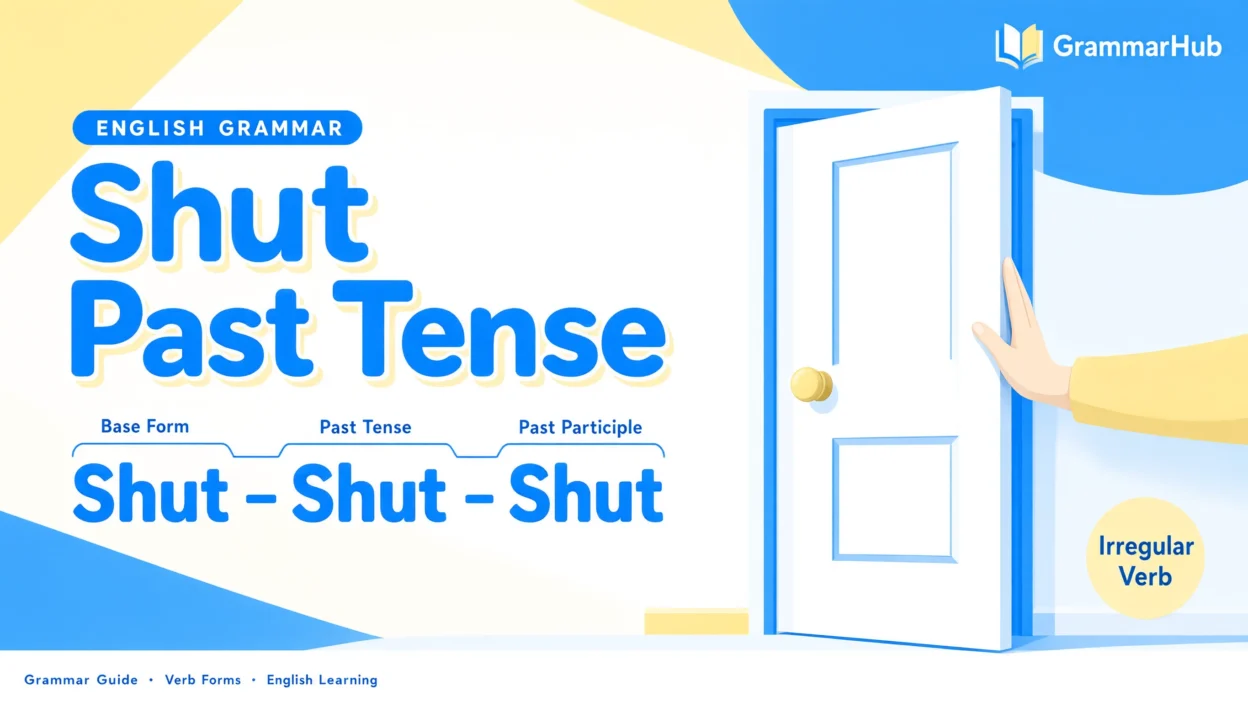
The past tense of shut is shut. It is an irregular verb, which means it does not form its past tense by adding -ed to the base verb. The word shut remains the same in the present, past, and past participle forms. For example, “I shut the door yesterday” is correct, not “I shutted the door yesterday.”
The verb shut means to close something, such as a door, window, gate, book, or shop. It can also describe stopping access, ending an activity, or preventing something from operating. Learning its correct forms helps you write grammatically accurate sentences and speak English more naturally.
Although many English verbs form their past tense by adding -ed, some common verbs follow irregular patterns. Shut is one of the easiest irregular verbs to remember because its spelling does not change. In this guide, you will learn its verb forms, how to use it in different tenses, common mistakes to avoid, and practical examples for everyday English.
Quick Answer: What Is the Past Tense of Shut?
The past tense of shut is shut. It is an irregular verb that keeps the same spelling in its base form, simple past tense, and past participle. For example, “She shuts the window every night” becomes “She shut the window last night.” The word shutted is incorrect in standard English.
Why Do People Confuse the Past Tense of Shut?
People sometimes confuse shut because many regular English verbs form their past tense by adding -ed. For example, open becomes opened, and close becomes closed.
However, shut belongs to a group of irregular verbs that do not change their spelling when used in the past tense.
Another source of confusion is the difference between the simple past tense and the past participle. With many verbs, these forms are different. For example, write becomes wrote in the simple past and written as a past participle. With shut, both forms are identical.
Remember that the correct forms are shut, shut, and shut.
First Word: Shut (Base Form and Present Tense)
Shut is the base form of the verb. It means to close something or prevent it from remaining open.
You can use it with subjects such as I, you, we, and they. With he, she, and it in the simple present tense, the verb usually becomes shuts.
Examples:
- I shut the door before leaving.
- They shut the windows when it rains.
- Please shut the gate.
- She shuts the shop at 8 p.m.
- He wants to shut his eyes for a few minutes.
The base form shut is also used after modal verbs such as can, should, and must.
Examples:
- You should shut the door.
- We must shut the windows.
- Can you shut the gate?
Second Word: Shut (Simple Past Tense and Past Participle)
The word shut is also the simple past tense and past participle of the verb shut. Its spelling remains unchanged even when you describe an action that happened in the past.
Examples of the simple past tense:
- I shut the door an hour ago.
- She shut her book after studying.
- They shut the office early yesterday.
Examples of the past participle:
- I have shut the window.
- He has shut the gate.
- They had shut the store before we arrived.
The past participle is generally used with helping verbs such as have, has, and had. The simple past tense can stand alone to describe a completed action.
Shut Verb Forms: Comparison Table
| Verb form | Correct word | Example |
| Base form | Shut | I shut the door every evening. |
| Simple present, third-person singular | Shuts | She shuts the window. |
| Simple past tense | Shut | She shut the window yesterday. |
| Past participle | Shut | She has shut the window. |
| Present participle | Shutting | She is shutting the window. |
| Third-person singular past | Shut | He shut the gate last night. |
The key point is that shut does not change its spelling in the simple past tense or past participle. However, its present participle is shutting, with a doubled t.
When Should You Use Shut, Shuts, or Shutting?
Choose the correct form based on the subject, tense, and sentence structure.
1. Use Shut for the Base Form
Use shut after modal verbs, after to, and with subjects such as I, you, we, and they in the simple present.
Examples:
- I shut the door every night.
- You should shut the window.
- They want to shut the office.
2. Use Shuts for the Simple Present
Use shuts with he, she, or it when describing a regular action or habit.
Examples:
- He shuts the door quietly.
- She shuts her laptop after work.
- The shop shuts at midnight.
3. Use Shut for the Simple Past
Use shut when describing an action completed in the past.
Examples:
- We shut the shop yesterday.
- He shut the door before going outside.
- She shut her eyes during the movie.
4. Use Has Shut, Have Shut, or Had Shut
Use these combinations when forming perfect tenses.
Examples:
- I have shut the window.
- She has shut the office.
- They had shut the doors before the storm began.
5. Use Shutting for an Action in Progress
Use shutting with forms of be to describe an action that is happening or was happening.
Examples:
- I am shutting the door now.
- She was shutting the window when I called.
- They are shutting down the factory.
12 Examples of Shut in Sentences
Here are 12 practical examples showing how to use shut in different situations.
- Present tense: I shut the front door every evening.
- Present tense: They shut their books after the lesson.
- Third-person singular: She shuts the windows before bed.
- Simple past: He shut the gate yesterday.
- Simple past: We shut the shop early last Friday.
- Simple past: The wind shut the door suddenly.
- Present perfect: I have shut all the windows.
- Present perfect: She has shut her laptop.
- Past perfect: They had shut the restaurant before we arrived.
- Future: I will shut the door when I leave.
- Modal verb: You should shut the refrigerator properly.
- Present continuous: He is shutting the garage door.
These examples show that the spelling depends on the grammatical form, but the simple past and past participle remain shut.
Common Mistakes When Using Shut
English learners sometimes apply regular verb rules to irregular verbs. Avoid these common errors.
| Incorrect sentence | Correct sentence |
| I shutted the door. | I shut the door. |
| She has shutted the window. | She has shut the window. |
| He did shut the door yesterday? | Did he shut the door yesterday? |
| They have shutting the gate. | They have shut the gate. |
| She shutted down her computer. | She shut down her computer. |
Why Is “Shutted” Incorrect?
In standard English, shutted is not the accepted past tense of shut. The verb is irregular, so its simple past tense is shut.
Why Do We Say “Did He Shut” Instead of “Did He Shut the Door Yesterday?” with Another Verb Form?
When forming questions and negatives with did, use the base form of the main verb.
- Did you shut the door?
- I did not shut the door.
- Did she shut the shop?
Incorrect examples:
- Did you shutted the door?
- I did not shutted the door.
The auxiliary did already marks the past tense, so the main verb stays in its base form.
Memory Trick: How to Remember the Past Tense of Shut
The easiest way to remember this verb is:
Shut – Shut – Shut
Think of it as a verb that stays the same in three important forms.
- Present: I shut the door.
- Past: I shut the door yesterday.
- Past participle: I have shut the door.
Remember this simple rule: No “-ed” is needed for shut.
You can also practise with a short sentence:
“Today I shut the door, yesterday I shut the door, and I have shut the door.”
Repeating this pattern will help you remember the correct form.
American vs. British English: Is the Past Tense Different?
No. Both American English and British English use shut as the simple past tense and past participle.
| English variety | Simple past | Past participle |
| American English | Shut | Shut |
| British English | Shut | Shut |
| Australian English | Shut | Shut |
The spelling and principal verb forms do not change between these varieties of English.
For example:
- American English: He shut the store early.
- British English: He shut the shop early.
The difference in these examples is mainly the choice of store or shop, not the verb form.
Similar Words to Shut
Learning related words can help you express yourself more clearly.
- Close: To move something into a position that blocks an opening. Example: Please close the window.
- Seal: To close something securely so that nothing can enter or escape. Example: Seal the envelope.
- Lock: To secure something with a lock. Example: She locked the door.
- Block: To prevent movement or access. Example: The fallen tree blocked the road.
- End: To bring an activity or event to a conclusion. Example: They ended the meeting.
- Shut down: To stop a machine, business, or system from operating. Example: The company shut down the factory.
- Shut off: To stop the flow of something or switch something off. Example: He shut off the water supply.
Although shut and close are often interchangeable, they are not always identical in meaning. For example, you can close a book, shut a door, or shut down a computer. The best choice depends on the context.
Final Verdict: What Is the Past Tense of Shut?
The past tense of shut is shut, not shutted. It is an irregular verb whose base form, simple past tense, and past participle are spelled the same way.
Once you remember the pattern shut – shut – shut, using this verb correctly becomes easy.
FAQs:
1. What is the past tense of shut?
The past tense of shut is shut. For example: “She shut the door before leaving.” The spelling remains the same as the base form.
2. Is “shutted” a real word?
Shutted is not the standard past tense of shut in modern English. Use shut instead. The correct sentence is “He shut the window,” not “He shutted the window.”
3. What is the past participle of shut?
The past participle of shut is shut. It is used with helping verbs such as have, has, and had. For example: “I have shut the gate.”
4. Is shut an irregular verb?
Yes, shut is an irregular verb because it does not form its past tense by adding -ed. Its base form, simple past, and past participle are all shut.
5. What are the three forms of shut?
The three principal forms are shut – shut – shut.
- Base form: shut
- Simple past: shut
- Past participle: shut
6. Is it “shut” or “shuts” in the present tense?
Use shut with I, you, we, and they. Use shuts with he, she, and it in the simple present tense.
Examples: “They shut the door” and “She shuts the door.”
7. What is the past tense of shut down?
The past tense of shut down is shut down. For example: “The company shut down its old factory last year.” The same pattern applies to the past participle: “The company has shut down its old factory.”
Remember This
- The past tense of shut is shut.
- The past participle is also shut.
- The three principal forms are shut – shut – shut.
- Shutted is incorrect in standard English.
- Use shuts with he, she, and it in the simple present.
- Use shutting for continuous tenses.
- After did, use the base form: “Did you shut the door?”
Conclusion
The past tense of shut is easy to learn once you understand that it is an irregular verb. Unlike regular verbs that add -ed, shut keeps the same spelling in its base form, simple past tense, and past participle. The correct pattern is shut – shut – shut. Whether you are talking about closing a door, shutting a shop, or stopping a machine, the past-tense form remains unchanged.
To improve your English, practise using shut in everyday sentences and pay attention to helping verbs. Say “I shut the door yesterday,” “I have shut the door,” and “She shuts the door every night.”
These examples demonstrate how the same word works in different grammatical situations. With regular practice, you will avoid common mistakes such as shutted and use shut confidently in speaking, writing, and school assignments.