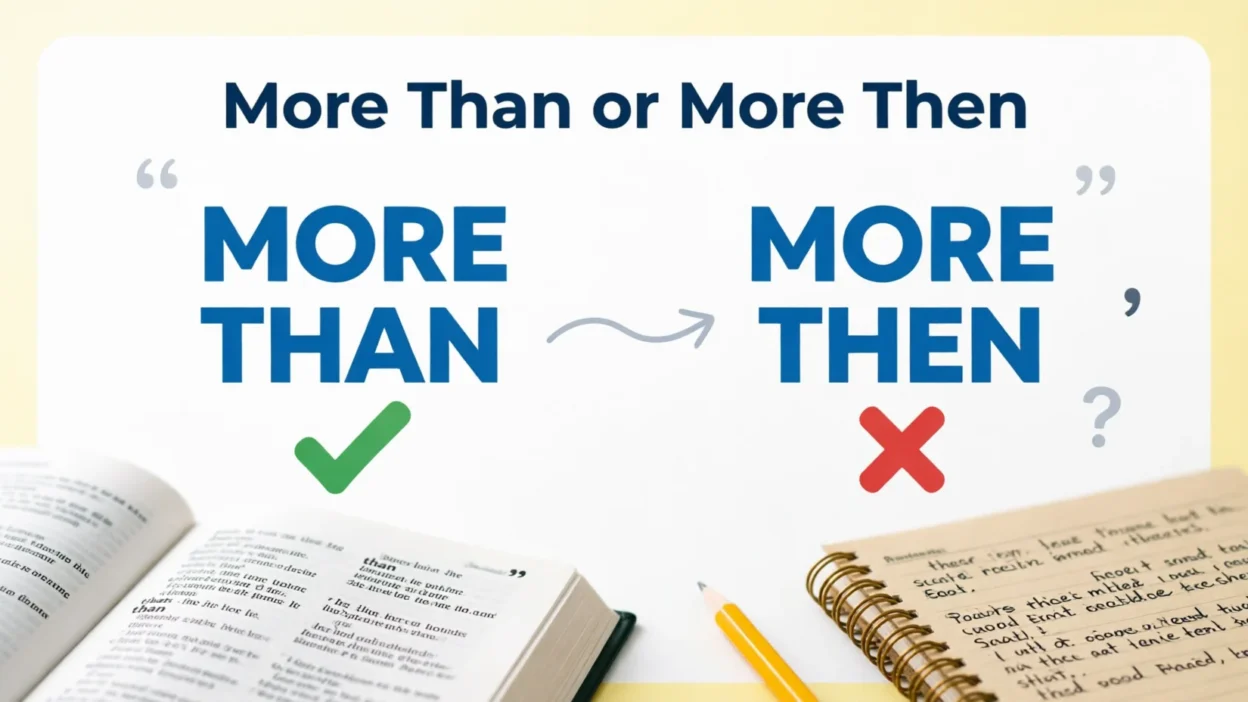
When you want to say that one amount or number is greater than another, the correct phrase is “more than.” The word “than” is used for comparisons, so we write “more than 100 people,” “more than enough,” or “more than I expected.” “More then” is incorrect when you are making a comparison.
The confusion happens because than and then sound similar in everyday speech. However, they have completely different meanings and grammatical functions. Than is mainly used to compare people, things, numbers, amounts, or qualities.
Then usually refers to time, sequence, or what happens next. Understanding this simple difference will help you avoid one of the most common spelling and grammar mistakes in English.
Quick Answer
“More than” is correct, while “more then” is incorrect for comparisons. Use than when comparing an amount, number, person, or thing: “She has more than $50.” Use then when talking about time or sequence: “Finish your work, then go home.”
Why Do People Confuse “More Than” and “More Then”?
The main reason is pronunciation. Than and then can sound very similar, especially in fast or casual speech.
Their meanings are different:
- Than → used for comparison.
- Then → used for time, sequence, or consequence.
For example:
- I have more than you. ✅
- I finished my work and then went home. ✅
- I have more then you. ❌
A useful way to remember the difference is to focus on the meaning rather than the sound.
What Does “Than” Mean?
Than is a conjunction or preposition commonly used to make comparisons.
It often appears after comparative words such as:
- more
- less
- better
- worse
- taller
- shorter
- faster
- slower
- older
- younger
Examples
- She is taller than her brother.
- This book is more interesting than that one.
- I have more than enough time.
- The journey took less than two hours.
- He earns more than $1,000 a month.
In “more than,” the word than introduces the thing being compared.
What Does “Then” Mean?
Then is generally related to time, sequence, or a result.
It can mean something like:
- at that time
- next
- afterward
- in that case
Examples
- I lived there then.
- Finish your homework, then watch TV.
- First wash the vegetables, then cook them.
- If you are tired, then take a break.
- We were younger then.
Because then deals with sequence or time, it does not belong in the phrase “more than” when making a comparison.
More Than vs More Then: Comparison Table
| Phrase | Correct? | Meaning | Example |
| more than | ✅ Yes | Greater in amount, number, or degree | I need more than $20. |
| more then | ❌ No, for comparison | Incorrect form of the comparison | I need more then $20. ❌ |
| than | ✅ Yes | Used for comparisons | She is older than me. |
| then | ✅ Yes | Refers to time or sequence | Eat first, then leave. |
When Should You Use “More Than”?
Use more than when you want to show that something is greater in amount, number, degree, or extent.
1. Comparing Numbers
- More than 50 students attended.
- The video has more than 10,000 views.
- More than 100 people joined the event.
2. Comparing Amounts
- The laptop costs more than $500.
- I need more than five dollars.
- She saved more than expected.
3. Comparing Degrees
- The movie was more than entertaining.
- His explanation was more than helpful.
- The experience was more than I expected.
4. Showing an Amount Greater Than a Limit
- It took more than three hours.
- He waited for more than a week.
- The box weighs more than 20 kilograms.
10+ Examples of “More Than”
Here are practical examples to make the difference clear:
- I have more than enough food.
- She has more than 500 followers.
- The building is more than 100 years old.
- He paid more than $50 for the shirt.
- We waited more than an hour.
- There were more than 200 guests.
- This job requires more than basic skills.
- The book contains more than 300 pages.
- I expected more than this.
- She knows more than I do.
- The trip cost more than we planned.
- He is more than ready to begin.
In every comparison above, than is the correct word.
Common Mistakes With “More Than” and “More Then”
Mistake 1: Writing “more then” for a comparison
❌ There were more then 100 people.
✅ There were more than 100 people.
Mistake 2: Choosing Based Only on Sound
Because than and then can sound alike, relying on pronunciation can cause mistakes.
Instead, ask yourself:
Am I comparing something?
If yes, use than.
Mistake 3: Confusing “then” with a comparative word
❌ She is more talented then her sister.
✅ She is more talented than her sister.
The sentence compares her talent with her sister’s talent, so than is required.
Mistake 4: Thinking “then” is always wrong
Then is a perfectly correct English word. It is simply not correct in “more than” when the phrase expresses a comparison.
For example:
- I had more work then. ✅
- I had more work than my brother. ✅
The first sentence refers to a previous time. The second makes a comparison.
A Simple Memory Trick
Remember:
THAN = COMPARISON
THEN = TIME / NEXT
You can use the letter A in than to remind yourself of comparison:
Than = Compare
And remember then as:
Then = Next
For example:
- More than 20 → comparison
- First eat, then leave → sequence
If you are comparing two things, than is usually the word you need.
American vs British English
There is no difference between American and British English in the basic distinction between than and then.
Both varieties use:
- more than for comparisons
- then for time or sequence
For example:
- American English: “She has more than enough.”
- British English: “She has more than enough.”
The spelling and grammatical distinction remain the same.
Similar Words: “Than” and “Then”
Several other English words can also cause confusion because they sound similar or have related spellings.
Than vs Then
- Than → comparison
- Then → time or sequence
Your vs You’re
- Your → shows possession
- You’re → means “you are”
Their vs There vs They’re
- Their → possession
- There → place or existence
- They’re → “they are”
To vs Too
- To → direction or infinitive marker
- Too → also or excessively
Learning these commonly confused words can make your writing much clearer.
Final Verdict: More Than or More Then?
The correct phrase is “more than” when you are making a comparison or describing an amount greater than something.
✅ More than 100 people attended.
❌ More then 100 people attended.
Then is a different word used mainly for time and sequence:
Finish your work, then take a break.
So, whenever you mean “greater than,” “over,” or “in excess of,” use more than.
FAQs:
Is “more than” correct?
Yes. “More than” is the correct phrase when comparing amounts, numbers, degrees, or quantities.
Is “more then” grammatically correct?
Not when you are making a comparison. In that situation, “more than” is correct. Then has a different meaning related to time or sequence.
What is the difference between than and then?
Than is mainly used for comparisons, while then is generally used for time, sequence, or consequences.
Is it “more than enough” or “more then enough”?
The correct phrase is “more than enough.”
Example:
We have more than enough food.
Is it “more than 10” or “more then 10”?
The correct expression is “more than 10.”
Example:
More than 10 students attended the class.
Can “then” ever be correct in a sentence with “more”?
Yes. Then can appear in the same sentence when it refers to time or sequence.
Example:
I had more free time then than I do now.
Here, the first then refers to a past time, while than introduces a comparison.
How can I remember “than” vs “then”?
Remember than = comparison and then = time or next. If you are comparing two things, choose than.
Remember This
- More than = correct for comparisons.
- More then = incorrect for comparisons.
- Than = comparison.
- Then = time, sequence, or consequence.
- More than 50 = greater than 50.
- Finish it, then leave = do one thing next.
Conclusion
The difference between “more than” and “more then” is simple once you understand the meanings of than and then. Use than when you are comparing quantities, numbers, people, things, or degrees. That is why “more than 100,” “more than enough,” and “more than I expected” are correct.
Use then when talking about a time, sequence, or what happens next. For example, “First study, then relax.” Remembering than = comparison and then = time/next will help you choose the right word confidently in everyday writing.

Lucas Smith is a skilled language writer at Synomity.com, passionate about synonyms, vocabulary enrichment, and word meanings. He develops engaging content that helps readers strengthen communication skills and expand their understanding of language.