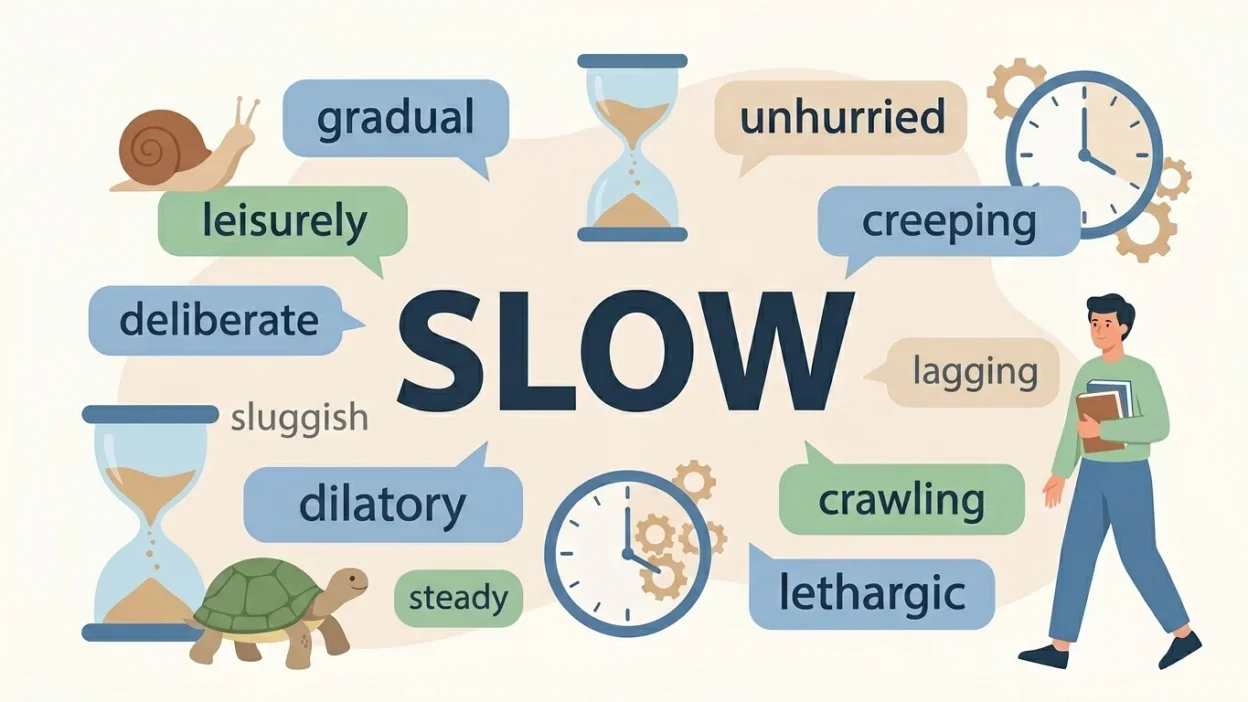
When you repeatedly use the word slow, your writing can start to feel repetitive. Whether you’re a student, ESL learner, writer, or content creator, expanding your vocabulary helps you communicate more clearly and naturally.
Learning different synonyms for slow allows you to describe movement, progress, behavior, learning speed, and even emotions with greater accuracy. Some alternatives sound formal, while others fit casual conversations or creative writing.
In this guide, you’ll discover simple meanings, example sentences, and usage tips for 30 useful synonyms for slow. By the end, you’ll know exactly which word to choose for different situations.
What Does “Slow” Mean?
The word slow generally means moving, happening, or progressing at a lower speed than expected.
It can describe:
- Physical movement
- Learning pace
- Business growth
- Technology performance
- Reactions and decision-making
- Story pacing
Examples
- The traffic was slow this morning.
- She is a slow reader but understands everything well.
- Sales have been slow this month.
Because “slow” has many meanings, choosing the right synonym can make your message more precise.
30 Synonyms for Slow
1. Gradual
Meaning: Happening little by little over time.
Example: The patient’s recovery was gradual.
Best Usage Context: Long-term changes and progress.
2. Leisurely
Meaning: Relaxed and unhurried.
Example: We took a leisurely walk through the park.
Best Usage Context: Pleasant, calm activities.
3. Unhurried
Meaning: Done without rushing.
Example: She spoke in an unhurried manner.
Best Usage Context: Peaceful actions and conversations.
4. Deliberate
Meaning: Careful and intentional rather than fast.
Example: His deliberate movements showed experience.
Best Usage Context: Thoughtful actions.
5. Measured
Meaning: Controlled and steady.
Example: She gave a measured response.
Best Usage Context: Speech and decision-making.
6. Sluggish
Meaning: Lacking energy or speed.
Example: The computer felt sluggish after the update.
Best Usage Context: Performance problems.
7. Lethargic
Meaning: Feeling tired and lacking energy.
Example: I felt lethargic after staying up late.
Best Usage Context: Energy levels.
8. Lazy
Meaning: Unwilling to work hard or quickly.
Example: He made a lazy attempt to finish the task.
Best Usage Context: Informal descriptions of effort.
9. Lagging
Meaning: Falling behind.
Example: The team is lagging behind schedule.
Best Usage Context: Progress and deadlines.
10. Behind
Meaning: Not keeping up.
Example: The project is behind its timeline.
Best Usage Context: Work and goals.
11. Tardy
Meaning: Late or delayed.
Example: The student received a warning for being tardy.
Best Usage Context: Formal situations and punctuality.
12. Delayed
Meaning: Happening later than planned.
Example: Our flight was delayed by two hours.
Best Usage Context: Schedules and events.
13. Prolonged
Meaning: Continuing longer than expected.
Example: The prolonged meeting exhausted everyone.
Best Usage Context: Extended situations.
14. Dragging
Meaning: Moving very slowly.
Example: The afternoon seemed to be dragging.
Best Usage Context: Time and pacing.
15. Crawling
Meaning: Extremely slow.
Example: Traffic was crawling during rush hour.
Best Usage Context: Traffic and movement.
16. Plodding
Meaning: Slow but steady.
Example: The hikers kept a plodding pace.
Best Usage Context: Consistent effort.
17. Poky
Meaning: Annoyingly slow.
Example: This internet connection is poky.
Best Usage Context: Informal speech.
18. Torpid
Meaning: Inactive or sluggish.
Example: The town felt torpid in the summer heat.
Best Usage Context: Literary writing.
19. Listless
Meaning: Lacking energy or enthusiasm.
Example: He appeared listless during class.
Best Usage Context: Mood and emotions.
20. Heavy
Meaning: Moving with effort.
Example: Her heavy footsteps echoed down the hall.
Best Usage Context: Physical movement.
21. Drowsy
Meaning: Sleepy and less active.
Example: The medicine made me drowsy.
Best Usage Context: Health and tiredness.
22. Passive
Meaning: Not active or energetic.
Example: The audience remained passive.
Best Usage Context: Behavior and participation.
23. Moderate
Meaning: Neither fast nor extreme.
Example: Exercise at a moderate pace is healthy.
Best Usage Context: Neutral descriptions.
24. Steady
Meaning: Consistent and even.
Example: Business growth remained steady.
Best Usage Context: Reliable progress.
25. Methodical
Meaning: Organized and careful.
Example: She took a methodical approach to studying.
Best Usage Context: Work and learning.
26. Patient
Meaning: Willing to take time.
Example: He remained patient throughout the process.
Best Usage Context: Attitude and personality.
27. Easygoing
Meaning: Relaxed and not rushed.
Example: Their easygoing lifestyle appealed to many people.
Best Usage Context: Informal personality traits.
28. Sedate
Meaning: Calm and composed.
Example: The ceremony had a sedate atmosphere.
Best Usage Context: Formal and literary writing.
29. Slothful
Meaning: Extremely lazy.
Example: The character was portrayed as slothful.
Best Usage Context: Strong criticism.
30. Dilatory
Meaning: Intended to cause delay.
Example: The committee used dilatory tactics.
Best Usage Context: Formal and legal writing.
Synonyms for Slow: Quick Comparison Guide
| Synonym | Tone | Best Used For |
|---|---|---|
| Leisurely | Positive | Relaxed activities |
| Gradual | Neutral | Changes over time |
| Deliberate | Positive | Careful actions |
| Sluggish | Negative | Performance issues |
| Lethargic | Negative | Low energy |
| Tardy | Formal | Being late |
| Crawling | Informal | Traffic and movement |
| Methodical | Positive | Organized work |
| Steady | Neutral | Consistent progress |
| Dilatory | Formal | Intentional delays |
How to Choose the Right Synonym
Choosing the best synonym depends on your purpose and tone.
When You Mean “Relaxed”
Use:
- Leisurely
- Unhurried
- Easygoing
- Sedate
These words create a calm and pleasant feeling.
When You Mean “Careful”
Use:
- Deliberate
- Methodical
- Measured
- Patient
These emphasize thoughtfulness rather than lack of speed.
When You Mean “Low Energy”
Use:
- Lethargic
- Listless
- Torpid
- Drowsy
- Sluggish
These describe tiredness or reduced activity.
When You Mean “Delayed”
Use:
- Tardy
- Delayed
- Lagging
- Behind
- Dilatory
These focus on lateness and missed timing.
When You Mean “Extremely Slow”
Use:
- Crawling
- Dragging
- Plodding
- Poky
These add emphasis and vivid imagery.
Why Learning Synonyms for Slow Matters
Expanding your vocabulary improves both speaking and writing skills.
Benefits include:
- Avoiding repetition
- Sounding more natural in English
- Improving essays and assignments
- Writing stronger stories and articles
- Understanding subtle differences in meaning
- Building confidence as an ESL learner
Even small vocabulary improvements can make your communication clearer and more engaging.
Conclusion
The word slow is useful, but it cannot express every situation accurately. Sometimes you need a word that suggests patience, while other times you want to describe delay, tiredness, or steady progress.
By learning these 30 synonyms for slow, you can choose language that better matches your intended meaning and tone. Whether you’re writing an academic paper, creating content, improving your English skills, or simply expanding your vocabulary, the right synonym helps your message connect more effectively with readers.
The next time you’re tempted to use the word slow, explore these alternatives and select the one that best fits the context. Strong vocabulary choices lead to stronger communication.

John Morrison is a dedicated content writer at Synomity.com, focused on synonyms, vocabulary development, and word meanings. He creates clear, educational resources that help readers improve language skills and communicate with confidence.