
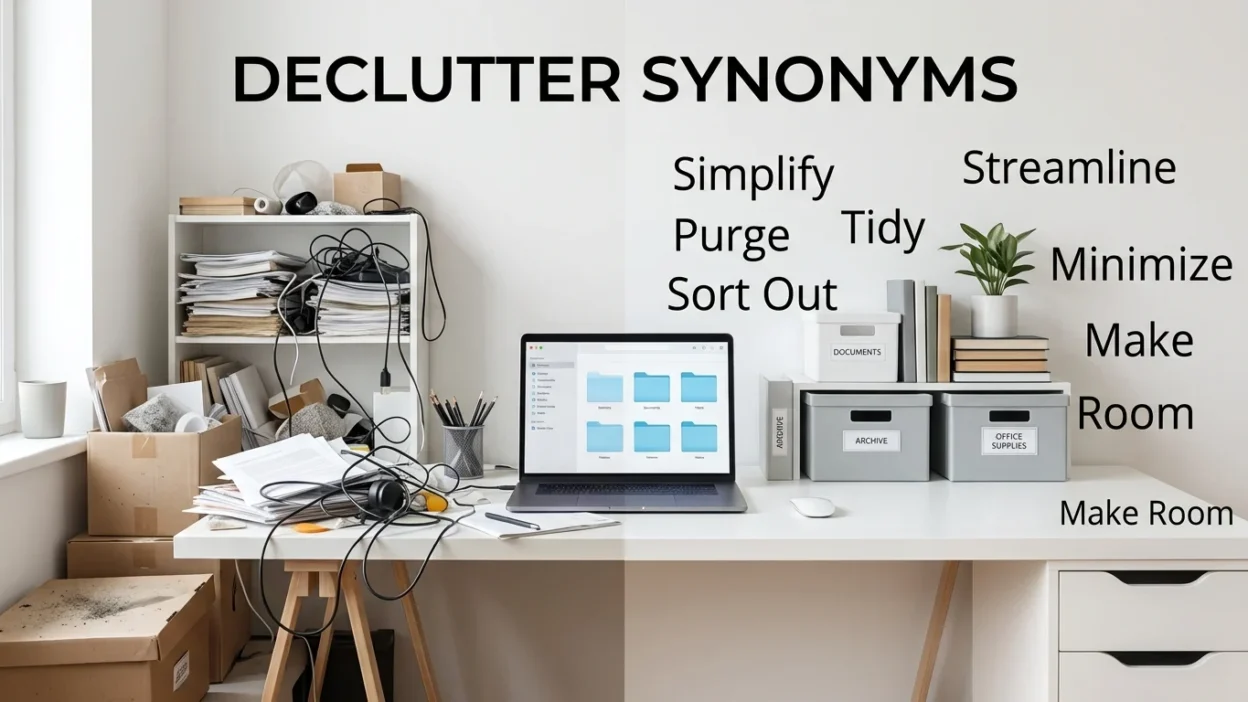
30 Declutter Synonyms to Describe Organizing, Clearing, and Simplifying Your Space.
When people search for declutter synonyms, they are usually looking for different ways to describe removing unnecessary items, organizing a messy space, or simplifying an environment.
The word “declutter” can refer to physical objects, digital files, schedules, ideas, or even daily routines.
Learning alternative words for “declutter” can help students, ESL learners, writers, and content creators express ideas more precisely.
Some synonyms focus on removing unwanted things, while others emphasize organizing, simplifying, cleaning, reducing, or creating more space.
In this guide, you will discover 30 useful declutter synonyms and closely related expressions.
Each word includes a simple meaning, an example sentence, and the best context for using it.
You will also learn how different alternatives compare and how to choose the right word for your writing.
What Does “Declutter” Mean?
Simple Definition
Declutter means to remove unnecessary, unwanted, or unused things from a place or situation in order to make it cleaner, simpler, or more organized.
Example
I spent the weekend decluttering my bedroom.
This means the speaker removed unnecessary items and made the room more organized.
Tone and Usage Context
“Declutter” has a practical, modern, and generally positive tone. It is often associated with organization, simplicity, productivity, and a more comfortable environment.
The word can be used for:
- Homes and rooms
- Offices
- Digital files
- Email inboxes
- Schedules
- Websites
- Ideas and information
- Daily routines
For example:
- She decluttered her desk before starting work.
- I need to declutter my email inbox.
- The company is trying to declutter its website.
30 Declutter Synonyms
1. Organize
Meaning: To arrange things in a neat and orderly way.
Example sentence:
I need to organize my desk before I begin studying.
Best usage context: General situations involving order and arrangement.
2. Tidy
Meaning: To make a place neat and orderly.
Example sentence:
She tidied her room before her guests arrived.
Best usage context: Everyday conversations about rooms, homes, and personal spaces.
3. Clear Out
Meaning: To remove unwanted or unnecessary things from a place.
Example sentence:
We need to clear out the garage before winter.
Best usage context: Physical spaces and informal conversation.
4. Clean Out
Meaning: To remove unwanted items from a place.
Example sentence:
He cleaned out his closet and donated several bags of clothes.
Best usage context: Closets, drawers, garages, storage areas, and containers.
5. Simplify
Meaning: To make something less complicated or crowded.
Example sentence:
She simplified her workspace by keeping only the items she regularly uses.
Best usage context: Physical spaces, schedules, systems, and ideas.
6. Purge
Meaning: To remove unwanted or unnecessary things, often in large amounts.
Example sentence:
They decided to purge their home of old and unused furniture.
Best usage context: Strong or thorough removal of unnecessary items.
7. Remove
Meaning: To take something away from a place or situation.
Example sentence:
We removed several broken items from the storage room.
Best usage context: General and neutral writing.
8. Discard
Meaning: To throw away or get rid of something that is no longer wanted.
Example sentence:
She discarded old papers that she no longer needed.
Best usage context: Formal writing and unwanted physical items.
9. Dispose of
Meaning: To get rid of something properly.
Example sentence:
The office disposed of outdated equipment responsibly.
Best usage context: Formal, professional, and environmental contexts.
10. Eliminate
Meaning: To completely remove something unnecessary or unwanted.
Example sentence:
The company eliminated unnecessary steps from its workflow.
Best usage context: Formal writing, systems, processes, and problems.
11. Weed Out
Meaning: To remove unwanted or unnecessary items from a group or collection.
Example sentence:
The editor weeded out repetitive information from the article.
Best usage context: Information, applications, choices, files, and collections.
12. Sort Out
Meaning: To organize things or deal with confusion and disorder.
Example sentence:
I need to sort out the documents on my desk.
Best usage context: Everyday speech, physical items, problems, and information.
13. Streamline
Meaning: To make a system or process simpler and more efficient.
Example sentence:
The company streamlined its filing system to save time.
Best usage context: Business, work processes, systems, and professional writing.
14. Reduce
Meaning: To make something smaller in amount or quantity.
Example sentence:
She reduced the number of unnecessary items in her apartment.
Best usage context: Possessions, expenses, workload, information, and consumption.
15. Minimize
Meaning: To reduce something to the smallest practical amount.
Example sentence:
He minimized distractions by removing unnecessary apps from his phone.
Best usage context: Digital spaces, distractions, risks, and physical belongings.
16. Empty
Meaning: To remove everything from a container, space, or location.
Example sentence:
She emptied the drawer and kept only the items she used regularly.
Best usage context: Drawers, cupboards, bags, rooms, and storage spaces.
17. Arrange
Meaning: To put things in a particular order or position.
Example sentence:
He arranged the books neatly on the shelf.
Best usage context: Organization after removing unnecessary clutter.
18. Neaten
Meaning: To make something look cleaner and more orderly.
Example sentence:
She neatened her workspace before the meeting.
Best usage context: Desks, rooms, offices, and everyday organization.
19. Straighten Up
Meaning: To make a messy place neat and orderly.
Example sentence:
Please straighten up the living room before dinner.
Best usage context: Informal everyday conversation.
20. Decongest
Meaning: To reduce overcrowding or remove excessive items from a space.
Example sentence:
The redesign helped decongest the crowded office.
Best usage context: Physical spaces, traffic, systems, and formal descriptions.
21. Unburden
Meaning: To remove a burden or unnecessary weight.
Example sentence:
Decluttering her schedule helped unburden her from unnecessary commitments.
Best usage context: Figurative use involving responsibilities, stress, or obligations.
22. Detox
Meaning: To remove unwanted or harmful elements from something.
Example sentence:
He decided to detox his digital life by deleting unused apps and accounts.
Best usage context: Modern, informal, digital, lifestyle, and figurative contexts.
23. Cleanse
Meaning: To remove unwanted or harmful elements.
Example sentence:
She cleansed her inbox by deleting thousands of old messages.
Best usage context: Digital organization, lifestyle writing, and figurative use.
24. Prune
Meaning: To remove unnecessary parts from something in order to improve it.
Example sentence:
The writer pruned unnecessary sentences from the final draft.
Best usage context: Writing, projects, schedules, websites, and figurative organization.
25. Cull
Meaning: To remove items that are unwanted, unnecessary, or less useful.
Example sentence:
The museum culled damaged items from its collection.
Best usage context: Formal writing, collections, lists, and professional contexts.
26. Edit Down
Meaning: To remove unnecessary parts and make something shorter or simpler.
Example sentence:
The author edited down the report to make it easier to read.
Best usage context: Writing, presentations, content, and information.
27. Pare Down
Meaning: To reduce something by removing unnecessary parts.
Example sentence:
The team pared down the project plan to focus on its main goals.
Best usage context: Formal and professional writing.
28. De-clutter
Meaning: To remove unnecessary items or information from a space or system.
Example sentence:
The designer de-cluttered the website to improve the user experience.
Best usage context: Alternative spelling and digital or physical organization.
29. Rationalize
Meaning: To reorganize or simplify something to make it more efficient.
Example sentence:
The company rationalized its filing system by removing duplicate records.
Best usage context: Formal business, organizational, and professional writing.
30. Make Room
Meaning: To create more available space by removing or moving things.
Example sentence:
We donated old furniture to make room for the new table.
Best usage context: Everyday conversation and physical spaces.
Comparison Table: Declutter Synonyms and Their Best Uses
| Synonym | Main Meaning | Tone | Best Usage Context |
|---|---|---|---|
| Organize | Arrange things neatly | Neutral | General organization |
| Tidy | Make a space neat | Casual | Homes and rooms |
| Clear out | Remove unwanted things | Informal | Physical spaces |
| Purge | Remove a large amount | Strong | Thorough decluttering |
| Discard | Throw away unwanted items | Formal | Objects and documents |
| Simplify | Make less complicated | Neutral | Spaces, ideas, and systems |
| Streamline | Make more efficient | Professional | Business and processes |
| Reduce | Decrease the amount | Neutral | Possessions and workload |
| Minimize | Reduce to the smallest amount | Formal | Distractions and belongings |
| Weed out | Remove unwanted items | Neutral | Lists, information, and collections |
| Sort out | Organize or resolve disorder | Casual | Items and problems |
| Neaten | Make more orderly | Neutral | Rooms and workspaces |
| Prune | Remove unnecessary parts | Formal | Writing, plans, and projects |
| Cull | Remove less useful items | Formal | Collections and lists |
| Pare down | Reduce by removing excess | Formal | Projects and content |
| Make room | Create more space | Casual | Physical spaces |
| Eliminate | Completely remove | Formal | Systems and unnecessary elements |
How to Choose the Right Synonym
The best alternative to “declutter” depends on what you are removing and the tone you want to create.
For Everyday Home Organization
Use:
- Tidy
- Straighten up
- Organize
- Neaten
- Clean out
These words are natural for rooms, closets, kitchens, desks, and homes.
Example:
“I need to tidy my bedroom before my friends arrive.”
For Removing Unwanted Items
Use:
- Clear out
- Purge
- Discard
- Remove
- Dispose of
- Cull
These words focus on getting rid of things that are no longer useful or wanted.
Example:
“We cleared out the garage and donated several boxes of old items.”
For Simplifying Systems and Processes
Use:
- Simplify
- Streamline
- Rationalize
- Eliminate
- Pare down
These words are especially useful for business, work, projects, and complicated systems.
Example:
“The company streamlined its workflow by removing unnecessary steps.”
For Digital Decluttering
Use:
- Organize
- Cleanse
- Detox
- Weed out
- Eliminate
- Minimize
These words work well for email inboxes, files, apps, websites, and online accounts.
Example:
“I spent Sunday weeding out old files from my computer.”
For Writing and Information
Use:
- Edit down
- Prune
- Pare down
- Weed out
- Simplify
- Reduce
These alternatives are ideal when removing repetition, unnecessary details, or excessive information.
Example:
“The editor pruned several unnecessary paragraphs from the article.”
For Creating More Physical Space
Use:
- Clear out
- Empty
- Reduce
- Make room
- Decongest
These words emphasize creating space or reducing overcrowding.
Example:
“We donated old furniture to make room for the new equipment.”
Declutter vs. Organize
Declutter means removing unnecessary things.
Organize means arranging things in a neat and useful order.
You can organize a room without removing anything, but decluttering usually involves deciding what should stay and what should go.
Examples:
- I decluttered my closet by donating clothes I no longer wear.
- I organized my remaining clothes by color.
Both activities can work together, but they are not exactly the same.
Declutter vs. Clean
Clean usually means removing dirt, dust, or stains.
Declutter means removing unnecessary objects or information.
Examples:
- She cleaned the kitchen floor.
- She decluttered the kitchen cabinets.
A space can be clean but still cluttered, or organized but not completely clean.
Declutter vs. Simplify
Declutter usually involves removing unnecessary physical or digital items.
Simplify has a broader meaning. It can refer to reducing complexity in a schedule, process, lifestyle, idea, or environment.
Examples:
- He decluttered his office by removing unused equipment.
- He simplified his work routine by reducing unnecessary meetings.
Declutter vs. Purge
Purge is stronger than “declutter.”
To purge something often suggests removing a large amount of unwanted material, sometimes quickly or thoroughly.
Example:
- She decluttered her bedroom.
- She purged her home of years of unused possessions.
“Purge” can sound more dramatic, while “declutter” often sounds calmer and more intentional.
Common Collocations with “Declutter”
Learning common phrases can help you use the word naturally.
Declutter Your Home
Example:
She decided to declutter her home before moving.
Declutter Your Room
Example:
I need to declutter my room this weekend.
Declutter Your Workspace
Example:
A clean workspace can make it easier to focus after you declutter your desk.
Declutter Your Inbox
Example:
He spent an hour decluttering his email inbox.
Declutter Your Digital Life
Example:
She wants to declutter her digital life by deleting unused apps.
Declutter Your Schedule
Example:
I need to declutter my schedule and focus on my most important responsibilities.
Declutter Your Mind
Example:
Writing down her thoughts helped her declutter her mind.
Why Use Declutter Synonyms?
Using synonyms helps you express the exact type of organization or removal you mean.
For example:
- Tidy suggests making a place neat.
- Purge suggests removing a large amount.
- Streamline suggests making a process more efficient.
- Prune suggests removing unnecessary parts.
- Simplify suggests reducing complexity.
- Make room emphasizes creating space.
These differences are especially useful in articles, essays, marketing content, lifestyle blogs, and professional writing.
Instead of repeating:
I decluttered my room. Then I decluttered my office. Finally, I decluttered my computer.
You could write:
I tidied my room, organized my office, and cleared out unnecessary files from my computer.
The result sounds more natural and precise.
Tips for ESL Learners
English learners should remember that the best synonym depends on what is being removed.
Use “Tidy” for Making a Place Neat
I tidied my bedroom.
Use “Clear Out” for Removing Unwanted Things
We cleared out the garage.
Use “Discard” for Throwing Things Away
She discarded old documents.
Use “Streamline” for Improving a Process
The company streamlined its operations.
Use “Simplify” for Making Something Less Complicated
He simplified his daily routine.
Use “Prune” for Removing Unnecessary Parts
The editor pruned the article.
Understanding these differences will help your English sound more natural and accurate.
Frequently Asked Questions About Declutter Synonyms
What is the best synonym for declutter?
The best synonym depends on the context. Organize, tidy, clear out, simplify, and purge are common alternatives.
What is a simple synonym for declutter?
Simple alternatives include tidy, clean out, clear out, and organize.
Is “organize” the same as “declutter”?
Not exactly. Decluttering involves removing unnecessary things, while organizing involves arranging things in a useful and orderly way.
What is a formal synonym for declutter?
Formal alternatives include streamline, rationalize, eliminate, pare down, and prune.
What is an informal synonym for declutter?
Informal alternatives include tidy, clear out, clean out, straighten up, and make room.
What is a synonym for decluttering a digital space?
Useful alternatives include organize, cleanse, detox, weed out, minimize, and eliminate.
What is the opposite of declutter?
Possible opposites include clutter, mess up, accumulate, crowd, overload, and fill up, depending on the context.
Conclusion
The word declutter means to remove unnecessary items, information, or complications in order to create a cleaner, simpler, and more organized situation. However, different synonyms highlight different aspects of this process.
Use tidy or neaten when making a space look orderly. Choose clear out, purge, or discard when removing unwanted items. Use streamline or rationalize for business systems and processes. For writing and information, prune, edit down, and pare down are useful choices. If your main goal is to create space, make room may be the most natural expression.
Understanding these differences can improve your vocabulary and make your writing more precise. Whether you are discussing a messy room, a crowded inbox, a complicated schedule, or an overloaded project, the right word can clearly express what you want to simplify or remove.
The key lesson is simple: declutter is a broad word, but its synonyms allow you to describe the exact action more accurately. Choose your word according to the situation, tone, and type of clutter you are removing.

Evelyn Mia is a passionate language writer and vocabulary enthusiast at Synomity.com, specializing in synonyms, word meanings, and language learning. She creates informative content that helps readers expand vocabulary and communicate more effectively.