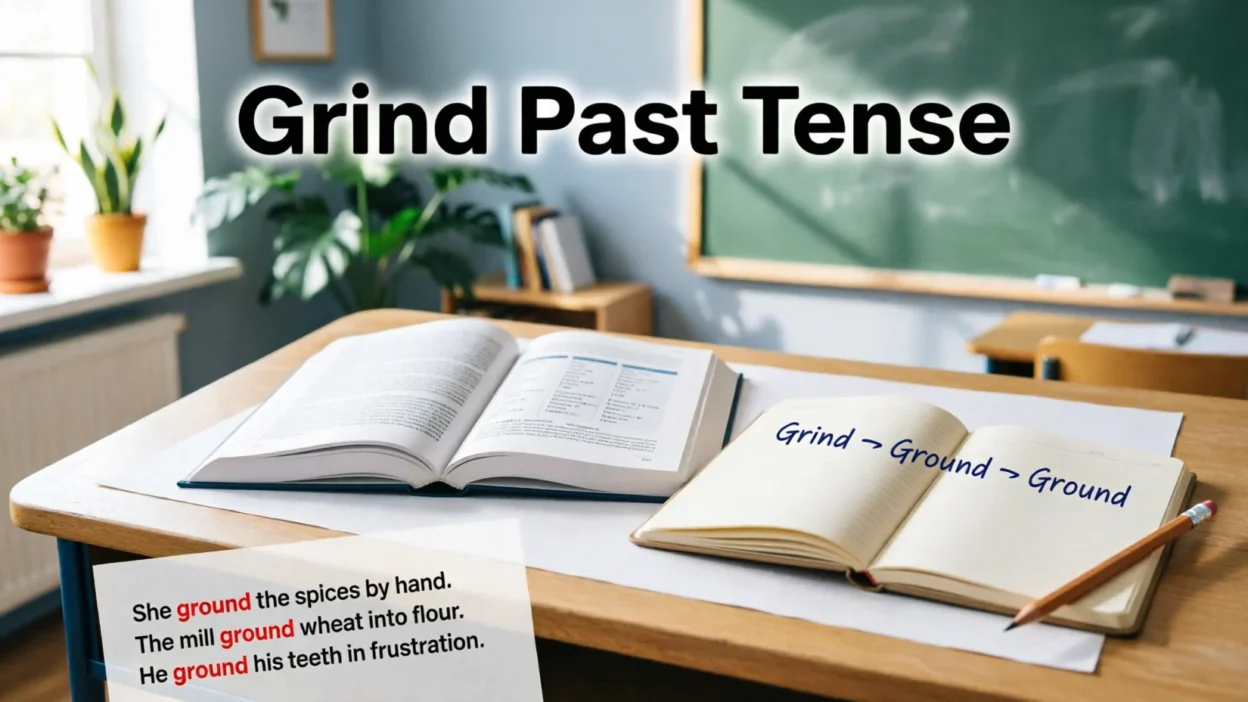
The past tense of grind is ground in standard English. The verb grind means to crush, break, or reduce something into smaller pieces, often using pressure or friction. For example, “She ground the coffee beans before breakfast.” The past participle is also ground, as in “She has ground the coffee beans.” However, grinded is sometimes used in informal speech, especially when people talk about working hard, playing video games, or repeating difficult tasks.
Understanding the past tense of grind can be confusing because many English verbs form their past tense by adding -ed, such as walked or played. However, grind is an irregular verb, so it changes its form instead of following that regular pattern. Learning its three main forms—grind, ground, and ground—will help you use it correctly in everyday conversations, school assignments, and professional writing.
Quick Answer
The past tense of grind is ground, and its past participle is also ground. The three forms are grind – ground – ground. Use ground when describing an action that happened in the past or when forming perfect tenses. Although grinded appears in informal contexts, ground is the standard choice.
Why Do People Confuse Grind and Ground?
People often confuse grind and ground because the verb does not follow the usual pattern of adding -ed to form the past tense.
For example:
- Walk → walked
- Play → played
- Grind → ground
The spelling change from grind to ground can seem unexpected, especially for English learners.
Another source of confusion is the word grinded. People sometimes use it by analogy with regular verbs, particularly when describing hard work, personal progress, or video game achievements.
However, in standard written English, ground is the preferred past-tense form of grind.
First Word: Grind
Grind is the base form of the verb. It describes crushing something into smaller pieces, rubbing a surface, or working persistently toward a goal.
Meaning of Grind
The verb grind has several common meanings:
- To crush something: Break food or another substance into small pieces.
- To sharpen or smooth: Rub a surface against another surface to change its shape.
- To work hard: Put consistent effort into a task or goal.
- To operate with friction: Move or rub together in a way that creates an unpleasant sound.
Examples of Grind in Sentences
- I grind fresh coffee beans every morning.
- They grind wheat to make flour.
- The mechanic uses a machine to grind metal.
- She continues to grind toward her dream career.
- The gears grind when the machine is damaged.
Remember: Use grind for the present tense, after to, and after modal verbs such as will, can, and should.
Examples: “I grind coffee,” “I want to grind the beans,” and “I will grind them tomorrow.”
Second Word: Ground
Ground is the simple past tense and past participle of grind. It describes an action that has already happened or helps form perfect tenses.
Meaning of Ground
When used as a form of grind, ground means that someone crushed, rubbed, or worked on something in the past.
Examples:
- She ground the spices yesterday.
- He ground the coffee beans before making coffee.
- They have ground the wheat into flour.
- I had ground the ingredients before the guests arrived.
Keep in mind that ground also has other meanings. It can refer to the surface of the Earth, a reason for an argument, or a prepared substance such as ground coffee. Its meaning depends on the sentence.
Examples of Ground in Sentences
- The chef ground black pepper over the soup.
- My grandfather ground corn using an old mill.
- The workers ground the rough edges off the metal.
- She has ground enough coffee for everyone.
Remember: Use ground for both the simple past and the past participle of grind.
Grind vs. Ground: Comparison Table
| Verb form | Usage | Example |
| Grind | Base form | I grind coffee every day. |
| Grinds | Present tense, third-person singular | She grinds fresh spices. |
| Ground | Simple past tense | He ground the beans yesterday. |
| Ground | Past participle | They have ground the beans. |
| Grinded | Nonstandard or informal variant | He grinded through the game. |
The most important distinction is that ground is the standard form for both the past tense and past participle.
When to Use Grind and Ground
Choosing the correct form depends on when the action happens and how the verb functions in the sentence.
When to Use Grind
Use grind for present actions, general habits, and future actions when it follows a modal verb or will.
Examples:
- I grind coffee beans every morning.
- We need to grind the spices.
- They will grind the wheat tomorrow.
- You should grind the pepper before serving.
When to Use Ground
Use ground when an action happened in the past or when using the past participle with auxiliary verbs.
Examples:
- She ground the coffee this morning.
- They have ground the wheat already.
- He had ground the spices before cooking.
- The machine has ground the material into powder.
When Does Grinded Appear?
Grinded occasionally appears in informal speech, gaming communities, and slang about working hard or earning experience points.
For example, someone might say, “I grinded all weekend to reach the next level.”
In standard edited English, however, I ground all weekend is the conventional grammatical choice when using grind as a verb. In gaming or workplace slang, you may encounter grinded, but it is best to use ground in formal writing and examinations.
12 Examples of Grind in Different Tenses
These examples show how grind changes depending on the tense and sentence structure.
- Present simple: I grind fresh coffee beans every morning.
- Present simple: She grinds spices for her recipes.
- Past simple: He ground the beans before breakfast.
- Past simple: They ground the wheat at the local mill.
- Present perfect: I have ground enough coffee for the guests.
- Past perfect: She had ground the spices before the chef arrived.
- Future simple: We will grind the corn tomorrow.
- Present continuous: He is grinding the metal surface.
- Past continuous: The machine was grinding the beans when it stopped.
- Present perfect continuous: She has been grinding coffee for the café all morning.
- Modal verb: You should grind the pepper more finely.
- Informal slang: He ground through several difficult tasks to finish the project.
These examples demonstrate that grind is the base form, ground is the standard past form, and grinding is the -ing form.
Common Mistakes When Using Grind
English learners sometimes make mistakes because grind is irregular. Here are the most common ones and how to correct them.
Mistake 1: Using Grinded Instead of Ground
Incorrect: She grinded the coffee beans yesterday.
Correct: She ground the coffee beans yesterday.
Why? Grind is an irregular verb, and its standard past-tense form is ground.
Mistake 2: Using Grind for a Completed Past Action
Incorrect: He grind the spices last night.
Correct: He ground the spices last night.
Why? The phrase last night indicates a completed past action, so use ground.
Mistake 3: Using Grind Instead of Ground After Have
Incorrect: I have grind the coffee.
Correct: I have ground the coffee.
Why? The present perfect tense requires the past participle, which is ground.
Mistake 4: Confusing Ground With Grinding
Incorrect: She is ground the beans now.
Correct: She is grinding the beans now.
Why? The present continuous tense uses is/am/are + verb-ing.
Mistake 5: Assuming Ground Always Means the Past Tense
The word ground can also be a noun or an adjective.
Examples:
- The ground was wet after the rain. (noun)
- We bought ground coffee. (adjective)
- She ground the coffee yesterday. (past-tense verb)
The surrounding words help you identify its meaning.
Memory Trick: How to Remember the Past Tense of Grind
A simple way to remember the verb forms is:
Grind – Ground – Ground
Think of the vowel change from i to ou, similar to other irregular verbs such as find – found – found.
Compare these examples:
- I grind the beans today.
- I ground the beans yesterday.
- I have ground the beans already.
You can also remember the phrase: “Yesterday, I ground the beans.”
Practicing this short sentence a few times can help you recall the correct form when speaking or writing.
American vs. British English: Is the Past Tense Different?
No. American English and British English generally use the same standard forms of grind.
| Form | American English | British English |
| Base form | Grind | Grind |
| Simple past | Ground | Ground |
| Past participle | Ground | Ground |
| Present participle | Grinding | Grinding |
Both varieties use sentences such as “She ground the coffee beans” and “He has ground the spices.”
The informal form grinded may appear in either variety, especially in slang, but ground remains the standard choice in formal writing.
Similar Words to Grind
Learning related irregular verbs can make it easier to remember the past tense of grind.
| Base form | Past tense | Past participle |
| Grind | Ground | Ground |
| Find | Found | Found |
| Wind | Wound | Wound |
| Bind | Bound | Bound |
| Wind (move in a twisting direction) | Wound | Wound |
| Slide | Slid | Slid |
| Build | Built | Built |
| Hold | Held | Held |
Notice that grind, find, wind, and bind all change their vowel sounds in the past tense. These patterns can help you recognize irregular verbs, although not every irregular verb follows the same pattern.
Final Verdict: Is It Grind or Ground?
The correct past tense of grind is ground, not grinded, in standard English.
Use grind for present actions and the base form. Use ground for completed past actions and as the past participle after words such as have, has, and had.
For example:
- Present: I grind coffee beans.
- Past: I ground coffee beans.
- Present perfect: I have ground coffee beans.
Although grinded appears in informal slang, ground is the safest and most widely accepted choice for schoolwork, professional writing, and everyday standard English.
FAQs:
1. What is the past tense of grind?
The past tense of grind is ground. For example, “She ground the coffee beans yesterday.” It is an irregular verb, so its past tense does not follow the regular -ed pattern.
2. Is it grinded or ground?
Ground is the standard past-tense form. Grinded is sometimes used in informal speech or slang, especially when discussing gaming or working hard, but ground is preferred in standard English.
3. What is the past participle of grind?
The past participle of grind is ground. It is used with auxiliary verbs to form perfect tenses. For example, “I have ground the spices” and “She had ground the coffee.”
4. Is grind an irregular verb?
Yes. Grind is an irregular verb because it changes to ground in the past tense instead of simply adding -ed. Its three main forms are grind, ground, and ground.
5. What is the difference between grind and ground?
Grind is the base form of the verb, while ground is its simple past tense and past participle. For example, “I grind coffee every day” describes a habit, while “I ground coffee yesterday” describes a completed action.
6. Can I use grinded in a sentence?
Yes, you may encounter grinded in informal slang, especially in gaming or expressions about working hard. However, ground is the standard form and is recommended for formal writing, exams, and conventional grammar.
7. What is the past tense of grind in American and British English?
The standard past tense is ground in both American and British English. The spelling and grammatical forms are the same: grind – ground – ground.
Remember This
- Base form: Grind
- Simple past: Ground
- Past participle: Ground
- Present participle: Grinding
- Standard formal usage: Ground, not grinded
Example: “I grind coffee every morning, ground some yesterday, and have ground enough for tomorrow.”
Conclusion
The past tense of grind is ground, and the past participle is also ground. Although grinded may appear in informal conversations and slang, it is not the standard form used in conventional English grammar. Remembering the three forms—grind, ground, and ground—will help you avoid common mistakes.
Practice using grind in the present tense, ground for past actions, and ground after have, has, or had. With a few simple examples and regular practice, you can use this irregular verb confidently in everyday conversations, school assignments, and professional writing.

Evelyn Mia is a passionate language writer and vocabulary enthusiast at Synomity.com, specializing in synonyms, word meanings, and language learning. She creates informative content that helps readers expand vocabulary and communicate more effectively.