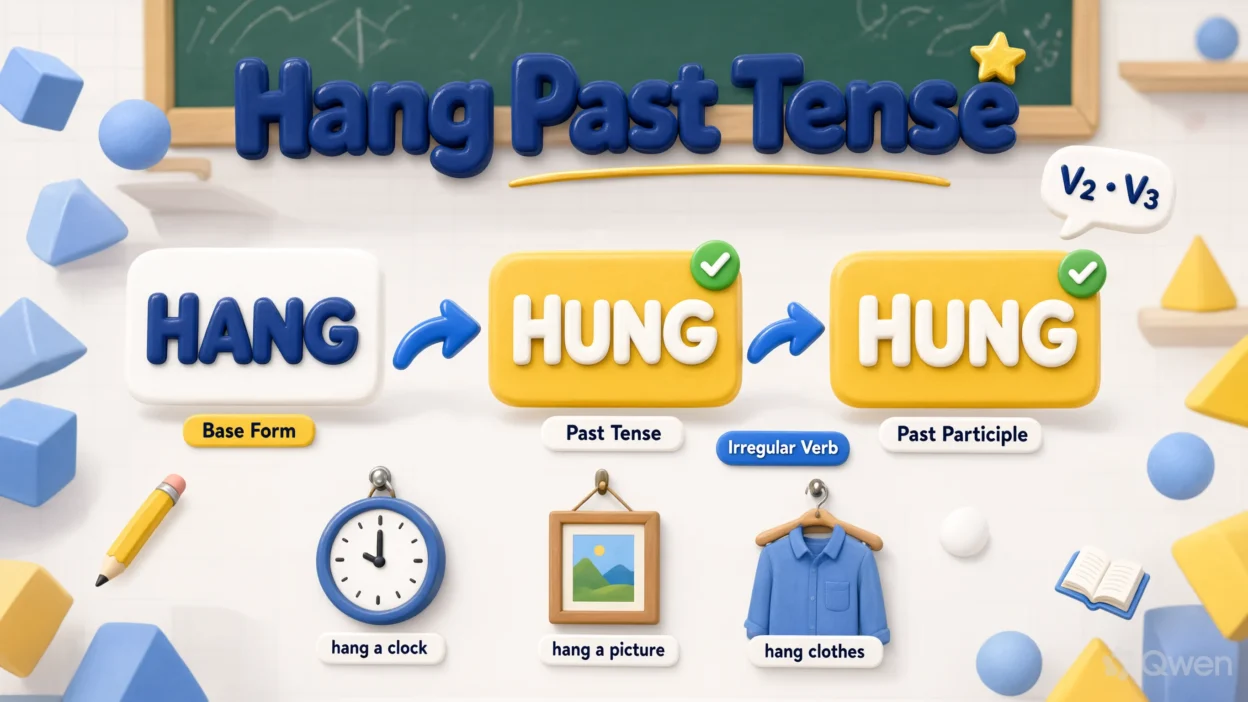
The past tense of hang is usually hung, but hanged is also correct in a specific situation. The correct form depends on the meaning of the sentence. Use hung when talking about placing or suspending something, such as “She hung the picture on the wall.” Use hanged when referring to execution by hanging, such as “The prisoner was hanged.”
The verb hang is an irregular verb, which means it does not follow the usual pattern of adding -ed to form its past tense. This can confuse students, English learners, and even confident writers because both hung and hanged are accepted past forms, but they are not interchangeable in every situation.
In this guide, you will learn the past tense and past participle of hang, understand the difference between hung and hanged, explore their grammatical rules, and see more than 15 practical examples. You will also discover common mistakes, an easy memory trick, and the differences between American and British English.
Quick Answer: What Is the Past Tense of Hang?
The past tense of hang is usually hung. Its past participle is also hung. However, hanged is used when referring to execution by hanging. For example, “I hung my coat yesterday” and “The prisoner was hanged” are both grammatically correct.
Why Do People Confuse Hang, Hung, and Hanged?
People often confuse hang, hung, and hanged because they are different forms of the same verb, and both hung and hanged can describe past actions.
Unlike regular verbs, hang has an irregular past-tense form. Most importantly, its past-tense form changes depending on the meaning.
Consider these examples:
- I hang my clothes outside. (Present)
- I hung my clothes outside yesterday. (Past)
- The picture has been hung on the wall. (Past participle)
- The criminal was hanged for his crimes. (Execution)
The key is to remember that hung is used for ordinary hanging actions, while hanged is traditionally used for execution.
1. What Is the First Form of Hang?
Hang is the base form (V1) of the verb. It means to suspend something from above, attach something to a surface, or allow something to remain in a hanging position.
It can also describe spending time with someone informally.
Examples of Hang in Sentences:
- I hang my clothes in the wardrobe.
- They hang pictures on the wall.
- Birds hang around the trees.
- Please hang your coat near the door.
- We hang out with our friends on weekends.
- She likes to hang decorations in her room.
When to Use Hang:
Use hang when:
- Talking about a present or regular action.
- Giving instructions or commands.
- Using the base form after modal verbs such as will, can, and should.
- Forming the infinitive with to.
More Examples:
- I usually hang my towel outside.
- You should hang your jacket properly.
- They will hang the decorations tomorrow.
- Please hang this painting carefully.
2. What Is the Second Form of Hang?
Hung is the simple past tense (V2) of hang for ordinary meanings. It describes an action that happened and finished in the past.
Use hung when talking about suspending, attaching, or placing something in a hanging position.
Examples of Hung in Sentences:
- I hung my coat behind the door.
- She hung a beautiful painting in her bedroom.
- They hung colorful lights around the garden.
- He hung his clothes outside to dry.
- We hung the decorations before the party.
- My father hung the clock on the wall.
- The children hung their bags on the hooks.
When to Use Hung:
Use hung when:
- Describing a completed hanging action.
- Talking about something suspended in the past.
- Explaining where someone placed an object.
- Referring to an ordinary hanging action in a story.
Important: Hung is also the past participle of hang in its ordinary sense.
Examples:
- I have hung the picture.
- She had hung her clothes outside.
- The curtains were hung yesterday.
3. What Does Hanged Mean?
Hanged is another past-tense and past-participle form of hang. It is traditionally used when referring to a person being executed by hanging.
Unlike hung, which is used for ordinary hanging actions, hanged has a specific meaning connected with execution.
Examples of Hanged in Sentences:
- The prisoner was hanged many years ago.
- The criminal was hanged for murder.
- The historical account described how the man was hanged.
- The prisoner had been hanged before the news reached the town.
- In the historical story, the convicted man was hanged.
When to Use Hanged:
Use hanged when:
- Referring to execution by hanging.
- Describing a historical execution.
- Writing about a person who was executed by hanging.
- Using the past perfect or passive voice in this specific context.
Important: In standard modern English, hanged is the traditional form for execution, while hung is the normal form for other meanings of the verb.
Hang vs Hung vs Hanged: Comparison Table
Here is a simple comparison to help you understand the three forms of the verb.
| Word | Grammatical Form | Main Usage | Example |
| Hang | Base form (V1) | Present or basic action | I hang my coat. |
| Hung | Simple past (V2) | Ordinary past actions | I hung my coat. |
| Hung | Past participle (V3) | Perfect tenses and passive voice | I have hung my coat. |
| Hanged | Simple past (V2) | Execution by hanging | He was hanged. |
| Hanged | Past participle (V3) | Perfect tenses and passive voice | He had been hanged. |
What Are the Five Forms of Hang?
The verb hang has the following forms:
| Verb Form | Word |
| V1 (Base Form) | Hang |
| V2 (Simple Past) | Hung / Hanged |
| V3 (Past Participle) | Hung / Hanged |
| V4 (Present Participle) | Hanging |
| V5 (Third-Person Singular) | Hangs |
Remember that the choice between hung and hanged depends on the meaning.
When to Use Hang, Hung, and Hanged
Choosing the correct form becomes easy when you understand the sentence structure and meaning.
When to Use Hang
Use hang for present actions, habits, instructions, and after modal verbs.
Examples:
- I hang my clothes every morning.
- She likes to hang pictures.
- You should hang your jacket here.
- We will hang the lights tomorrow.
- They hang out together after school.
When to Use Hung
Use hung for ordinary past actions and as the past participle of the verb.
Examples:
- I hung my shirt outside yesterday.
- She has hung the curtains.
- They had hung the decorations before the guests arrived.
- The painting was hung above the fireplace.
- He hung his backpack on the chair.
When to Use Hanged
Use hanged when referring specifically to execution by hanging.
Examples:
- The prisoner was hanged.
- The criminal had been hanged.
- The historical records stated that the man was hanged.
Hang vs Hung vs Hanged in Different Tenses
| Tense | Correct Form | Example |
| Simple Present | Hang / Hangs | She hangs her coat here. |
| Simple Past | Hung | She hung her coat yesterday. |
| Present Perfect | Have/Has Hung | She has hung her coat. |
| Past Perfect | Had Hung | She had hung her coat. |
| Simple Future | Will Hang | She will hang her coat. |
| Present Continuous | Am/Is/Are Hanging | She is hanging her coat. |
For execution, use hanged in the corresponding past and past participle constructions.
15+ Examples of Hang, Hung, and Hanged in Sentences
The following examples show how to use each form correctly in everyday English and historical contexts.
Examples Using Hang
- I hang my clothes in the wardrobe.
- Please hang your bag on the hook.
- She will hang the new curtains tomorrow.
- We hang decorations during celebrations.
- They like to hang out after school.
- You should hang this picture carefully.
Examples Using Hung
- I hung my jacket near the door.
- She hung a photograph on the wall.
- They hung colorful balloons in the hall.
- He has hung his clothes outside.
- We had hung the lights before the event.
- My mother hung the curtains yesterday.
- The painting was hung in the living room.
- The children hung their school bags on the hooks.
Examples Using Hanged
- The prisoner was hanged after the trial.
- The historical document explained why the criminal was hanged.
- The man had been hanged many years earlier.
- The condemned prisoner was hanged according to the law of that period.
These examples demonstrate why choosing the correct form depends on the meaning of hang.
Common Mistakes When Using Hang, Hung, and Hanged
Many English learners make mistakes because they assume that hung and hanged can be used in exactly the same way.
Here are some common errors and their corrections.
| Incorrect Sentence | Correct Sentence |
| I hang my coat yesterday. | I hung my coat yesterday. |
| She hanged the picture. | She hung the picture. |
| He has hang the curtains. | He has hung the curtains. |
| They had hang the decorations. | They had hung the decorations. |
| The prisoner was hung. | The prisoner was hanged. |
| I have hanged my clothes outside. | I have hung my clothes outside. |
Mistake 1: Using Hang Instead of Hung
Incorrect: I hang the picture yesterday.
Correct: I hung the picture yesterday.
Why? The sentence describes a completed action in the past, so the simple past form hung is needed.
Mistake 2: Using Hanged for Ordinary Objects
Incorrect: She hanged the painting on the wall.
Correct: She hung the painting on the wall.
Why? Hung is the standard past form for ordinary hanging actions.
Mistake 3: Using Hang After Have or Has
Incorrect: He has hang his jacket.
Correct: He has hung his jacket.
Why? The present perfect tense requires the past participle, which is hung for ordinary meanings.
Mistake 4: Confusing Hung and Hanged in Execution
Incorrect in traditional usage: The prisoner was hung.
Correct: The prisoner was hanged.
Why? Hanged is the traditional form used when describing execution by hanging.
Easy Memory Trick to Remember the Past Tense of Hang
Here is a simple way to remember the difference between hang, hung, and hanged.
HANG = Present or base form
Example: I hang my clothes outside.
HUNG = Ordinary past hanging action
Example: I hung my clothes outside yesterday.
HANGED = Execution by hanging
Example: The prisoner was hanged.
Remember this simple rule:
- Objects and ordinary actions = Hung.
- Execution of a person = Hanged.
- Present or base form = Hang.
You can also memorize the verb forms:
Hang → Hung → Hung
For the special execution meaning:
Hang → Hanged → Hanged
Practicing these patterns will help you choose the right word without confusion.
Hang Past Tense in American vs British English
There is no significant difference between American and British English regarding the standard use of hang, hung, and hanged.
Both varieties generally follow the same rules:
- Hang is the base form.
- Hung is the past tense and past participle for ordinary hanging actions.
- Hanged is traditionally used for execution by hanging.
- I hung the picture on the wall.
- She has hung her clothes outside.
- The prisoner was hanged.
Examples in British English:
- I hung the picture on the wall.
- She has hung her clothes outside.
- The prisoner was hanged.
The grammatical distinction remains the same in both varieties. You may encounter hung in informal or historical references to executions, but hanged is the traditional standard choice for this meaning.
Similar Irregular Verbs Like Hang
Learning other irregular verbs can help you understand how English past-tense forms work.
Here are some useful examples:
| Base Form | Simple Past | Past Participle |
| Hang | Hung | Hung |
| Bring | Brought | Brought |
| Buy | Bought | Bought |
| Catch | Caught | Caught |
| Teach | Taught | Taught |
| Fight | Fought | Fought |
| Think | Thought | Thought |
| Seek | Sought | Sought |
| Sleep | Slept | Slept |
| Keep | Kept | Kept |
Notice that some irregular verbs have the same simple past and past participle forms.
For example:
- I bought a new phone yesterday.
- I have bought a new phone.
- She taught English last year.
- She has taught English for five years.
Similarly, hung is used for both the simple past and past participle of ordinary meanings of hang.
Final Verdict: What Is the Past Tense of Hang?
The past tense of hang is usually hung, but hanged is also correct when referring to execution by hanging.
Here is the easiest way to remember:
- Hang: Base form (V1).
- Hung: Simple past and past participle (V2 and V3) for ordinary meanings.
- Hanged: Simple past and past participle for execution by hanging.
For example:
- Present: I hang my coat.
- Past: I hung my coat.
- Past participle: I have hung my coat.
- Execution: The prisoner was hanged.
Understanding this difference will help you avoid common grammar mistakes and use the verb correctly in everyday conversations and formal writing.
FAQs:
1. What Is the Past Tense of Hang?
The past tense of hang is usually hung. For example, “I hung my clothes outside yesterday.” However, hanged is used when referring to execution by hanging.
2. Is It Hung or Hanged?
Both words are correct, but they have different uses. Use hung for ordinary actions, such as hanging pictures or clothes. Use hanged when referring to a person being executed by hanging.
3. What Is the Past Participle of Hang?
The past participle is usually hung. For example, “I have hung the painting on the wall.” When referring to execution, hanged is traditionally used as the past participle.
4. Is Hanged a Real Word?
Yes, hanged is a correct English word. It is the past-tense and past-participle form of hang when referring to execution by hanging.
5. Should I Say I Hung or I Hanged My Clothes?
You should say “I hung my clothes.” The word hung is the standard past-tense form when talking about suspending clothes, pictures, curtains, or other objects.
6. Is It Correct to Say The Prisoner Was Hung or Hanged?
The traditional standard expression is “The prisoner was hanged.” The word hanged specifically refers to execution by hanging, although hung also appears in some historical and informal usage.
7. What Are the Three Forms of Hang?
The three main forms of hang are:
- V1: Hang
- V2: Hung (ordinary meaning) / Hanged (execution)
- V3: Hung (ordinary meaning) / Hanged (execution)
Remember This
- Hang is the base form of the verb.
- Hung is the usual simple past tense.
- Hung is also the usual past participle.
- Hanged refers specifically to execution by hanging.
- Use hung for pictures, clothes, curtains, and decorations.
- Use hanged when describing a traditional execution.
- The ordinary verb pattern is Hang → Hung → Hung.
Conclusion
The past tense of hang is generally hung, while hanged is used specifically when talking about execution by hanging. Although both forms are grammatically correct, their meanings and uses are different. Understanding this distinction will help you write accurate sentences and communicate more confidently in English.
The easiest way to remember the rule is to connect hung with ordinary hanging actions and hanged with execution. Practice the examples, learn the verb forms, and pay attention to the meaning of each sentence. With regular practice, using hang, hung, and hanged correctly will become much easier.

John Morrison is a dedicated content writer at Synomity.com, focused on synonyms, vocabulary development, and word meanings. He creates clear, educational resources that help readers improve language skills and communicate with confidence.