
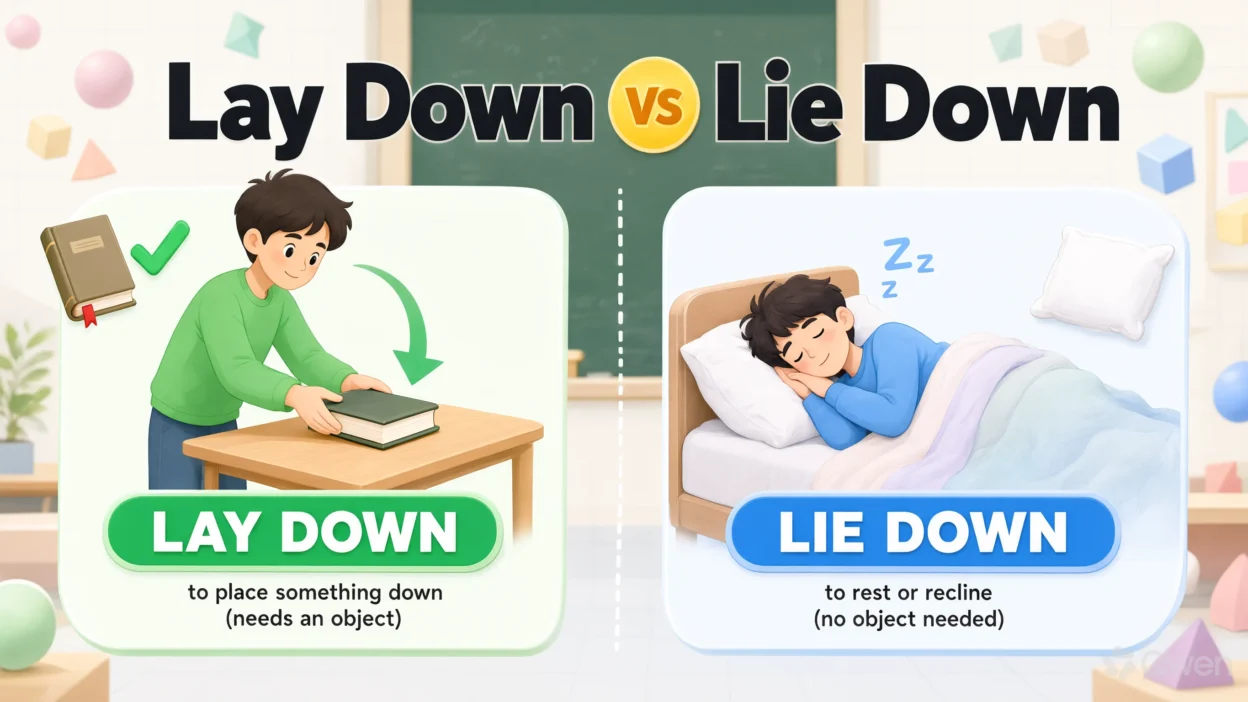
Are you confused about if to say “lay down” or “lie down”? You are not alone. These two expressions are commonly mixed up because they sound similar and both describe someone or something moving into a resting position. However, they have different grammatical meanings, and choosing the correct one depends on whether an object is involved.
The main difference is that lie down means to rest or put your body in a horizontal position, while lay down means to place something somewhere. For example, “I need to lie down” is correct when you want to rest. On the other hand, “I need to lay down my phone” means you want to put your phone somewhere.
Understanding this distinction will help you avoid common grammar mistakes and use both expressions confidently. In this guide, you will learn their meanings, verb forms, sentence structures, common mistakes, and practical examples.
Quick Answer: Lay Down or Lie Down?
Lie down means to recline or put your body in a horizontal resting position. Lay down means to put or place something somewhere. Say “I need to lie down” when you want to rest, but say “Please lay down the book” when you want someone to place an object on a surface.
Why Do People Confuse Lay Down and Lie Down?
People often confuse lay down and lie down because both expressions describe placing something in a horizontal position. Their meanings are closely related, but their grammatical structures are different.
The most important difference is whether the verb needs a direct object.
- Lie does not require a direct object. You lie down yourself.
- Lay requires a direct object. You lay something down.
Another reason for the confusion is that lie and lay are irregular verbs. Their past-tense forms create additional difficulties.
For example:
- Present: I lie down every afternoon.
- Past: I lay down yesterday afternoon.
- Present: I lay my keys on the table.
- Past: I laid my keys on the table yesterday.
Notice that lay is both the present tense of one verb and the past tense of another. This is why understanding the context is important.
1. What Does Lay Down Mean?
Lay down means to put, place, or position something on a surface or in a particular location.
It is the base form of the phrasal verb lay down, which comes from the verb lay. It requires a direct object because someone or something is being placed somewhere.
Meaning of Lay Down
Use lay down when you are putting an object or another person somewhere.
Examples of Lay Down in Sentences:
- Please lay down your phone.
- She wants to lay down her bag.
- Lay down the book on the table.
- He decided to lay down his jacket.
- I will lay down the tools here.
- The mother asked her child to lay down the toy.
- They lay down the equipment carefully.
When to Use Lay Down
Use lay down when:
- Placing an object on a surface.
- Putting something in a particular position.
- Giving someone instructions to place something.
- Describing the act of setting something aside.
More Examples:
- Please lay down the newspaper.
- I need to lay down these heavy boxes.
- She carefully laid down the baby in the crib.
Remember that lay needs an object. You lay something down; you do not simply lay down when you mean that you are resting.
2. What Does Lie Down Mean?
Lie down means to move your body into a horizontal position, usually to rest, relax, or sleep.
It is an intransitive verb, which means it does not require a direct object.
Meaning of Lie Down
Use lie down when you or another person wants to rest on a bed, sofa, floor, or another surface.
Examples of Lie Down in Sentences:
- I want to lie down for a while.
- She needs to lie down after work.
- He likes to lie down on the sofa.
- The children lie down before bedtime.
- You should lie down and relax.
- My dog likes to lie down in the sun.
- I usually lie down after lunch.
When to Use Lie Down
Use lie down when:
- You want to rest your body.
- Someone is going to sleep.
- You are feeling tired.
- You want to relax horizontally.
- You are describing someone reclining on a surface.
More Examples:
- I feel tired, so I will lie down.
- She lay down on the bed yesterday.
- The patient needs to lie down for a few minutes.
The important rule is that lie down describes the action of resting your own body without placing a direct object.
Lay Down vs Lie Down: Comparison Table
Here is a simple comparison to help you understand the difference.
| Feature | Lay Down | Lie Down |
| Meaning | Place something somewhere | Recline or rest your body |
| Verb type | Transitive | Intransitive |
| Requires an object? | Yes | No |
| Present form | Lay | Lie |
| Simple past | Laid | Lay |
| Past participle | Laid | Lain |
| Example | Lay down the book. | Lie down on the bed. |
| Correct usage | Lay something down. | Lie down yourself. |
Complete Verb Forms
Understanding the verb forms makes this distinction much easier.
| Verb Form | Lay (Place Something) | Lie (Rest) |
| V1 (Base Form) | Lay | Lie |
| V2 (Simple Past) | Laid | Lay |
| V3 (Past Participle) | Laid | Lain |
| V4 (Present Participle) | Laying | Lying |
| V5 (Third-Person Singular) | Lays | Lies |
Examples:
- Present: I lay the book on the desk.
- Past: I laid the book on the desk.
- Past participle: I have laid the book on the desk.
- Present: I lie on the sofa.
- Past: I lay on the sofa.
- Past participle: I have lain on the sofa.
Notice that the simple past form of lie is lay. This is one of the biggest reasons people confuse these verbs.
When to Use Lay Down vs Lie Down
Choosing the correct expression depends on what you are trying to describe.
When to Use Lay Down
Use lay down when you are placing something somewhere.
Examples:
- Lay down your keys on the counter.
- I need to lay down my backpack.
- She laid down her phone before dinner.
- He has laid down the documents on the desk.
- Please lay down the package carefully.
In each sentence, there is an object being placed.
When to Use Lie Down
Use lie down when describing the position of your body.
Examples:
- I want to lie down after dinner.
- She lies down whenever she feels tired.
- He lay down on the grass.
- They have lain down to rest.
- Please lie down and take a break.
In these sentences, nobody is placing a separate object. The subject is simply reclining.
What About Lay Down to Sleep?
This expression can be confusing.
In everyday conversation, people sometimes say:
– I am going to lay down.
However, in standard grammar, when you mean that you are going to rest, the correct expression is:
– I am going to lie down.
If you are placing something before resting, use lay down with an object:
– I am going to lay down my book before I sleep.
15 Examples of Lay Down and Lie Down in Sentences
The following examples show how both expressions work in everyday English.
Examples Using Lay Down
- Please lay down your bag near the door.
- He laid down his jacket on the chair.
- I will lay down my phone before sleeping.
- She carefully laid down the baby.
- They laid down the carpet in the living room.
- The worker laid down his tools after finishing the job.
- Lay down the papers on my desk.
- I have laid down the keys beside the television.
Examples Using Lie Down
- I need to lie down because I feel tired.
- She likes to lie down after lunch.
- The dog lay down beside its owner.
- He is lying down on the couch.
- We should lie down and get some rest.
- The children have lain down for a nap.
- I lay down on my bed after a long day.
These examples demonstrate the main difference: lay down involves placing something, while lie down describes reclining.
Common Mistakes When Using Lay Down and Lie Down
Many people use these expressions interchangeably, but doing so can create grammatical errors.
Here are some common mistakes and their corrections.
| Incorrect Sentence | Correct Sentence |
| I am going to lay down. | I am going to lie down. |
| She wants to lay down. | She wants to lie down. |
| I need to lie the book down. | I need to lay the book down. |
| He laid down on the sofa. | He lay down on the sofa. |
| I have laid down all afternoon. | I have lain down all afternoon. |
| Please lie your phone down. | Please lay your phone down. |
Mistake 1: Using Lay Without an Object
Incorrect: I need to lay down.
Correct: I need to lie down.
Why? When you mean that you want to rest, lie is the correct verb because there is no direct object.
Mistake 2: Using Lie for Placing Something
Incorrect: Please lie the book on the table.
Correct: Please lay the book on the table.
Why? The book is the direct object being placed on the table, so you need lay.
Mistake 3: Confusing the Past Tense
Incorrect: Yesterday, I laid down on the bed.
Correct: Yesterday, I lay down on the bed.
Why? The simple past tense of lie is lay, not laid.
Mistake 4: Confusing Past Participles
Incorrect: I have laid down for two hours.
Correct: I have lain down for two hours.
Why? The past participle of lie is lain. The past participle of lay is laid.
Easy Memory Trick to Remember Lay Down vs Lie Down
Here is a simple trick to remember which expression to use.
LAY = PLACE SOMETHING
Think of the sentence: “Lay the book on the table.”
You are placing an object somewhere.
LIE = REST YOURSELF
Think of the sentence: “Lie down on the bed.”
You are putting your own body in a resting position.
Remember this easy rule:
- Lay something down.
- Lie down yourself.
You can also remember the verb forms with these two patterns:
Lay → Laid → Laid
Lie → Lay → Lain
Practice these forms regularly, and you will find it much easier to choose the correct expression.
Lay Down vs Lie Down in American and British English
The grammatical difference between lay down and lie down is the same in American and British English.
Both varieties follow the same standard verb forms:
| Verb Form | American English | British English |
| Base form (rest) | Lie | Lie |
| Past tense (rest) | Lay | Lay |
| Past participle (rest) | Lain | Lain |
| Base form (place) | Lay | Lay |
| Past tense (place) | Laid | Laid |
| Past participle (place) | Laid | Laid |
American English Examples:
- I am going to lie down for a few minutes.
- Please lay down your jacket.
British English Examples:
- I am going to lie down for a few minutes.
- Please lay down your jacket.
In informal speech, some speakers in both countries use lay down when they mean lie down. However, the traditional grammatical distinction remains the same.
Similar Words Related to Lay Down and Lie Down
Learning related verbs can help you understand the difference between transitive and intransitive verbs.
Here are some useful examples:
| Verb | Meaning | Example |
| Sit | Rest on your bottom | I sit on the chair. |
| Set | Put something somewhere | Set the glass on the table. |
| Rise | Move upward yourself | The sun rises in the morning. |
| Raise | Lift something | Raise your hand. |
| Stand | Be in an upright position | Please stand here. |
| Place | Put something somewhere | Place the bag near the door. |
| Recline | Lean back or lie down | He reclined on the sofa. |
| Rest | Relax or stop working | I need to rest. |
Lay vs Lie vs Set vs Sit
These verbs are also commonly confused.
- Lay: Place something somewhere.
- Lie: Recline or rest your body.
- Set: Put something in a particular position.
- Sit: Rest in a seated position.
Examples:
- Lay the book on the desk.
- Lie down on the bed.
- Set the cup on the counter.
- Sit on the chair.
Understanding these differences will improve your everyday English grammar.
Final Verdict: Which One Should You Use?
Both lay down and lie down are correct expressions, but they have different meanings.
Use lay down when you are placing something somewhere.
Example: Please lay down your phone on the table.
Use lie down when you are resting or putting your body in a horizontal position.
Example: I want to lie down for a while.
The most important thing to remember is that lay requires an object, while lie does not require one.
Also, remember their past-tense forms:
- Lay → Laid → Laid
- Lie → Lay → Lain
Once you understand these basic rules, you can use both expressions correctly in everyday conversations and writing.
FAQs:
1. Is It Lay Down or Lie Down?
Both expressions are correct, depending on the meaning. Use lie down when you want to rest your body. Use lay down when you want to place an object somewhere. For example, “I need to lie down” and “Lay down your phone” are both correct.
2. Should I Say I Am Going to Lay Down or Lie Down?
The grammatically correct expression is “I am going to lie down” when you mean that you want to rest. The verb lie does not require a direct object. Saying “I am going to lay down” is common in informal speech, but it is not the traditional standard form for this meaning.
3. Is Lay Down the Past Tense of Lie Down?
Yes. Lay is the simple past tense of lie. For example, “I lie down every evening” becomes “I lay down yesterday evening.” Do not confuse it with laid, which is the past tense of the verb lay meaning to place something.
4. What Is the Difference Between Lay and Lie?
Lay means to put or place something somewhere and requires a direct object. Lie means to recline or rest and does not require a direct object. For example, “Lay the book down” and “Lie down on the bed” are correct.
5. Is It Lay Down on the Bed or Lie Down on the Bed?
Lie down on the bed is correct when describing someone resting on a bed. The verb lie describes the person’s position. However, “Lay the blanket down on the bed” is correct because the blanket is being placed somewhere.
6. What Are the Past Tense and Past Participle of Lie Down?
The simple past tense of lie down is lay down, and its past participle is lain down.
Examples:
- Present: I lie down.
- Past: I lay down.
- Past perfect: I had lain down.
7. Is It Laying Down or Lying Down?
Both are correct, but they have different meanings. Laying down means placing something somewhere, while lying down means reclining your body.
Examples:
- She is laying down the book.
- She is lying down on the sofa.
Remember This
Here are the most important rules to remember:
- Lay down: Place something somewhere.
- Lie down: Rest your body.
- Laid: Past tense and past participle of lay.
- Lay: Past tense of lie.
- Lain: Past participle of lie.
- Say “I want to lie down,” not “I want to lay down,” in standard grammar.
- Say “Please lay down the book” when placing an object.
The easiest rule: Lay something down, but lie down yourself!
Conclusion
Understanding the difference between lay down and lie down is essential for speaking and writing correct English. Although these expressions sound similar, they have different grammatical meanings. Lay down means to place something somewhere, while lie down means to recline or rest your body. Remembering whether a direct object is involved will help you choose the right expression.
The easiest way to master these verbs is to practice their forms and use them in everyday sentences. Remember the patterns lay, laid, laid and lie, lay, lain. With regular practice, you will become more confident using these expressions and avoid common grammar mistakes.


