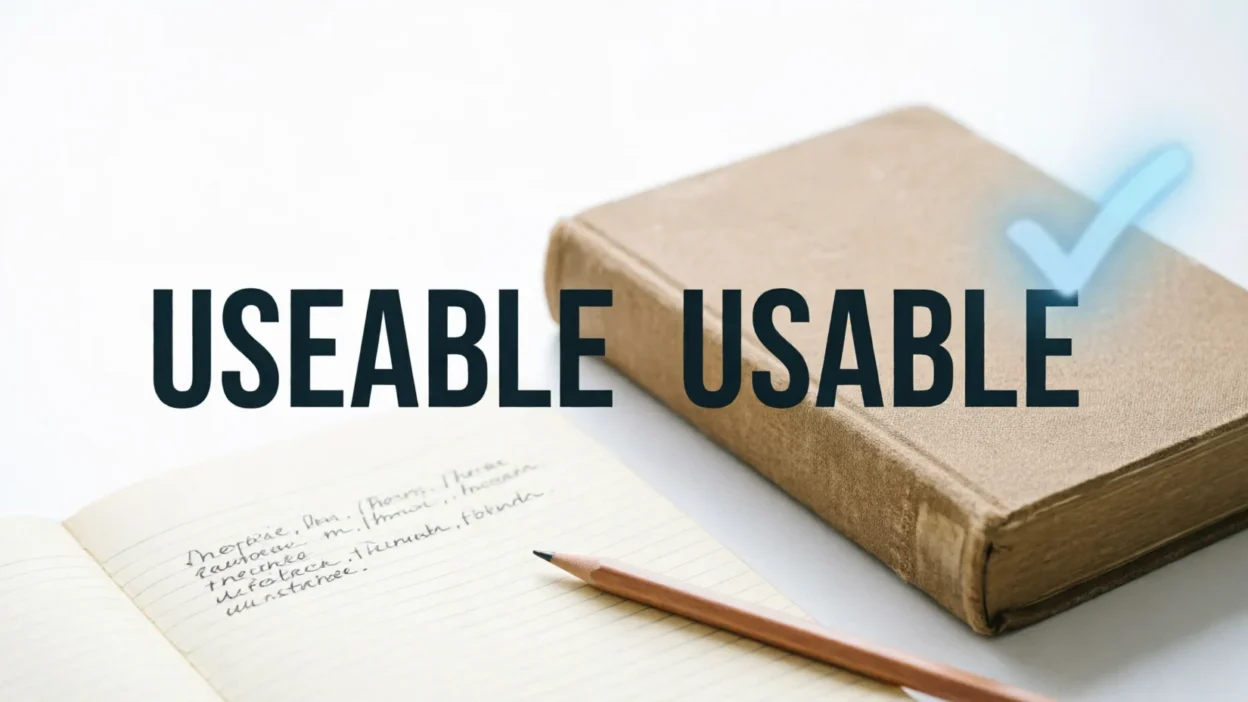
When deciding between useable and usable, the correct and standard spelling is usable. It means “able to be used,” “practical,” or “fit for a particular purpose.” Although useable may occasionally appear, usable is the preferred spelling in modern standard English.
The confusion happens because the verb use ends with a silent e, and learners may expect that use + -able should produce useable. However, English spelling often removes the final e before certain suffixes.
This gives us usable, just as comfort + able becomes comfortable. Understanding this spelling pattern can help you avoid a common mistake in writing, schoolwork, professional communication, and everyday English.
Quick Answer
Usable is the correct and more common spelling. It means something can be used successfully or is practical for use. Useable is sometimes seen, but it is generally less preferred. For standard English, especially in formal writing, choose usable.
Why Do People Confuse “Useable” and “Usable”?
The confusion mainly comes from the way the word is formed.
The verb is use, and the suffix is -able, meaning “capable of” or “fit for.” It may seem logical to combine them as:
use + able = useable
However, English spelling conventions often remove the final e when adding a suffix that begins with a vowel.
So the preferred spelling is:
use + able → usable
This is why usable is the form you will most often find in dictionaries, professional writing, and edited English.
First Word: Usable
Usable is the standard and preferred spelling.
It is an adjective meaning:
- able to be used
- suitable for use
- practical
- functional
- useful for a particular purpose
Examples of “Usable”
- The old computer is still usable.
- We need to make the website more usable.
- Only usable data should be included in the report.
- The room has very little usable space.
- Is this document usable for the presentation?
Usable can describe physical objects, information, space, software, designs, resources, and many other things.
Second Word: Useable
Useable is a possible spelling that you may encounter, but it is much less common and is generally not the preferred form.
It is understandable because it appears to be a straightforward combination of use + able. However, in modern standard English, usable is the better choice in most situations.
For example:
- Preferred: The equipment is usable.
- Less preferred: The equipment is useable.
If you are writing an essay, application, article, report, or other formal text, usable is the safest choice.
Usable vs Useable: Comparison Table
| Feature | Usable | Useable |
| Meaning | Able or suitable to be used | Able or suitable to be used |
| Standard usage | Preferred | Less common |
| Frequency | Much more common | Relatively uncommon |
| Formal writing | Recommended | Usually avoid |
| Example | This tool is usable. | This tool is useable. |
| Best choice | ✅ Yes | ⚠️ Generally no |
When Should You Use “Usable”?
Use usable when you want to say that something can be used effectively, practically, or successfully.
Common situations include:
1. Products and objects
The damaged phone is still usable.
2. Technology
The software is simple and usable.
3. Information
We need more usable information before making a decision.
4. Space
The apartment has limited usable space.
5. Resources
We have enough usable materials to complete the project.
6. Design
The new layout is cleaner and more usable.
10+ Examples of “Usable”
- This laptop is old, but it is still usable.
- The instructions should be clear and usable.
- We found some usable furniture at the store.
- Is this information usable for our research?
- The damaged road is still usable.
- The application needs a more usable interface.
- There is not much usable space in the room.
- Please remove any files that are no longer usable.
- The teacher gave us several usable examples.
- The recycled materials are clean and usable.
- We need a usable solution to this problem.
- The old equipment remains usable despite its age.
Notice that usable does not necessarily mean something is perfect. It simply means that it can be used or is suitable for use.
Common Mistakes
Mistake 1: Assuming “use + able” must be “useable”
It is easy to think that adding -able to use automatically produces useable.
Incorrect or less preferred: The device is useable.
Preferred: The device is usable.
Mistake 2: Thinking “usable” means “useful”
The two words are related but do not mean exactly the same thing.
Usable means something can be used or is suitable for use.
Useful means something provides a benefit or helps you accomplish something.
For example:
The old computer is still usable, but it is not very useful for modern gaming.
Mistake 3: Using “useable” in formal writing
Although you may encounter useable, choosing usable is usually better for formal and professional English.
Memory Trick
Remember:
USE + ABLE → USABLE
Think of it as:
Use it → Usable
If something can be used, call it usable.
A simple memory sentence is:
“If I can use it, it is usable.”
American vs British English
There is no major American-versus-British spelling difference here.
Both American and British English generally use usable as the preferred spelling.
For example:
- American English: This software is usable.
- British English: This software is usable.
The spelling useable may appear in some dictionaries or publications, but usable is the more common and widely preferred form in both varieties.
Similar Words
Several words are closely related to usable, but their meanings are slightly different.
Useful
Means helpful or beneficial.
This guide is very useful.
Practical
Means suitable for real-world use.
We need a practical solution.
Functional
Means working or performing its intended function.
The machine is old but still functional.
Serviceable
Means suitable for use, especially despite not being new or perfect.
The furniture is basic but serviceable.
Convenient
Means easy or suitable for a particular situation.
Online payment is convenient for many customers.
Final Verdict
Usable is the spelling you should normally choose.
- ✅ Usable — standard and preferred
- ⚠️ Useable — less common and generally less preferred
Both forms are understandable, but usable is the better choice for essays, professional documents, websites, reports, academic writing, and everyday standard English.
If you are unsure, remember:
Something that can be used is usable.
FAQs:
Is “useable” a correct word?
Useable can be found in English usage, but it is much less common than usable. In most modern standard writing, usable is the preferred spelling.
Is “usable” or “useable” correct?
Usable is the preferred spelling. Use it when you mean “able to be used” or “suitable for use.”
Why is “usable” spelled without the “e”?
The final e in use is dropped when forming the preferred spelling usable. English spelling does not always preserve the complete base word when a suffix is added.
What does usable mean?
Usable means capable of being used or suitable for a particular purpose. For example, “The information is usable” means the information can be used effectively.
Is “useable” acceptable in British English?
It can be encountered, but usable is generally the more common and preferred form in British English as well.
What is the difference between usable and useful?
Usable means something can be used or is suitable for use. Useful means something is helpful or beneficial. Something can be usable without being particularly useful.
What is the opposite of usable?
Depending on the context, possible opposites include unusable, impractical, ineffective, or unserviceable.
Remember This
Usable is the best spelling to remember.
Usable = able to be used
Use usable in formal writing, school assignments, professional communication, and most everyday situations. While useable may appear occasionally, it is not usually the first choice.
Conclusion
The difference between useable and usable is mainly a matter of spelling preference rather than meaning. Usable is the standard and much more common form, meaning something is able or suitable to be used. The spelling may seem surprising because the word comes from use, but English spelling often changes when suffixes are added.
If you want to write clearly and naturally, choose usable. Whether you are describing a device, a website, information, space, equipment, or a solution, usable is the safest and most widely accepted choice. Remember the simple rule: if something can be used, it is usable.

Lucas Smith is a skilled language writer at Synomity.com, passionate about synonyms, vocabulary enrichment, and word meanings. He develops engaging content that helps readers strengthen communication skills and expand their understanding of language.


