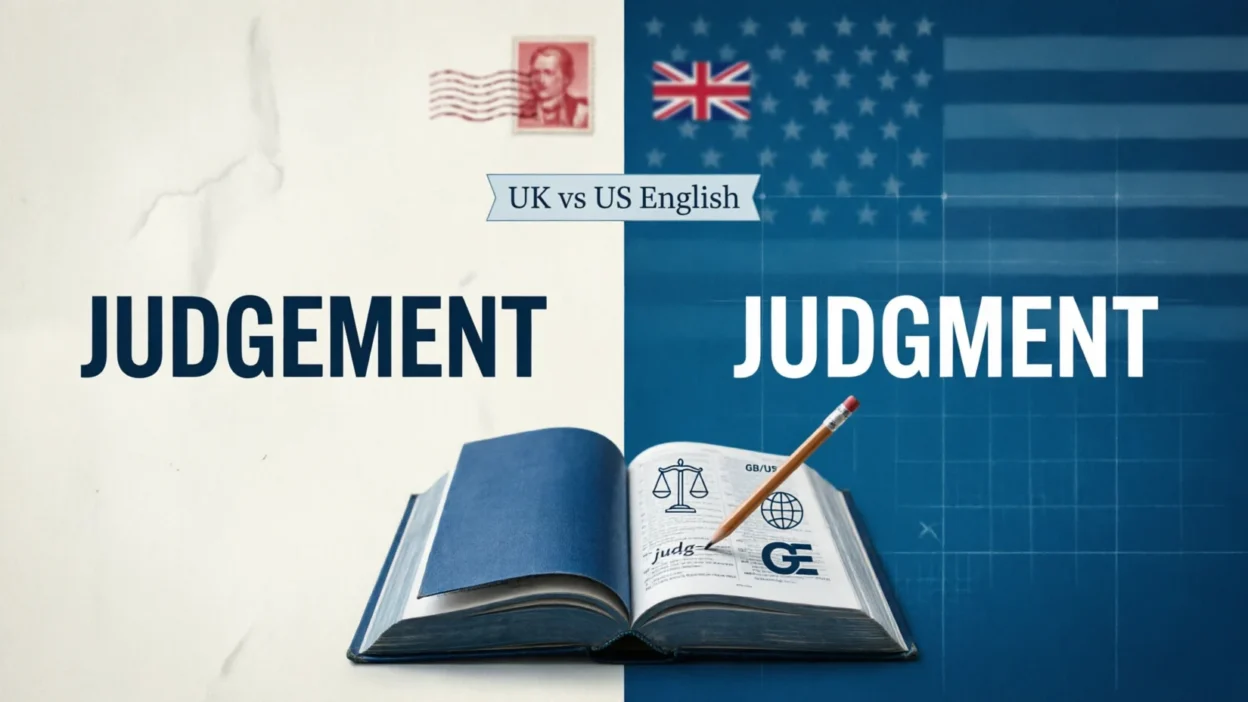
Have you ever wondered if to write judgement or judgment? Both spellings are correct, and the main difference is the variety of English in which they are commonly used.
Judgment is the standard spelling in American English and is also widely used in British English, especially in legal contexts. Judgement is a common alternative in British English and other varieties that follow British spelling conventions.
Both words have the same meaning. They refer to the ability to make decisions, form opinions, or reach conclusions after considering information. They can also describe a decision made by a court or an opinion about someone or something. For example, you might use good judgment when making an important choice or refer to a judge’s judgment in a legal case.
Understanding the difference is useful for students, writers, English learners, and anyone who wants to improve their spelling. In this guide, you will learn when to use each form, see practical examples, and discover an easy way to remember which spelling suits your writing.
Quick Answer
Both “judgement” and “judgment” are correct spellings. American English generally prefers judgment, while British English commonly accepts judgement in general writing. However, judgment is also standard in British legal writing. Both forms have the same meaning, so choose the spelling that matches your audience and remain consistent.
Why Do People Confuse Judgement and Judgment?
People confuse these words because they have the same pronunciation and meaning, but their spellings differ by one letter. The word judgement contains an extra e between g and m, while judgment does not.
The confusion also comes from differences between American and British spelling conventions. Many British English words retain an extra e in similar word forms, so judgement looks natural to British English users. American English generally uses the shorter spelling, judgment.
Another reason is that both spellings appear in books, newspapers, websites, and everyday writing. Neither form is automatically wrong. The appropriate choice depends on the style of English you are using and, in some cases, the conventions of a particular organization or legal system.
First Word: Judgement
Judgement is a correct spelling commonly used in British English and some other English varieties. It refers to the ability to make sensible decisions, the process of forming an opinion, or a decision reached after considering facts.
Meaning of Judgement
The word judgement can be used in several situations:
- Decision-making: The ability to make a sensible choice.
- Opinion: An assessment of a person, situation, or event.
- Legal decision: A ruling made by a court, although judgment is the standard spelling in British legal usage.
- Personal assessment: An opinion about someone’s behavior or character.
Examples of Judgement in Sentences
- She showed excellent judgement during the emergency.
- Good judgement comes from experience and careful thinking.
- Try not to make a judgement before hearing both sides.
- His judgement of the situation was accurate.
- The teacher praised her sound judgement.
Second Word: Judgment
Judgment is the preferred spelling in American English and is also widely used in British English, particularly in legal writing. It has exactly the same meaning as judgement.
Meaning of Judgment
The word judgment can refer to a decision, an opinion, or the ability to evaluate information and make choices.
It is especially common in American books, newspapers, academic writing, and legal documents.
Examples of Judgment in Sentences
- You should use good judgment when spending money.
- Her judgment helped the team avoid a serious mistake.
- The judge delivered the final judgment.
- I trust his judgment because he considers every detail.
- Avoid passing judgment on others too quickly.
Judgement vs Judgment: Comparison Table
| Feature | Judgement | Judgment |
| Correct spelling | Yes | Yes |
| American English | Less common | Preferred |
| British English | Common in general writing | Also correct; standard in legal contexts |
| Pronunciation | Same | Same |
| Meaning | Decision, opinion, or ability to decide | Decision, opinion, or ability to decide |
| Extra letter | Contains an extra e | No extra e |
| Best use | British-style general writing | American English and British legal writing |
When Should You Use Each Spelling?
Choosing between judgement and judgment is simple once you know your audience.
Use Judgement in British English
Choose judgement when writing for a British English audience and following a style guide that prefers this spelling.
Examples:
- His judgement was fair and reasonable.
- She has excellent professional judgement.
- We should respect the judgement of experienced teachers.
Remember that British English does not require judgement in every context. The shorter spelling is also established and widely accepted.
Use Judgment in American English
Choose judgment when writing for an American audience. It is the standard spelling in American English.
Examples:
- He demonstrated good judgment.
- The court issued its judgment yesterday.
- Making decisions requires careful judgment.
Follow the Required Style Guide
If you are writing an academic paper, business report, or legal document, follow the spelling conventions required by your institution, publisher, or jurisdiction.
Consistency matters more than switching between the two forms without a reason.
12 Examples of Judgement and Judgment in Sentences
The following examples show how both spellings work in natural English.
- Judgement: Her judgement improved as she gained experience.
- Judgment: Her judgment improved as she gained experience.
- Judgement: He showed good judgement by remaining calm.
- Judgment: He showed good judgment by remaining calm.
- Judgement: Never make a judgement without knowing the facts.
- Judgment: Never make a judgment without knowing the facts.
- Judgement: The manager trusted her professional judgement.
- Judgment: The manager trusted her professional judgment.
- Judgement: His judgement of the situation was correct.
- Judgment: His judgment of the situation was correct.
- Judgement: The decision required careful judgement.
- Judgment: The decision required careful judgment.
All these sentences are grammatically correct. The choice of spelling depends on the English variety or style guide being followed.
Common Mistakes to Avoid
Although both forms are correct, writers sometimes make mistakes when choosing between them.
1. Assuming Judgement Is Always Wrong
This is incorrect. Judgement is an accepted spelling, particularly in British English general writing.
2. Assuming Judgment Is Only American
This is also incorrect. Judgment is widely used in British English, including as the standard spelling in legal contexts.
3. Mixing Spellings in the Same Document
Using judgement in one paragraph and judgment in another can make your writing look inconsistent. Pick one form according to your chosen style.
4. Changing the Spelling Based on Meaning
Both spellings can refer to opinions, decision-making, and court rulings. The difference is not a difference in meaning.
5. Confusing Judgment With Judging
Judgment is a noun, while judging is commonly used as a verb form.
- Correct noun: Her judgment was fair.
- Correct verb form: She is judging the competition.
Memory Trick: How to Remember Judgement vs Judgment
Use this simple memory trick:
- American English = Judgment: Remember the shorter spelling without the extra e.
- British English = Judgement: The extra e is a familiar British spelling preference in general writing.
You can also remember this sentence:
“Use judgment for American writing, and consider judgement for British writing.”
This is a helpful guide rather than an absolute rule because both forms are used in British English.
American vs British English: What Is the Difference?
The difference between judgement and judgment is mainly a spelling preference, not a difference in definition or pronunciation.
In American English, judgment is the established standard. It appears in ordinary writing, academic work, business communication, and legal documents.
In British English, both forms are accepted. Judgement is common in general writing, while judgment is traditionally preferred in legal contexts. Other English-speaking regions may follow British conventions, American conventions, or their own institutional style guides.
| English variety or context | Common preference |
| United States | Judgment |
| United Kingdom, general writing | Judgement or judgment |
| United Kingdom, legal writing | Judgment |
| International academic writing | Follow the required style guide |
The safest approach is to check the conventions used by your intended audience and apply them consistently.
Similar Words to Know
Learning related words can help you recognize spelling patterns and use each term correctly.
- Judgement / Judgment: A decision, opinion, or ability to make decisions.
- Judging: Forming an opinion or evaluating something.
- Judge: A person who makes legal decisions or evaluates a competition.
- Judgmental: Describes someone who tends to criticize or form negative opinions about others.
- Misjudgment: An incorrect assessment or decision.
- Judicious: Showing good sense and careful judgment.
- Judicial: Related to judges, courts, or the administration of justice.
Notice that judgmental, misjudgment, and judicious have their own established spellings. Do not automatically add an e to every word related to judge.
Final Verdict: Judgement or Judgment?
Both judgement and judgment are correct. The best choice depends on your audience and the writing conventions you follow.
Choose judgment for American English and for British legal writing. Choose judgement when it suits the British English style you are following, especially in general writing.
Neither spelling changes the word’s meaning or pronunciation. If you are unsure, judgment is a broadly recognized option, but always follow any specific style guide provided by your school, employer, publisher, or legal authority.
FAQs:
1. Is judgement or judgment correct?
Both spellings are correct. Judgment is preferred in American English, while judgement is common in British English general writing. British legal writing traditionally uses judgment.
2. Is judgement British English?
Yes, judgement is a common British English spelling. However, judgment is also accepted in British English and is standard in legal contexts.
3. Is judgment American English?
Yes, judgment is the standard American English spelling. It is used in everyday communication, formal writing, academic work, and legal documents.
4. Do judgement and judgment mean the same thing?
Yes. Both words have the same meaning and pronunciation. They can refer to decision-making ability, an opinion, an assessment, or a legal ruling.
5. Why does judgment have no e?
The spelling judgment follows an established spelling convention that drops the extra e found in judgement. American English uses this shorter form as its standard spelling.
6. Which spelling should I use in an essay?
Use the spelling required by your teacher, university, or style guide. If no specific rule is provided, choose the form appropriate for your audience and use it consistently throughout the essay.
7. Is it good judgement or good judgment?
Both expressions are correct. Use good judgment in American English and good judgement when following a British English style that prefers the longer form.
8. Is judgement spelled with an e in legal documents?
Not necessarily. In British legal writing, judgment is the standard spelling. In American legal writing, judgment is also standard. Always follow the terminology and spelling conventions of the relevant jurisdiction.
Remember This
- Judgment: The standard spelling in American English.
- Judgement: A common British English spelling.
- British legal writing: Generally uses judgment.
- Meaning: Both words mean the same thing.
- Best practice: Choose the spelling that matches your audience and stay consistent.
Conclusion
The difference between judgement and judgment is straightforward once you understand the spelling conventions of American and British English. Both words refer to making decisions, forming opinions, or reaching conclusions. The shorter form, judgment, is standard in American English and British legal writing, while judgement is common in British English general writing.
When deciding which spelling to use, consider your readers, the type of document you are writing, and any style guide you need to follow. Do not assume that one spelling is universally wrong simply because it is less common in your variety of English. By understanding these regional preferences and using one form consistently, you can write with greater clarity and confidence.

Lucas Smith is a skilled language writer at Synomity.com, passionate about synonyms, vocabulary enrichment, and word meanings. He develops engaging content that helps readers strengthen communication skills and expand their understanding of language.